

Simplifying night feeding for twins means building a synchronized, prepared system that reduces disruptions, cuts time awake, and protects everyone’s sleep. The standard term for this approach is synchronized twin feeding, and it combines logistics planning, tandem feeding techniques, paced bottle feeding, and partner coordination into one manageable routine. Newborns require feeds every 3 to 4 hours, which means you and your partner could be up five or more times a night in those first weeks. The night feeding twins simplification tips in this guide give you a concrete system to work from, not a perfect schedule to chase.
1. Set up an efficient bedside feeding station
An organized bedside feeding station is the single most effective night feeding hack for twins. A well-stocked station cuts the number of steps per feed from several trips across the room to simply reaching over. That difference matters enormously at 3 a.m. when you are running on two hours of sleep.
Stock your station with these items before you go to bed each night:
- Two pre-made bottles or a pitcher of cooled breastmilk
- A bottle warmer plugged in and ready
- Diapers and wipes for both babies
- Burp cloths (at least four, because twins double the spit-up)
- Pacifiers within easy reach
- A dim red nightlight, which preserves melatonin production and keeps the room sleep-friendly
A rolling cart works better than a fixed bedside table because you can wheel it between two bassinets without getting up. Organize supplies in the order you use them: warm the bottle first, then feed, then burp and change. That sequence becomes automatic fast.
Pro Tip: If your twins sleep in separate rooms or your home has multiple floors, set up a duplicate station in each location. Restocking both stations during the day takes five minutes and saves you from scrambling in the dark.
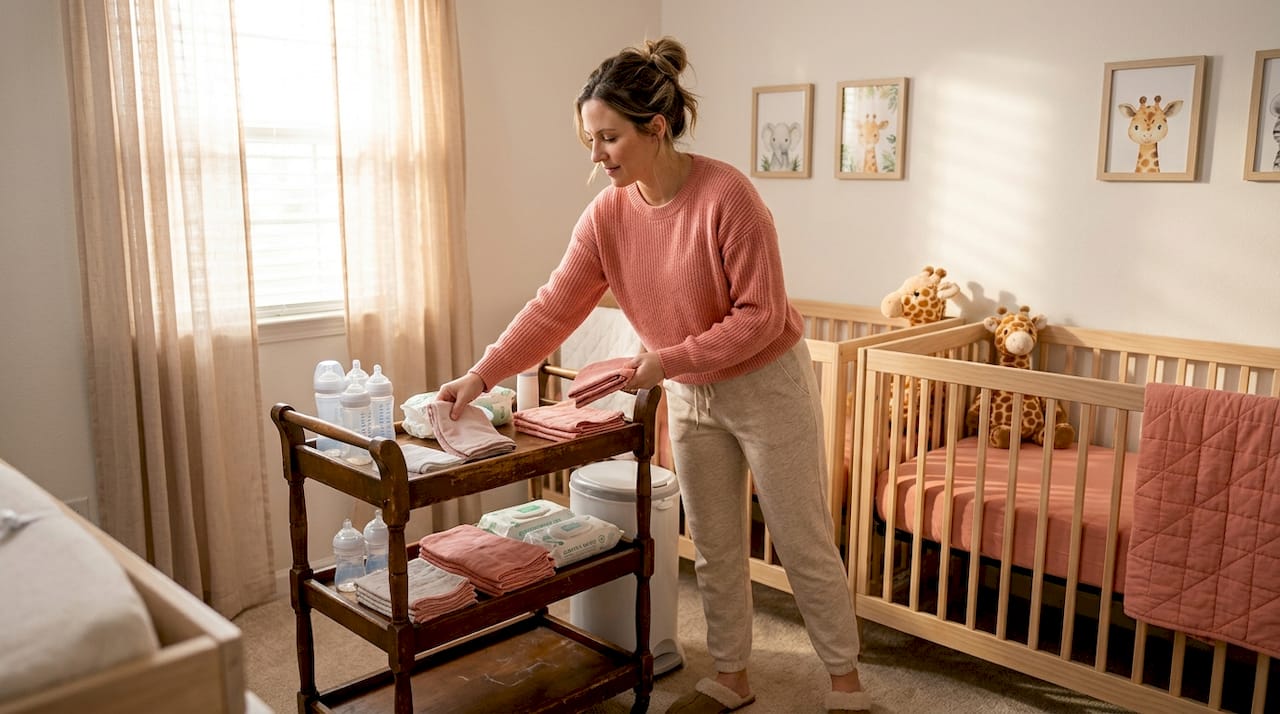
Restock the station every morning as part of your daytime routine. Treat it like prepping a workstation before a shift. The mental load of night feeds drops significantly when you never have to think about where anything is.
2. Master tandem breastfeeding positions for nighttime
Tandem breastfeeding, feeding both babies at the same time, is the most time-efficient twin night feed strategy available to nursing parents. The Australian Breastfeeding Association recommends the twin football hold, the parallel hold, and the lying-down position as the most practical options for nighttime use.
Here is a quick breakdown of each position:
- Twin football hold: Each baby is tucked under one arm like a football, with their legs pointing behind you. This keeps both heads at breast level and gives you good control. It works best with a Twin Z pillow or My Brest Friend Twin pillow for hands-free support.
- Parallel hold: Both babies lie in the same direction across your body. One baby uses the cradle position while the other mirrors it. This is easier to manage once babies have better head control.
- Front V hold: Babies face each other across your chest in a V shape. Less common but useful for smaller newborns.
- Lying down: You lie on your side and nurse one baby while the other waits or is propped nearby. This is the most restful option for nighttime feeds and reduces back strain significantly.
Tandem feeding equipment like the Twin Z pillow or My Brest Friend Twin pillow provides hands-free support that parents consistently rate as the most useful gear for managing simultaneous feeds. Without a good pillow, tandem feeding at night is exhausting and hard to sustain.
Pro Tip: Practice tandem positions during the day when you are less tired and have better lighting. Attempting a new hold at 2 a.m. for the first time adds stress rather than reducing it. Build muscle memory first.
If tandem feeding feels too difficult in the early weeks, that is completely normal. Start by feeding one twin, then the other, and work toward simultaneous feeds as your confidence grows. A lactation consultant can help you troubleshoot positioning in person, which is far more effective than reading about it.
3. Use paced bottle feeding to prevent overfeeding
Paced bottle feeding is a technique where you hold the baby semi-upright, keep the bottle nearly horizontal, and pause every 20 to 30 seconds to let the baby rest and signal fullness. Paced feeds last 15 to 20 minutes compared to traditional bottle feeds that empty in five minutes. That slower pace mimics breastfeeding and protects babies from taking in more than they need.
For twins, paced feeding serves a second purpose: it synchronizes feeding windows. When both babies take a similar amount of time to finish, you can feed them in sequence or simultaneously without one finishing and screaming while the other is still eating.
Follow these steps for every bottle feed at night:
- Hold the baby at a 45-degree angle, not flat on their back.
- Keep the bottle nearly horizontal so milk flows slowly.
- Let the baby draw the nipple in rather than pushing it into their mouth.
- Pause every 20 to 30 seconds by tipping the bottle down. Watch for swallowing and breathing cues.
- Stop when the baby turns away, slows sucking, or relaxes their hands.
Use slow-flow nipples for both babies, even as they get older, if you are also breastfeeding. Fast-flow nipples create a preference for the bottle because the milk comes too easily, which can disrupt the breastfeeding relationship and make nursing harder.
Pro Tip: If one twin consistently finishes faster than the other, feed the faster eater first and use pacing to slow them down. Feeding the faster twin first and pacing them prevents frustration and gives the slower feeder the time they need without being rushed.
Overfeeding at night causes more frequent waking, not less. Babies who take in too much too fast experience discomfort and gas, which disrupts sleep for everyone. Paced feeding is one of the most underused tools in efficient feeding for twins.
4. Coordinate night feeding shifts with your partner
Shift-based sleep schedules with clear role assignments improve parental sleep and feeding consistency more than any other single strategy. The goal is to give each parent at least one uninterrupted block of three to four hours per night, which is the minimum needed to reach restorative sleep.
Here are the most effective twin night feed strategies for partner coordination:
- Split the night into two shifts. One parent handles all feeds from 9 p.m. to 2 a.m. The other takes 2 a.m. to 7 a.m. Each person gets a full sleep block on their off shift.
- Wake the second twin when the first wakes. This is the core principle of simplifying twin nighttime feeding. If Twin A wakes at 2 a.m., wake Twin B immediately. Feed them together or in quick sequence. This keeps both babies on the same nighttime feeding schedule instead of staggering wakes every 45 minutes.
- Pre-decide who does what. Before your shift starts, agree on who feeds, who changes, and who settles. Removing decisions from the middle of the night reduces friction and speeds everything up.
- Use a feeding tracker app. Apps like Huckleberry or Baby Tracker let you log feeds, diapers, and sleep times so the incoming parent knows exactly what happened without a groggy handoff conversation.
- Adjust as babies grow. By 5 to 6 months, many twins consolidate to one to three night feeds. Revisit your shift structure every few weeks and reduce the overnight burden as the babies’ needs change.
Keeping twins on the same schedule is the foundation that makes shift coordination work. Without schedule alignment, one parent ends up awake for the entire night regardless of the plan.
5. Optimize the sleep environment to reduce wake-ups
A low-stimulation sleep environment is not a bonus feature. It is a core component of any nighttime feeding schedule for twins. Darkness and white noise reduce waking frequency and help babies settle faster after feeds, which shortens the total time you spend awake each night.
Use blackout curtains in the twins’ room and keep the space dark from the first feed of the night until morning. White noise machines set to a consistent volume, around 65 decibels, mask household sounds and the noise one twin makes when they wake. This is especially useful for keeping the sleeping twin asleep while you feed the first.
Side-by-side bassinets or a co-sleeper designed for twins reduce the distance you travel during feeds and make it easier to wake the second baby when needed. Safe co-bedding, placing twins in the same bassinet, is approved by the American Academy of Pediatrics for healthy twins in the early weeks, though guidelines recommend transitioning to separate sleep surfaces once they show signs of rolling.
Distinguishing hunger from comfort waking starting around 3 to 4 months helps you avoid feeding when a baby just needs resettling. Pause for 60 seconds before picking up a waking twin. If the cry escalates, it is likely hunger. If it softens or stops, the baby may resettle on their own. Feeding every time a baby stirs trains them to expect a feed, which increases night waking over time.
A bedtime wind-down routine that signals sleep to both babies, such as a bath, dim lights, and a final feed, also reduces the number of times they wake overnight. Consistency in the pre-sleep routine is what makes it effective.
Key takeaways
Efficient twin night feeding depends on logistics and preparation far more than parenting instinct alone. The system you build before bedtime determines how hard the night actually is.
| Point | Details |
|---|---|
| Bedside station setup | Stock supplies nightly so every feed requires zero trips across the room. |
| Tandem feeding positions | Use the Twin Z or My Brest Friend Twin pillow to enable simultaneous nursing and cut total feed time. |
| Paced bottle feeding | Keep the bottle horizontal and pause every 20 to 30 seconds to prevent overfeeding and reduce reflux. |
| Partner shift coordination | Split the night into two defined shifts and wake both twins together to protect each parent’s sleep block. |
| Sleep environment | Use blackout curtains and white noise consistently to reduce wake-ups and speed up settling after feeds. |
What I’ve learned about night feeding twins that no one tells you
The advice you find online about twin night feeding tends to be either too optimistic or too rigid. I have seen parents burn out trying to follow a precise schedule in the first six weeks when their babies simply were not ready for it. Lactation consultants consistently point out that consistency and rhythm matter more than strict timing early on. That shift in thinking changes everything.
The part that actually saves you is the preparation you do before you are tired. A stocked feeding station, a pre-agreed shift plan, and a practiced tandem hold are worth more than any app or gadget. When you are operating on broken sleep, your brain cannot problem-solve. It can only execute what you already set up.
I also think parents underestimate how much the environment matters. Most families focus entirely on feeding technique and ignore the room setup. A white noise machine and blackout curtains are not luxuries. They are tools that directly reduce how many times you get out of bed.
The hardest part of twin night feeding is not the feeding itself. It is the mental load of managing two babies with different needs at the same time, night after night. Share that load deliberately. Assign roles, track feeds, and protect each other’s sleep blocks. The nights get shorter as the babies grow, but the habits you build now shape how sustainable the whole experience feels.
Give yourself credit for every feed you get through. Two babies, one night at a time.
— Jay
More twin care support from Twinsandcounting
Twinsandcounting has built a library of guides specifically for parents managing the realities of two infants at once. Whether you are still figuring out your first week of night feeds or trying to drop the 3 a.m. session at six months, there is practical, twin-specific advice waiting for you.

The twin care tips guide covers everything from feeding logistics to sleep routines in one place, written for parents who need real answers fast. You can also explore how to get twins sleeping through the night as your babies grow and their feeding needs shift. Twinsandcounting is here for the long haul, not just the newborn stage.
FAQ
How often do newborn twins need to feed at night?
Newborn twins typically need feeds every 3 to 4 hours, which means 3 to 5 breastfeeding sessions or 2 to 4 formula feeds per night in the first two months. This frequency decreases as babies grow and their stomach capacity increases.
Should you wake the second twin when the first wakes to feed?
Yes. Waking the second twin when the first wakes is the most effective way to keep both babies on the same nighttime feeding schedule and protect your sleep. Staggered wakes mean you are up continuously rather than in defined blocks.
What is paced bottle feeding and why does it matter for twins?
Paced bottle feeding keeps the bottle nearly horizontal and includes 20 to 30 second pauses so babies control their intake. For twins, it prevents overfeeding, reduces reflux, and synchronizes feeding windows so both babies finish at a similar time.
When do twins start sleeping through the night?
By 7 to 9 months, many breastfed twins consolidate to zero to three night feeds, while formula-fed twins often reach zero to one feed earlier. Developmental readiness, not a fixed age, determines when night weaning is appropriate.
What equipment helps most with twin night feeds?
A Twin Z pillow or My Brest Friend Twin pillow for tandem breastfeeding, a bottle warmer, slow-flow nipples, a white noise machine, and a rolling bedside cart are the most consistently recommended tools for simplifying twin nighttime feeding.