

Feeding premature twins is defined by a collision of immature biology, doubled logistical demands, and two infants who may develop at entirely different rates. The clinical term for what you are managing is neonatal feeding difficulty in preterm multiples, and it covers everything from poor oral-motor coordination to feeding intolerance and discordant growth between siblings. Twin premature feeding challenges explained in plain terms means understanding why each baby struggles, why they may struggle differently, and what you can do about it right now. This article gives you the research, the strategies, and the honest perspective you need to move forward with confidence.
Twin premature feeding challenges explained: what causes them?
Feeding difficulties in preterm infants are multifactorial by nature, involving the respiratory, digestive, and neurological systems all at once. A baby born at 28 weeks has not yet developed the coordinated suck-swallow-breathe reflex that full-term newborns use automatically. That reflex typically matures around 34 to 36 weeks of gestational age, which means many premature babies spend weeks learning a skill most parents never think about.
The digestive system adds another layer of complexity. Preterm guts have thinner intestinal walls, reduced enzyme activity, and slower motility. This makes advancing feeding volumes a careful, incremental process rather than a straightforward progression. One of the most serious risks is necrotizing enterocolitis, or NEC, a dangerous intestinal condition that NICU teams work hard to prevent through controlled feeding protocols.

Energy conservation is a third factor that catches many parents off guard. Premature infants burn a disproportionate number of calories just staying warm and breathing. That leaves very little energy for the work of feeding. A baby who tires after two minutes at the breast or bottle is not failing. The baby is prioritizing survival.
For premature twins specifically, these challenges are compounded by the fact that two infants rarely share the same developmental timeline. One twin may tolerate oral feeds while the other still relies on a nasogastric tube. Discordant birth weights, meaning a significant size difference between twins, amplify this gap further.
Key physiological causes of feeding difficulties in premature twins include:
- Immature suck-swallow-breathe coordination, which limits safe oral feeding before 34 weeks
- Gut immaturity, including reduced enzyme production and slower intestinal motility
- High energy expenditure, leaving little caloric reserve for the effort of feeding
- Feeding intolerance, which can signal NEC risk and requires immediate clinical attention
- Discordant birth weights, where the smaller twin faces greater feeding maturation delays
Pro Tip: Keep a simple per-feed log for each twin separately. Note volume taken, time spent feeding, and any signs of distress like color changes or pulling away. This data becomes invaluable when your NICU team adjusts feeding plans.
How do feeding strategies differ for premature twins vs. singletons?
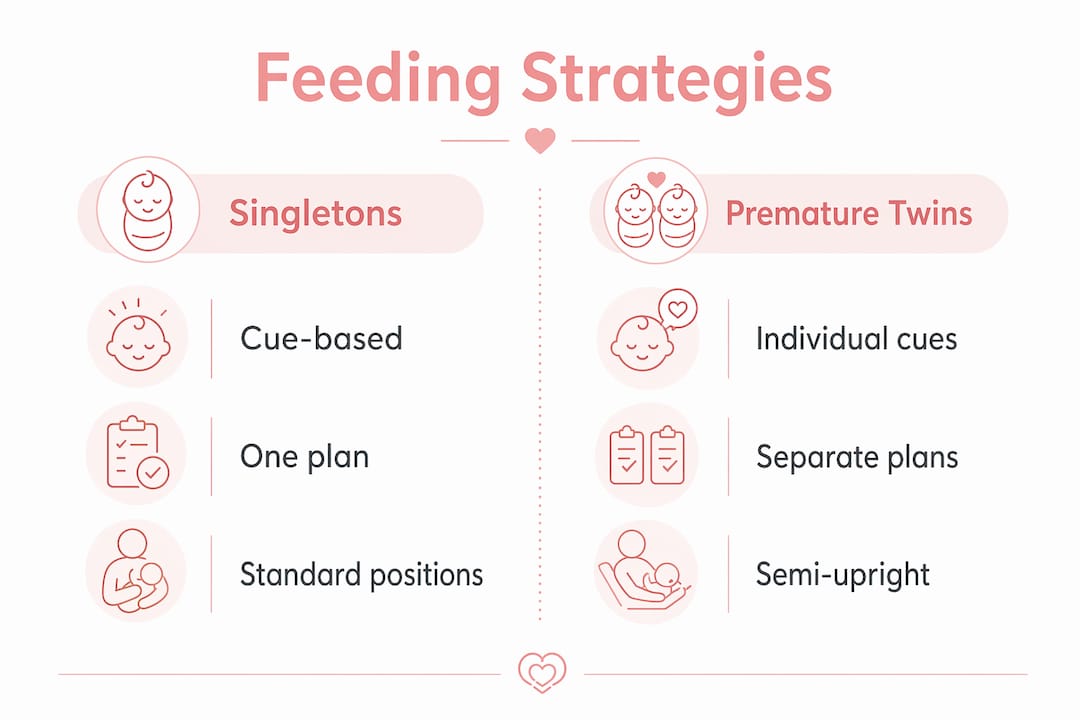
The single biggest strategic difference for feeding preterm twins is the shift from schedule-driven feeding to cue-based feeding, or CBF. CBF means responding to each infant’s readiness signals rather than feeding by the clock. Research shows that cue-based feeding is associated with earlier hospital discharge, less coercive feeding behavior, and normal growth trajectories through two years of age. For twins, this matters because the two babies will rarely show readiness cues at the same moment.
Nutrition type is equally critical. Human breast milk is the gold standard for preterm infants, offering immune protection, digestive enzymes, and growth factors that no formula fully replicates. When it comes to formula, the ingredient list deserves close attention. Glucose polymers in preterm formulas are linked to increased NEC risk and feeding intolerance compared to lactose-containing formulas, with a dose-response relationship noted in both animal and clinical studies. This means the higher the glucose polymer percentage, the greater the risk. Ask your neonatologist specifically about the carbohydrate source in any formula your twins receive.
Another area where twins diverge from singletons is transfusion-related feeding. Many NICUs historically withheld feeds during red blood cell transfusions, but emerging evidence suggests the preterm gut can tolerate feeding during transfusion with proper assessment. Protocols still vary by institution, so ask your care team directly what their current practice is and why.
Here is a practical framework for managing feeding strategies with premature twins:
- Establish individual feeding baselines for each twin before attempting any synchronization. One baby’s tolerance does not predict the other’s.
- Prioritize breast milk whenever possible. If direct breastfeeding is not yet feasible, pumped milk delivered via tube or bottle preserves the nutritional advantage.
- Learn each twin’s readiness cues separately. Rooting, hand-to-mouth movement, and sustained alertness signal readiness. Arching, color change, and turning away signal stop.
- Coordinate with your NICU team on volume advancement schedules. Extremely preterm infants under 25 weeks require individualized nutrition plans adjusted daily based on clinical stability and growth markers.
- Attempt partial synchronization once both twins are medically stable. Feeding them within the same 30-minute window, rather than simultaneously, reduces caregiver exhaustion without forcing a timeline on either baby.
| Strategy | Singleton preterm | Premature twins |
|---|---|---|
| Feeding schedule | Cue-based, one plan | Cue-based, two separate plans |
| Nutrition source | Breast milk or formula | Breast milk prioritized; formula scrutinized for glucose polymers |
| Volume advancement | Individualized | Individualized per twin, not mirrored |
| Caregiver coordination | Single caregiver sufficient | Two-caregiver approach reduces burnout |
| Synchronization | Not applicable | Partial synchronization after stability established |
Pro Tip: When reviewing feeding positions for your preemies, the semi-upright or side-lying position often works best for preterm infants because it slows milk flow and reduces the risk of aspiration.
What feeding differences should you expect between your twins?
Discordant twins, meaning twin pairs with a birth weight difference of 20% or more, represent one of the most misunderstood aspects of premature twin care. Parents often assume that because the babies share a birthday, they share a developmental timeline. They do not. Research confirms that the smaller twin in a discordant pair consistently takes longer to achieve full enteral feeding than the larger twin, reflecting genuinely different feeding maturation trajectories.
This gap has real clinical consequences. The smaller twin faces elevated risks of feeding intolerance and NEC, and the data on feeding intolerance outcomes is stark. Feeding intolerance in small-for-gestational-age preterm infants is associated with an 85.9% rate of extrauterine growth restriction compared to 49.5% in those without intolerance, with an adjusted odds ratio of 5.82. That means the smaller twin’s feeding tolerance is not just a comfort issue. It directly shapes long-term growth and neurodevelopmental outcomes.
Tracking each twin’s progress separately is non-negotiable. The following indicators should be monitored individually, not averaged between the two babies:
- Daily weight gain, with a target of approximately 15 to 20 grams per kilogram per day in the NICU
- Feeding volume tolerance, noting any residuals, vomiting, or abdominal distension
- Stool pattern, since changes can signal gut intolerance before other symptoms appear
- Oxygen saturation during feeds, particularly for the smaller twin who may desaturate more easily
- Time to full enteral feeds, which is the point at which all nutrition comes through the gut rather than intravenously
Your NICU team should have separate feeding goal sheets for each twin. If they are using a single plan for both, ask for individualized documentation. The signs that each twin is feeding adequately are distinct and worth reviewing as you prepare for discharge.
What coping strategies actually help parents of premature twins?
The emotional weight of feeding two premature infants simultaneously is significant and underacknowledged. You are managing two sets of feeding cues, two sets of medical updates, and your own physical and emotional recovery, often in a NICU environment that is loud, clinical, and disorienting. Acknowledging that reality is not weakness. It is the starting point for building a sustainable approach.
Caregiver consistency is one of the most evidence-backed tools available to you. Consistent feeding strategies across shifts, including stable positioning, consistent nipple types, and pacing techniques, reduce feeding variability and infant stress. This means briefing every person who feeds your twins, whether a nurse, partner, or grandparent, on the specific approach that works for each baby. Variation between caregivers is one of the most common and correctable sources of feeding regression.
Practical coping strategies that make a measurable difference include:
- Symptom tracking per feed for each twin, using a simple notebook or an app like Huckleberry or Baby Tracker. This transforms your observations into data your care team can use.
- Scheduled check-ins with your NICU social worker or family support coordinator, not just when a crisis arises. Proactive support prevents burnout.
- Breastfeeding support from a lactation consultant who has experience with premature or NICU infants. General breastfeeding advice often does not translate to the preterm context. Resources on breastfeeding comfort and technique can supplement what you learn in the NICU.
- Dividing feeding responsibilities between two caregivers when possible, so each parent bonds with and learns one twin’s cues deeply before attempting tandem feeding.
- Setting a realistic transition timeline for home feeding. The shift from NICU to home feeding is one of the most stressful periods for parents of premature twins. Reviewing a practical home feeding guide before discharge reduces the shock of that transition.
Pro Tip: Give yourself permission to feed the twins sequentially rather than simultaneously in the early weeks at home. Tandem feeding two premature infants is an advanced skill. Sequential feeding lets you stay attuned to each baby’s cues without splitting your attention.
Key takeaways
Feeding preterm twins requires two individualized plans, not one shared approach, because each baby’s tolerance, maturation, and cues are distinct.
| Point | Details |
|---|---|
| Separate feeding plans | Each twin needs individual volume targets, cue assessments, and tolerance tracking. |
| Breast milk is the priority | Human milk reduces NEC risk and supports gut maturation better than glucose polymer formulas. |
| Smaller twin needs more time | Discordant twins show different feeding timelines; the smaller twin consistently takes longer to reach full enteral feeds. |
| Cue-based feeding works | CBF supports normal growth through two years and reduces coercive feeding behavior in preterm infants. |
| Caregiver consistency matters | Stable positioning, nipple type, and pacing across all caregivers reduces infant stress and feeding regression. |
What I’ve learned watching premature twins feed
I have seen parents walk into the NICU expecting both twins to hit the same milestones on the same day, and I understand why. They shared a womb. They share a birthday. It feels logical. But the feeding trajectories I have observed consistently tell a different story. The smaller twin almost always needs more time, more patience, and a more conservative volume advancement plan. Treating that as a setback misses the point entirely.
The parents who navigate this best are the ones who stop comparing the twins to each other and start partnering deeply with their care team around each baby’s individual signals. They ask specific questions: not “when will they both be off the tube?” but “what does Twin B’s gut need to tolerate 5 more milliliters today?” That shift in framing changes everything.
Cue-based feeding is not a soft, intuitive approach that contradicts clinical rigor. It is evidence-backed and measurably effective. Trust what your babies are showing you. The research and your instincts are pointing in the same direction.
— Jay
How Twinsandcounting supports you through every feeding challenge
Feeding two premature infants is one of the hardest things you will do as a parent, and you should not have to figure it out alone. Twinsandcounting is built specifically for parents in your position, with twin-focused resources that go far beyond generic newborn advice.
From detailed feeding schedules to nutritional guidance and real-world strategies for the NICU-to-home transition, Twinsandcounting covers the twin-specific details that most parenting sites skip entirely. Start with the tips for caring for twins to build your foundation, then explore the full library of resources designed to help you feed, track, and support both babies with confidence. You have already done the hard work of getting here. Let Twinsandcounting help you take the next step.
FAQ
What is the biggest feeding challenge unique to premature twins?
The most significant challenge is that premature twins often develop feeding readiness at different rates, requiring two separate feeding plans rather than one shared approach. Discordant birth weights amplify this gap, with the smaller twin consistently taking longer to achieve full enteral feeding.
Is breast milk really better than formula for premature twins?
Breast milk is the clinical standard for preterm infants because it provides immune protection, digestive enzymes, and growth factors that formula cannot replicate. Preterm formulas containing glucose polymers carry an increased risk of NEC and feeding intolerance compared to lactose-based alternatives.
What does cue-based feeding mean for premature twins?
Cue-based feeding means responding to each infant’s individual readiness signals, such as rooting or hand-to-mouth movement, rather than feeding on a fixed schedule. Research links this approach to earlier discharge and normal growth trajectories through two years of age.
How do I know if my premature twin has feeding intolerance?
Signs of feeding intolerance include vomiting, abdominal distension, blood in stool, and significant feeding residuals. Feeding intolerance in small-for-gestational-age preterm infants is strongly associated with extrauterine growth restriction and neurodevelopmental impairment, so report any symptoms to your care team immediately.
When can premature twins start feeding at the same time?
Tandem feeding is typically attempted once both twins are medically stable and showing consistent oral feeding readiness. Most NICU teams recommend mastering sequential feeding first, then gradually working toward partial synchronization within the same 30-minute window.