

Bringing premature twins home from the NICU is a moment of pure joy and, honestly, a lot of fear. Feeding premature twins at home is one of the most demanding parts of those early weeks, and it looks nothing like feeding a full-term baby. You are managing two infants with heightened nutritional needs, fragile feeding skills, and schedules that can feel relentless. This guide walks you through exactly what you need to know: from building your milk supply and learning bottle technique, to creating a feeding routine and troubleshooting the hard days. You have already gotten through the NICU. This part, you can handle too.
Table of Contents
- Key Takeaways
- Feeding premature twins at home: understanding nutrition needs
- Bottle feeding techniques and the tube-to-oral transition
- Building a feeding schedule and tracking growth
- Common challenges and how to work through them
- My honest take on feeding premature twins
- Resources from Twinsandcounting to support your feeding journey
- FAQ
Key Takeaways
| Point | Details |
|---|---|
| Mother’s milk is the priority | Breast milk significantly lowers the risk of serious complications for premature babies. |
| Pump early and pump often | Starting within hours of delivery and pumping through the night protects your long-term supply for both babies. |
| Fortification is non-negotiable | Follow your NICU’s fortification recipe precisely. It functions like a prescription for your twins’ growth. |
| Paced bottle feeding protects preemies | Slow-flow nipples and horizontal bottle positioning prevent choking, overfeeding, and feeding fatigue. |
| Track everything and ask for help | Feeding logs and regular pediatric weight checks catch problems early before they become serious. |
Feeding premature twins at home: understanding nutrition needs
Before your twins left the NICU, their medical team was managing something very specific: helping two underdeveloped digestive systems absorb enough calories to grow. That same mission continues at home, and understanding the “why” behind their nutrition plan makes it much easier to stick with it.
The American Academy of Pediatrics is clear that mother’s own milk is the best choice for very premature and very low birth weight babies. Breast milk actively reduces the risk of necrotizing enterocolitis (NEC), a dangerous gut condition that premature infants are especially vulnerable to. For twins, that protection matters twice over.
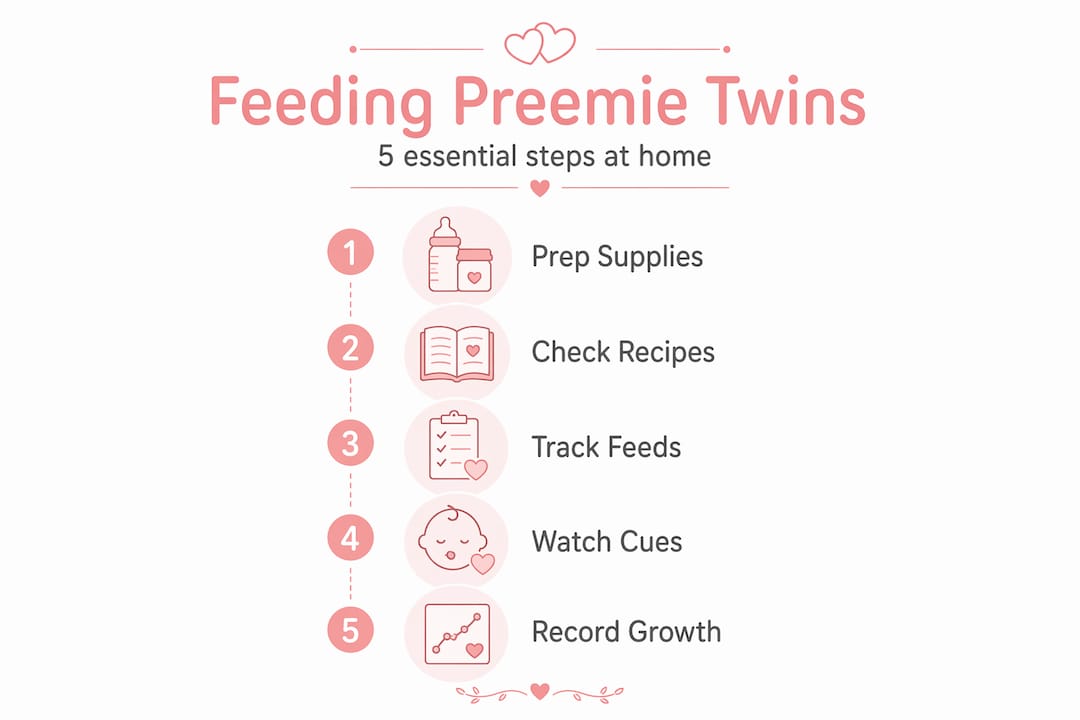
Here is what a solid nutrition foundation looks like at home:
- Breast milk as the base. Fresh expressed milk from you is ideal. If supply is limited, donor milk is the next best option before transitioning to preterm formula.
- Human milk fortifiers. Your NICU may have sent you home with a fortification plan. Fortifiers added to breast milk provide the extra calories, protein, and vitamins premature twins need to reach full-term growth targets.
- Preterm formula as backup. If breastfeeding is not possible, preterm formulas are specially designed with higher calorie and nutrient content. Never use standard newborn formula as a substitute without medical guidance.
- Pumping schedule. Pumping within 6 to 8 hours of delivery, then at least 5 to 6 times daily including nights, helps establish and protect your supply. With twins, your demand is doubled, so consistency is non-negotiable. The NHS recommends expressing 8 to 10 times per 24 hours, with night sessions especially important because nighttime hormones prime milk production.
Pro Tip: Before discharge, ask your NICU team for a written copy of your babies’ exact fortification recipe, including the ratio of fortifier to milk volume. Treat it like a prescription. Any guesswork with fortification can undermine the growth gains your babies worked so hard to achieve in the NICU.
Before you leave the hospital, arrange your pumping setup at home. A hospital-grade electric double pump is your best tool for keeping up with two babies’ needs. Think through storage: labeled bags, a dedicated fridge shelf, and a clear rotation system so older milk gets used first.
| Nutrition Source | Best For | Key Benefit |
|---|---|---|
| Mother’s own milk | All premature babies | Reduces NEC risk, builds immunity |
| Human milk fortifier | Babies under 34 weeks or low weight | Adds calories, protein, vitamins |
| Donor breast milk | When own supply is insufficient | Safer than formula for fragile guts |
| Preterm formula | When breast milk unavailable | Higher calorie and nutrient content |
Bottle feeding techniques and the tube-to-oral transition
Most premature twins come home having made some progress toward oral feeding, but they are rarely fully there. The transition from tube feeding to full bottle or breast feeding is gradual. Oral feeds are introduced based on each baby’s ability to coordinate sucking, swallowing, and breathing. These three skills mature on their own timeline. Corrected age matters more than birth age here, meaning a baby born at 30 weeks will developmentally feed like a newborn around two months after their due date.
The method you use for bottle feeding makes a real difference for premature babies. Paced bottle feeding (also called responsive feeding) is the clinical standard for preemies. Paced feeding mirrors breastfeeding by slowing the flow and allowing the baby to set the pace. Here is how to do it:
- Position the bottle horizontally. Hold the bottle nearly parallel to the floor. This limits the milk flow and stops babies from gulping faster than they can manage.
- Use a slow-flow nipple. Preemies tire quickly. A slow-flow nipple reduces the effort needed per sip, which conserves energy for growth.
- Watch for feeding cues, not the clock. Pause every few sips to let the baby breathe and rest. If you see flared nostrils, a furrowed brow, or color change around the mouth, stop and give a longer break.
- Keep feeds to 20 to 30 minutes max. Feeding longer than this burns more calories than the baby takes in. If your baby cannot finish a feed in that window, talk to your care team about adjusting volume.
- Alternate sides and babies. If you are feeding both babies simultaneously, use a twin nursing pillow and recruit a second set of hands when possible. Check out this guide on handling twins alone for those moments when you are on your own.
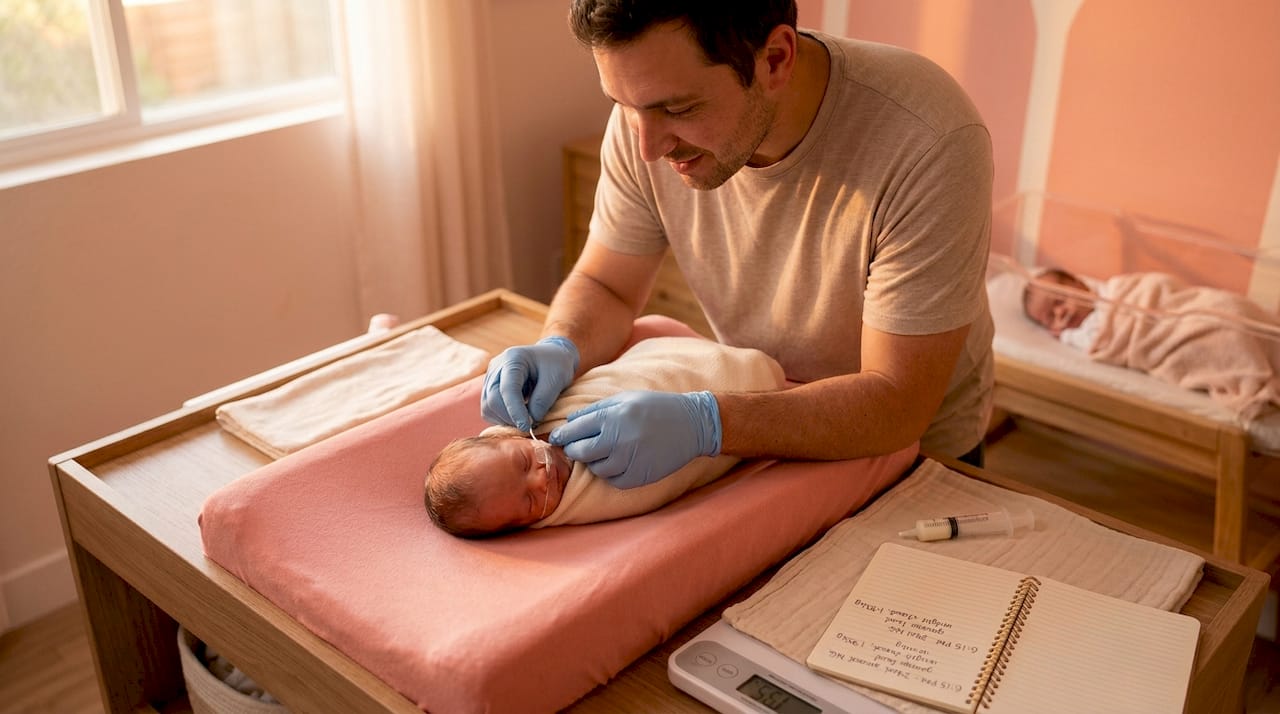
If one or both of your twins came home with a nasogastric (NG) tube, the transition to full oral feeding will happen in small increments over days or weeks. Readiness depends on maturation, not a set date. You will practice oral attempts before and during tube feeds, gradually increasing oral volume as tolerance improves. Your care team will guide this, but you are the one at home watching for the cues that say “more, please” versus “I need a rest.”
Pro Tip: Keep a small whiteboard or dry-erase chart on the fridge to track which twin fed, how much they took, and when. With two babies, your memory cannot reliably hold all of that data. A two-minute log saves you from a 2 a.m. panic wondering if Baby B actually ate or if you just dreamed it.
Understanding infant developmental readiness can also help you recognize the subtle oral motor progress your babies are making between feeds.
Building a feeding schedule and tracking growth
Premature twins typically feed every 3 to 4 hours at home. That means you are looking at 6 to 8 feeding windows every 24 hours, multiplied by two babies. Consistent feeding volumes and fortification are the backbone of catching up on growth, so sticking to your schedule matters.
The best feeding routine for premature twins is synchronized. You want both babies on the same feeding schedule so that you are not perpetually in a feeding cycle. Twinsandcounting has a helpful resource on keeping twins on one schedule that applies directly to feeding windows.
Here is what to monitor and why it matters:
- Weight checks. Your pediatrician will weigh your babies frequently in the first weeks home. Premature twins need to gain roughly 15 to 30 grams per day to stay on track. Falling below that signals a feeding or absorption problem.
- Hunger and fullness cues. Hunger cues include rooting, hands to mouth, and light fussing. Fullness looks like turned head, slowing sucking, and relaxed hands. Learning to read these cues saves you from both underfeeding and overfeeding.
- Fortification consistency. Think of your babies’ feeding plans like medication schedules. Skipping or altering the fortification ratio even occasionally adds up over time.
- Feeding logs. Note start time, duration, volume taken, and any concerns after each feed for both babies. Bring this log to every pediatric appointment.
For a deeper look at what feeding progress actually looks like, the Twinsandcounting article on signs twins are feeding adequately is worth bookmarking.
Common challenges and how to work through them
Even with a solid plan, feeding two premature babies at home is hard. Here are the problems you are most likely to face, and how to handle them.
Baby fatigue during feeds. Premature babies have very limited energy reserves. If your baby keeps falling asleep mid-feed, try gentle stimulation: tickling the feet, changing their position slightly, or removing a layer of clothing to cool them just enough to stay alert.
Signs of feeding intolerance. Watch for vomiting beyond typical spit-up, abdominal bloating, blood in stool, or significant feeding refusal. These need a call to your pediatrician right away. Do not wait and see on these symptoms with a premature baby.
Milk supply dips. Stress, poor sleep, and skipped pump sessions all reduce supply. Pumping every 2 to 3 hours and maintaining nighttime sessions is the most reliable way to protect output. Skin-to-skin contact with your babies, even outside of feeds, also helps.
Emotional and physical exhaustion. This one deserves more acknowledgment than it usually gets. You are managing what is essentially a medical care plan for two fragile infants around the clock. That is not just tiring. It can push parents to a breaking point.
“Feeding a premature baby is a marathon, not a sprint. Every milliliter of milk you give your baby is medicine. Please do not minimize what you are doing or how hard it is.” This sentiment, echoed by NICU nurses and neonatologists, reflects the reality that caregiving for premature twins is extraordinary work.
When to get specialized support. If feeds are consistently taking over 30 minutes, weight gain has stalled for more than a week, or you are struggling emotionally to keep up with the demands, reach out. A lactation consultant who specializes in preemies, an occupational therapist for feeding assessment, or your pediatrician are all appropriate contacts. You do not have to troubleshoot alone.
My honest take on feeding premature twins
I have talked with enough parents of premature twins to know that the hardest part is not the technique. It is the relentlessness of it. Every few hours, twice over, with babies who tire easily, gain weight slowly, and can’t tell you what they need.
What I’ve learned is that the parents who come out the other side with their sanity intact are the ones who asked for help without waiting until they were desperate. They called the lactation consultant at week two, not week six. They let a partner or family member take one night feed, even when it felt impossible to hand off. They gave themselves permission to use donor milk when supply dropped, instead of pushing through on empty.
I’ve also seen well-meaning parents improvise with the fortification ratios at home because the measuring felt tedious or supplies ran low. That is the one area I would push back on hardest. The fortification plan from your NICU is not optional. It is the engine behind your babies’ growth, and consistency there pays off in ways you will see clearly at those weight checks.
The emotional side of breastfeeding premature twins is real too. Pumping around the clock while your babies are in the NICU, then continuing at home, takes a psychological toll that goes beyond physical exhaustion. If you find yourself dreading the pump, that matters. Talk to someone. Your ability to care for your twins long-term depends on you not burning out in month one.
My take: the feeding phase is temporary, but the confidence you build by getting through it stays with you. Every feed is proof you can do this.
— Jay
Resources from Twinsandcounting to support your feeding journey
Feeding two premature babies at home is a lot to hold at once, and you should not be doing it without a strong support system. Twinsandcounting was built specifically for parents managing the doubled demands of twin care, and there is a lot waiting for you there.

Start with the twin care tips and tricks guide, which covers the day-to-day realities of twin newborn care including feeding, sleep, and sanity-saving routines. If you want a broader foundation, the first-year feeding guide walks through every major feeding milestone your twins will hit from birth through their first year. Thousands of twin parents have found their footing with the community and expert-backed content at Twinsandcounting. You do not have to figure this out alone.
FAQ
What is paced bottle feeding for premature babies?
Paced bottle feeding is a technique that slows milk flow by holding the bottle horizontally and using a slow-flow nipple. It allows premature babies to control their own feeding rhythm and reduces the risk of choking or overfeeding.
How often should I feed premature twins at home?
Most premature twins feed every 3 to 4 hours, totaling 6 to 8 feeds per day for each baby. Your NICU team will give you a specific volume and schedule before discharge based on each baby’s weight and age.
Can I make homemade baby formula for twins?
No. Homemade baby formula is not safe for premature twins and can cause serious nutritional deficiencies or contamination. Use only hospital-prescribed preterm formula or fortified breast milk under your care team’s guidance.
How do I know if my premature twins are getting enough to eat?
Consistent weight gain (roughly 15 to 30 grams per day), steady wet and dirty diapers, and calm behavior after feeds are all good signs. Your pediatrician will confirm growth trends at regular weigh-ins. You can also review the signs of adequate feeding guide from Twinsandcounting.
When do premature twins transition from tube to bottle feeding?
The transition from tube to oral feeding depends on each baby’s developmental maturity, specifically their ability to coordinate sucking, swallowing, and breathing. This process is gradual and guided by your care team, typically beginning around 32 to 34 weeks corrected age.