

Organizing your twins’ days around consistent feeding, naps, and age-appropriate play is the single most effective way to keep two toddlers thriving without losing your mind by noon. Twin developmental activities scheduling, at its core, means building a predictable daily rhythm that pairs routine care with purposeful play, so both babies grow well and you stay functional. It is not about a rigid minute-by-minute timetable. It is about a repeatable sequence your twins can anticipate and you can actually maintain.
Here is what a well-structured twin toddler day covers:
- Feeding: Synchronized meal and nursing or bottle times, starting from birth
- Naps: Aligned sleep windows that give you recovery time between cycles
- Developmental play: Sensory, motor, and language activities matched to each age stage
- Wind-down: A consistent evening routine that signals bedtime for both twins
- Flexibility: Timing shifts of 15–30 minutes are normal and expected; the sequence matters more than the clock
The core principles are consistency, synchronization, and room to adapt as your twins grow.
What do age-by-age twin schedules actually look like?
Twin toddler schedules shift meaningfully across four stages: newborn, 6–12 months, 12–24 months, and 24–30 months. Each stage has different sleep needs, feeding patterns, and play capacity. The table below gives you a practical framework for each.
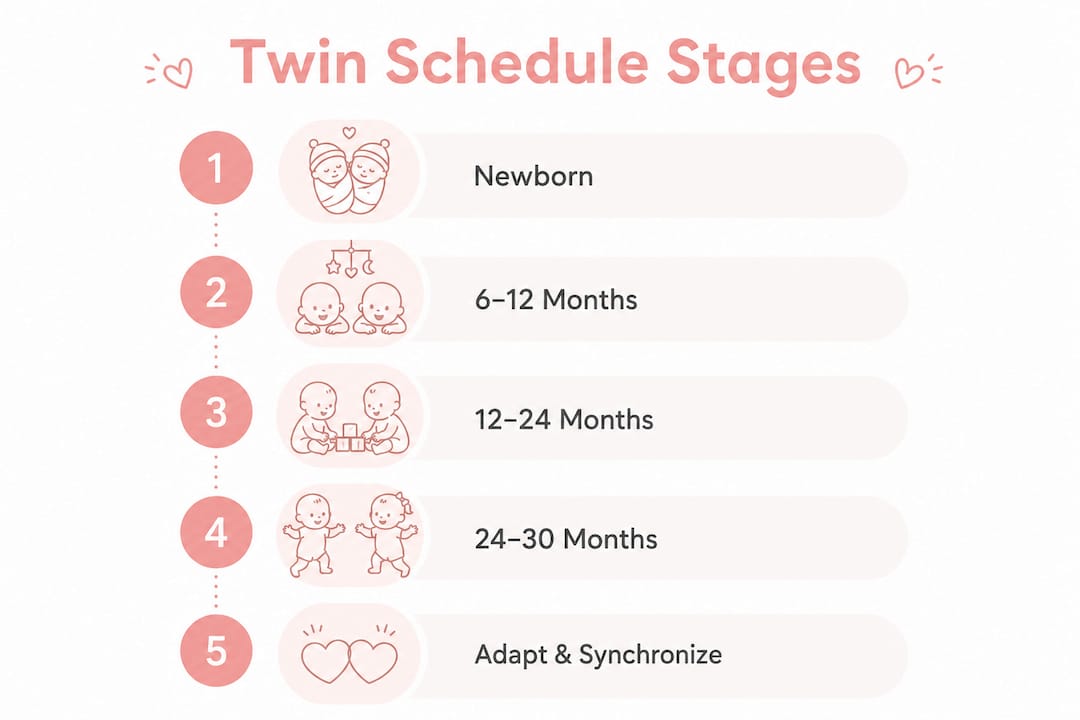
| Age Stage | Wake Time | Feeding Rhythm | Naps | Play Blocks | Bedtime |
|---|---|---|---|---|---|
| Newborn (0–6 weeks) | Frequent wake and feeding intervals | Tandem feedings when possible | Multiple short naps | Tummy time, face-to-face | Early evening bedtime |
| 6–12 weeks | Frequent wake and feeding intervals | Synced feeds; eat-play-sleep cycle | Several naps daily | Tummy time, visual tracking | Early evening bedtime |
| 6–12 months | Morning wake time | Several meals and nursing/bottle sessions | Two naps daily | Sensory bins, floor play | Early evening bedtime |
| 12–24 months | Morning wake time | Multiple meals and snacks | One midday nap of moderate length | Independent play, outdoor time | Early evening bedtime |
| 24–30 months | Morning wake time | Multiple meals and snacks | One afternoon nap of typical length | Free play, learning activities | Early evening bedtime |
Newborn stage: sync first, everything else follows
The foundational rule for newborn twins is simple: when one wakes, wake the other. Feed both at the same time, or as close together as possible. This one habit builds the entire schedule. Newborns need 14–17 hours of sleep per 24-hour period according to the American Academy of Sleep Medicine, so you are not building a routine yet. You are establishing feeding and keeping both babies gaining weight.

The eat-play-sleep cycle works well from about week two onward. Feed both babies when alert, allow a short awake window for tummy time or face-to-face interaction, then put both down together. That sequence is the architecture of every newborn schedule that holds.
Key developmental markers for this stage:
- Tummy time builds neck and shoulder strength for later milestones
- Visual tracking games improve hand-eye coordination
- Singing and rhymes support early motor and auditory development
- Swaddling both twins for naps helps signal sleep time consistently
12–24 months: the rhythm that actually works
Consistent meal and nap times provide the stability twin toddlers need at this stage, even when activity timing shifts by 15–30 minutes. A realistic sample day looks like this:
- 7:00 AM: Wake both twins, diaper change, breakfast
- 8:30 AM: Independent play block, open-ended and low stimulation
- 10:00 AM: Outdoor time or errands
- 12:00 PM: Lunch, then nap (expect 1–2 hours)
- 3:30 PM: Second play block, sensory or structured activity
- 5:30 PM: Dinner, same seats and plates every night
- 6:30 PM: Bath and wind-down
- 7:30 PM: Bedtime
Predictable routines give toddlers the security to explore confidently. When children know what comes next, they spend less energy on anxiety and more on learning. A consistent twin toddler schedule also norms expectations across every caregiver in your child’s life, whether that is a nanny, a grandparent, or a co-parent on weekends.
24–30 months: stability without constant adjustment
By around 24 months, your twins’ needs stabilize enough that you can hold the same schedule for several months without major overhauls. Nap time typically runs in the early to mid-afternoon, with free play and learning activities filling the morning. The sequence stays the same: wake, breakfast, play, lunch, nap, play, dinner, family time, bed. Toddlers at this age internalize the rhythm itself, not the exact times.
Pro Tip: Avoid pressuring twins to hit milestones at the same time. Twins often leapfrog each other or copy a sibling’s new skill days later. A broad developmental range is completely normal and influenced by birth factors, feeding patterns, and sleep history.
How do you choose developmental activities that work for two?
Developmental activities for twin toddlers serve double duty: they support brain and motor growth, and when set up correctly, they give you a few minutes to breathe. Sensory play supports brain and motor development and provides parents needed independent playtime with toddlers. The key is matching the activity to the age and managing the twin-specific dynamics that come with it.
Sensory and motor activities by age
- 0–6 months: Tummy time, face-to-face interaction, simple high-contrast toys, floor time
- 6–12 months: Soft sensory balls, stacking cups, peek-a-boo, crawling obstacles
- 12–24 months: Dry sensory bins (oats, rice, dried pasta), cloud dough, water play, simple puzzles
- 24–30 months: Sand play, mud play, finger painting, sorting games, pretend play
For twin toddlers specifically, sensory bins work well because each child can engage at their own level and pace, without needing to cooperate or compete. Giving each twin their own identical station removes most of the conflict before it starts.
Managing twin-specific challenges
Twin dynamics introduce challenges that singleton parenting rarely covers. Imitating twin language and intense twin bonds can hinder social development, so encouraging regular interaction with other children is important from the toddler stage onward.
Competition over toys and attention is normal, but you can reduce it with structure. Experts recommend fostering special interests for each child and teaching sharing’s nuanced rewards rather than forcing equal division of everything. Not every toy needs to be shared. Each twin benefits from having some things that belong only to them.
Balancing joint and individual activities matters too. Joint play builds cooperation and sibling connection. Individual play, even in the same room, builds independence and self-regulation. Both belong in the daily schedule.
- Dedicate one-on-one time with each twin regularly, even if it is just 10–15 minutes during the other’s independent play
- Use individual attention to notice each child’s unique preferences and strengths
- Avoid labeling twins by role (“the quiet one,” “the active one”), which can limit how each child sees themselves
- Praise sharing when you see it, but do not force it at 12–18 months, when it is not yet developmentally expected
Pro Tip: Set up two identical sensory play stations with the same materials in each bin. At this age, seeing what the other twin holds is more appealing than what they already have. Identical stations remove the rivalry before it starts and let both children focus on the activity itself.
How do you keep twin routines synchronized and handle disruptions?
Synchronization is the practical skill that makes twin parenting manageable. The goal is not that everything happens at exactly the same minute. The goal is that both twins are hungry at roughly the same time, tired at roughly the same time, and give you a predictable gap between cycles.
Synchronization techniques that hold
- Wake both twins together each morning at a consistent anchor time, even if one slept longer
- Feed simultaneously whenever possible; tandem feeding with a twin nursing pillow cuts feeding time significantly
- Put both down for naps at the same time, even if one seems less tired; the routine itself signals sleep
- When one twin disrupts the sync due to illness or a growth spurt, keep waking the cooperative twin at the established times rather than letting the schedule drift
Involving caregivers and family members
A written schedule is one of the most useful tools you can give a caregiver. When grandparents, babysitters, or partners know the sequence, transitions are smoother for the twins and less stressful for everyone. Twinsandcounting’s guide on babysitter twin routines walks through exactly how to communicate your twins’ schedule to anyone stepping in to help.
The sequence matters more than the exact times. Whether the nap starts at 12:00 PM or 12:30 PM is less important than the fact that lunch always comes before the nap and outdoor time always comes before lunch. Caregivers who understand the sequence can adapt timing without derailing the day.
Handling illness and unexpected disruptions
Illness is the most common schedule disruptor for twin families, and it almost always hits both twins within days of each other. When one twin is sick:
- Maintain the sequence even if timing shifts significantly
- Prioritize sleep over activity; drop play blocks before dropping nap time
- Return to the established rhythm as soon as both twins are well, rather than waiting for a “perfect” restart
- Growth spurts cluster around predictable windows and last a few days; ride them out on the existing framework rather than rebuilding the schedule from scratch
Pro Tip: Focus on predictable rhythm rather than rigid timing. When your twins internalize the sequence of their day, they become calmer and more cooperative, because they know what comes next. That internal map is what makes the schedule work, not the clock.
Flexibility is built into good twin scheduling from the start. As your twins grow, scheduling activities for twins will require periodic adjustments, especially around nap transitions and the shift from two naps to one. Treat each adjustment as a normal part of development, not a failure of the schedule.
What Twinsandcounting knows about scheduling that actually helps
Twinsandcounting was built specifically for parents navigating the twin experience, and the scheduling guidance on the site reflects that focus. The advice is grounded in real-life twin parenting, pediatric expertise, and a clear understanding that what works for singleton families often does not translate to twins.
A few principles that run through Twinsandcounting’s approach:
- Routine stability reduces parental stress. When the day has a predictable shape, you spend less mental energy deciding what comes next and more energy actually being present with your kids.
- Developmental milestones are ranges, not deadlines. Twins often develop at different paces, and that is normal. Tracking each child individually, rather than comparing them to each other, gives a more accurate picture of their growth.
- Supporting individuality reduces rivalry. Individuality within twin development builds better social and emotional skills over time. Schedules that include both shared and separate activities support this from the toddler stage onward.
- Community matters. Connecting with other twin parents, whether through local groups or online communities, provides practical support that books and articles cannot fully replace.
- Adapting the schedule as twins grow is part of the plan. The framework of wake, play, eat, and nap cycles applies from birth through the toddler years. The specific times shift; the structure stays.
For parents managing twin care with a partner, a nanny, or on their own, Twinsandcounting’s time-saving twin care routines offer practical efficiency strategies that fit into the daily schedule without adding complexity.
You do not need a perfect schedule. You need a rhythm your family can actually live inside, day after day, and adjust when life requires it. That is what Twinsandcounting is here to help you build.

Ready to go deeper? Twinsandcounting’s 9 tips for twin care covers the practical strategies that make the biggest difference in the early years, from feeding logistics to sleep training to keeping your own sanity intact.
Key Takeaways
A predictable daily sequence, not a rigid timetable, is what makes twin developmental activities scheduling work from birth through age 2.5.
| Point | Details |
|---|---|
| Sync from day one | Wake both twins together and feed simultaneously to build aligned sleep and hunger cycles. |
| Sequence over clock time | The order of wake, play, eat, and nap matters more than hitting exact times; 15–30 minute shifts are normal. |
| Match activities to age | Sensory bins, tummy time, and open-ended play each serve different developmental stages from newborn through 30 months. |
| Protect individuality | Dedicate one-on-one time to each twin and give each child some toys and interests that belong only to them. |
| Write it down for caregivers | A shared written schedule reduces transition stress for twins and guesswork for every adult in their lives. |