
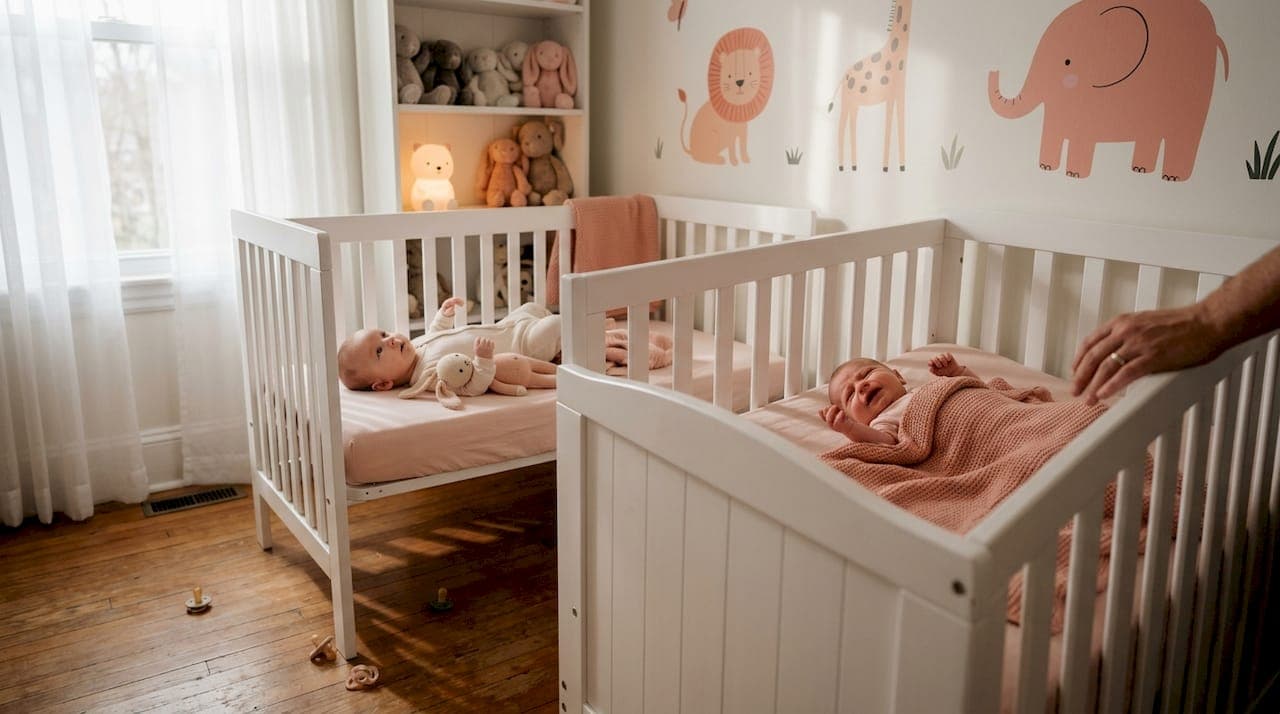
If you’ve spent another night pacing the hallway while both babies scream, you already know why twins fight sleep is one of the most searched phrases among parents of multiples. The exhaustion is real, and so is the confusion. You look at two children who shared a womb, share a room, and share a schedule, and you wonder why sleep feels like a nightly battle you keep losing. The truth is, twin sleep resistance is rarely random. It has specific biological roots, behavioral triggers, and environmental causes that are completely different from what singleton parents face.
Table of Contents
- Key takeaways
- Why twins fight sleep: the biology behind it
- Behavioral and environmental triggers
- Recognizing sleep fight behaviors
- Practical routines that actually work
- When to look beyond behavior
- My honest take on twin sleep advice
- Find more help at Twinsandcounting
- FAQ
Key takeaways
| Point | Details |
|---|---|
| Genetics shape sleep differently | Up to 70% of insomnia risk is genetic, meaning twins can have very different sleep needs even when raised identically. |
| Twins amplify each other’s resistance | One twin waking or crying can trigger the other, creating a loop of mutual sleep disruption. |
| Overtired twins look hyper, not sleepy | Manic energy and running around at bedtime is often a sign of overtiredness, not readiness to play. |
| Consistency beats perfection | Behavioral sleep training takes 1 to 3 weeks, with the hardest nights coming first. Stick with it. |
| Medical causes deserve attention | Chronic snoring, gasping, or excessive daytime sleepiness can signal conditions that need pediatric evaluation. |
Why twins fight sleep: the biology behind it
Most parents assume that because twins are born together and raised the same way, they should sleep the same way. That assumption is the source of a lot of unnecessary frustration. The science tells a different story.
Genetics account for 40 to 70% of an individual’s insomnia risk and up to 40% of chronotype, which is your body’s natural preference for sleeping early or late. This means even identical twins can carry genes that push their internal clocks in opposite directions. One twin might feel genuinely drowsy at 7:00 p.m. while the other is biologically wired to stay alert until 8:30 p.m. or later.
Circadian rhythms, the internal 24-hour clocks that regulate when we feel sleepy and when we feel alert, are partially inherited and partially shaped by light exposure and daily patterns. When you force both twins into an identical sleep window that doesn’t match both of their rhythms, at least one of them will resist. That resistance is not defiance. It’s biology.
Here’s what this means practically for twin sleep patterns:
- One twin may consolidate sleep earlier and respond well to a 7:00 p.m. bedtime, while the other genuinely isn’t tired until 45 minutes later
- Sleep pressure, meaning how strongly the body craves sleep after being awake, builds at different rates between twins
- The twin with a later chronotype may appear disruptive at bedtime, not because they are difficult, but because their body simply isn’t ready
- Identical twins share more genetic sleep traits than fraternal twins, but neither pair is guaranteed to sync perfectly
Pro Tip: If one twin consistently resists sleep while the other falls asleep quickly, try shifting the resistant twin’s bedtime 20 to 30 minutes later and see if the fighting decreases within a week.
Understanding this biological reality doesn’t mean you abandon a schedule. It means you build a schedule with a little flexibility baked in, rather than expecting military precision from two separate nervous systems.
Behavioral and environmental triggers
Biology sets the stage, but behavior and environment run the show at bedtime. Twins face a set of relational sleep challenges that singleton parents simply don’t encounter.
One of the most underappreciated issues is what sleep specialists call intertwined sleep associations. This is when one twin has learned to fall asleep only when the other is present, awake, or making noise. When the other twin is quiet or absent, sleep becomes impossible. Twins often develop these intertwined associations, which is why standard solo sleep training advice frequently fails when applied to twins without modification.
The sibling factor also creates a cycle of mutual disruption. A twin who wakes at 2:00 a.m. makes noise, which wakes the other twin, who then cries, which fully wakes the first twin, and suddenly you have two alert, distressed children at the worst possible hour. Shared sleeping environments without adequate white noise dramatically increase this kind of “sibling-trigger” arousal. The babies aren’t trying to wake each other. The setup makes it inevitable.
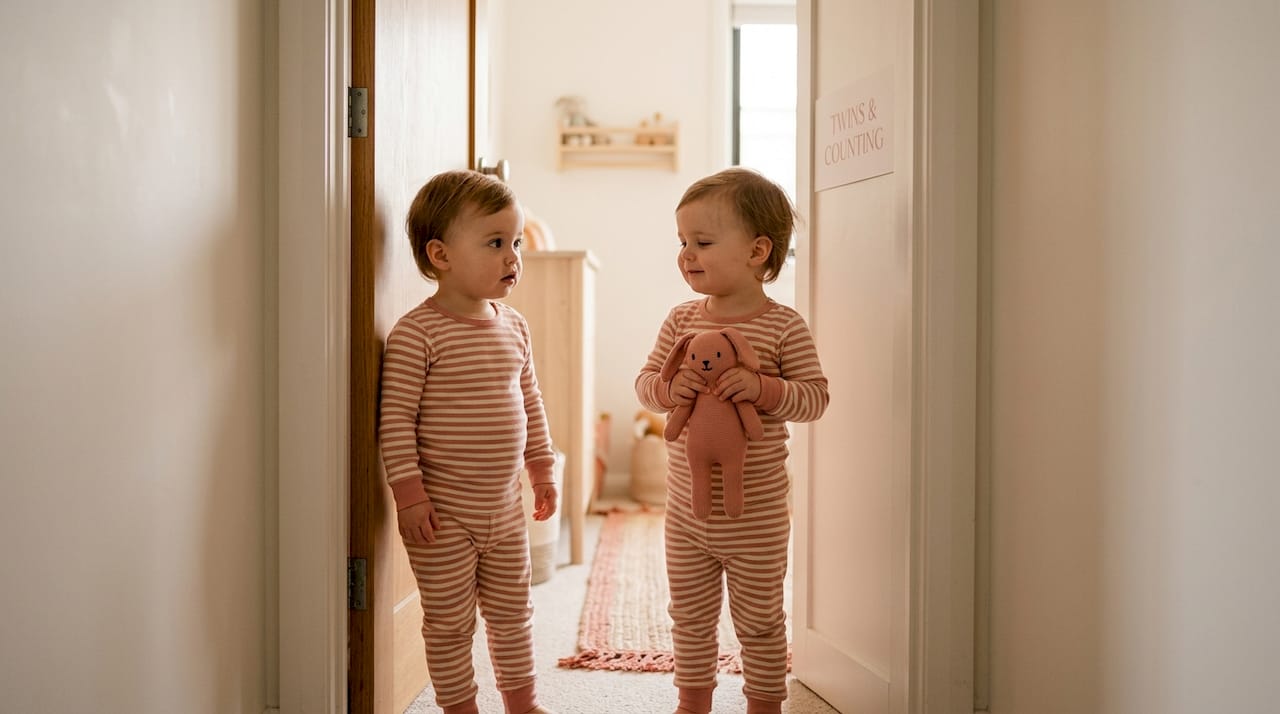
Separation anxiety adds another layer. Twins who are used to constant proximity can experience genuine distress when separated at sleep time, and they mirror each other’s emotional state. If Twin A is anxious and crying, Twin B feels and responds to that energy. The result looks like coordinated sleep resistance, even when it starts with just one child.
Here’s a breakdown of the most common environmental contributors to twin bedtime struggles:
- Shared crib or sleep surface beyond four months: proximity increases mutual arousal during light sleep phases
- No white noise: every small sound one twin makes travels directly to the other
- Inconsistent room temperature or light levels: disrupts circadian signaling for both children
- Bedtime that starts too late: the window of calm before overtiredness closes fast, especially for twins who feed off each other’s stimulation
- One twin receiving more parental contact at sleep time: creates unequal sleep associations and resentment-driven resistance
Pro Tip: Place a white noise machine between the two cribs, not just in the corner of the room. The goal is to create a sound buffer between the twins, not just mask external noise from the hallway.
Recognizing sleep fight behaviors
There’s a pattern that catches almost every parent of twins off guard. Your child has been awake for five hours. You’d expect them to look tired. Instead, they’re running in circles, jumping on the couch, and laughing hysterically. You think: they must not be tired yet. So you wait. And then bedtime becomes a disaster.
Overtired children often show hyperactive behavior rather than the yawning and eye-rubbing you might expect. The body floods itself with cortisol and adrenaline to compensate for fatigue, making the child appear wired. In twins, this gets amplified because they stimulate each other. One hyper twin feeds the other’s energy, and both end up pushed past the point where sleep comes easily.
Toddlers between ages 1 and 2 need 11 to 14 hours of total sleep in a 24-hour period. When they don’t get it, behavioral problems compound. Tantrums, emotional outbursts, and meltdowns at bedtime are not character flaws. They are symptoms of cumulative sleep deprivation.
“Many parents give up on sleep training just before the breakthrough. The extinction burst, where resistance intensifies before improving, is the most misleading phase of the process.” — Sleep Training Twins
Knowing what a normal extinction burst looks like can save you from abandoning a routine that’s actually working. Behavioral sleep interventions typically take 1 to 3 weeks to show sustained improvement. The first three to five nights are the hardest. If you stop during those nights, you reset the clock and teach your twins that resistance eventually works.
Here’s what to watch for during twin sleep fights:
- Manic energy, giggling, and running around despite a long wake window
- One twin escalating when the other calms down, keeping the cycle going
- Complete refusal to lie still even when clearly exhausted
- Crying that begins the moment the parent leaves the room and stops when they return
Practical routines that actually work
The most important shift you can make is moving away from “identical schedules for identical children” and toward “synchronized but individualized routines.” These are not the same thing. Here’s how to build something that holds up in real life.
Step 1: Establish a consistent pre-sleep sequence. The sequence matters more than the clock time. Bath, followed by dimmed lights, followed by a calming bedtime story, followed by lights out creates neural associations with sleep onset. Do this in the same order every night. Consistent bedtime routines establish neural associations that significantly improve how fast children fall asleep over time. A bedtime wind-down routine as short as 20 minutes can meaningfully reduce resistance.
Step 2: Use white noise strategically. Place a machine between the cribs at a consistent volume every night. This is not optional for twins in a shared room. It reduces stimulation, connects sleep cycles, and cuts down on the chain-reaction wake-ups that make twin sleep disruption so exhausting.
Step 3: Consider temporary physical separation during training. If one twin is significantly disrupting the other during sleep training, moving them to separate spaces for one to two weeks while establishing individual sleep habits can break the mutual disruption cycle. Then reunite them once both are falling asleep independently.
Step 4: Address each twin’s schedule separately if needed. Twins rarely share identical sleep needs, and forcing a uniform schedule can worsen bedtime battles. Stagger the start of each twin’s routine by 15 to 30 minutes if one consistently fights sleep harder than the other.
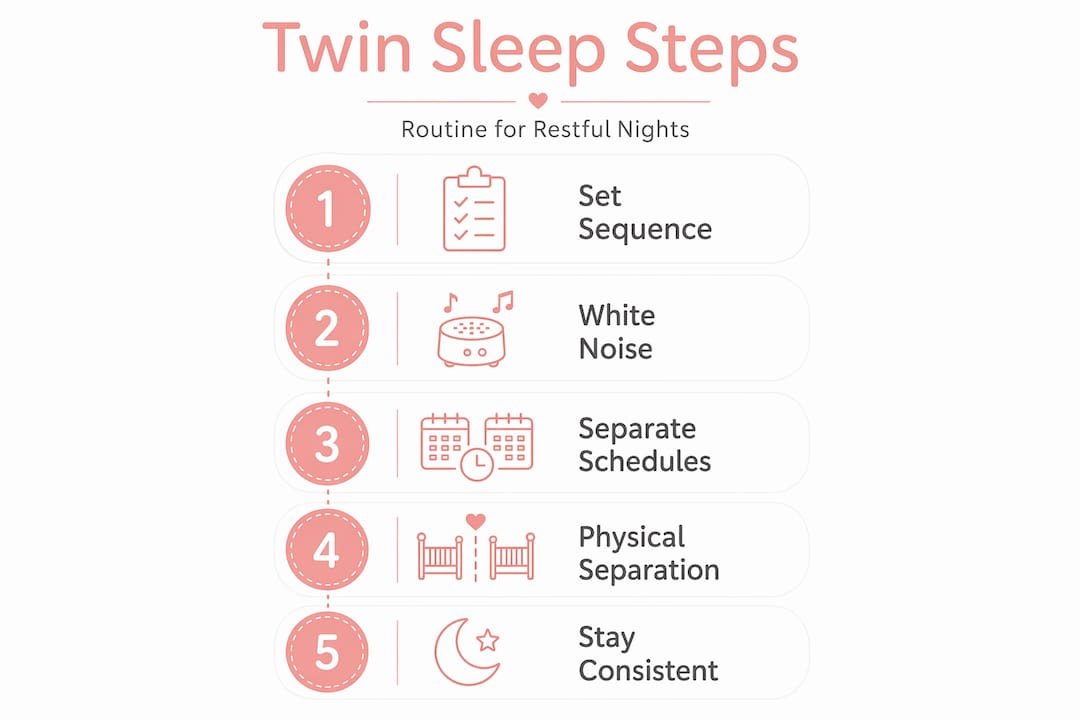
Step 5: Stay consistent through the hard nights. Waking one twin during training can inadvertently wake the other, so synchronized sleep plans matter. Go in together, respond the same way to both, and resist the urge to make exceptions for the louder or more distressed twin.
Here’s a quick comparison of what works versus what backfires:
| Strategy | Works | Backfires |
|---|---|---|
| White noise between cribs | Reduces sibling-trigger wake-ups | Skipping it to “see if it matters” |
| Staggered bedtimes by 15 to 30 min | Respects chronotype differences | Forcing identical bedtimes despite resistance |
| Consistent routine sequence | Builds sleep associations | Changing the routine based on mood |
| Temporary separation during training | Breaks mutual disruption cycle | Separating indefinitely without reuniting |
| Staying consistent through extinction bursts | Produces lasting improvement | Responding inconsistently to night crying |
For a deeper look at keeping twins on a schedule, Twinsandcounting has practical frameworks that adapt to twins at different developmental stages.
When to look beyond behavior
Most twin sleep resistance is behavioral and environmental. But some of it isn’t, and knowing the difference matters.
“Chronic bedtime fighting can mask medical issues like obstructive sleep apnea or anxiety. If symptoms like chronic snoring or significant daytime behavioral changes appear, medical evaluation is important.” — AOL Health
Watch for these signs that something beyond normal sleep training is happening:
- Heavy snoring or gasping sounds during sleep: possible indicators of obstructive sleep apnea, which physically prevents restful sleep
- Leg discomfort or restlessness at night: may point to restless leg syndrome, which is more common in children than most parents realize
- Excessive daytime sleepiness despite spending adequate hours in bed: suggests the child is not getting restorative sleep, not that bedtime is too early
- Extreme anxiety at bedtime that doesn’t improve after weeks of consistent routine: could signal an anxiety disorder or sensory processing issue that needs professional evaluation
- Behavioral changes during the day that seem disproportionate to the amount of sleep the child received
If you’ve maintained a consistent routine for three to four weeks and one or both twins are still fighting sleep intensely, talk to your pediatrician. Not every sleep problem is a parenting problem. Some are medical ones, and catching them early makes an enormous difference in your child’s development and your family’s sanity.
My honest take on twin sleep advice
I’ve watched a lot of well-meaning parents tie themselves in knots trying to follow sleep guides written for single children and wondering why nothing sticks. The advice isn’t wrong. It’s just incomplete.
In my experience, the biggest mistake parents of twins make is chasing synchronization as a goal in itself. The idea that both babies should fall asleep at the exact same minute, in the same way, after the same routine, is a fantasy that causes real suffering when it doesn’t materialize. And it almost never does, at least not without a long season of adjustment.
What I’ve learned is this: consistency in process beats precision in outcome. You can’t control when each twin’s body decides to surrender to sleep. You can control the sequence, the environment, and how calmly you respond when things go sideways. Those are the variables that actually move the needle.
I also want to be honest about how exhausting twin sleep fights are on the parent. The second month of sleep training two babies, when you’re still in the middle of the hard nights and not yet seeing results, is one of the loneliest stretches of twin parenting. Ask for help. Swap nights with your partner. Accept that you cannot run this marathon alone. Your consistency matters, but so does your capacity to keep going. Protect both.
— Jay
Find more help at Twinsandcounting
If tonight felt like too much, you’re not alone, and you don’t have to figure this out without support.

Twinsandcounting has a library of guides built specifically for the twin experience. From establishing those first routines with twin newborn sleep schedules to navigating the toddler years when naps disappear and bedtime resistance peaks, every guide is written with the reality of two children in mind, not one. Start with the essential tips for caring for twins for a practical overview covering sleep, feeding, and daily rhythms. If night sleep is your most pressing issue right now, the detailed walkthrough on getting twins to sleep through the night is the place to begin. You’ve got this, and Twinsandcounting is here for every hard night along the way.
FAQ
Why do twins resist sleep more than single babies?
Twins resist sleep for a combination of genetic, behavioral, and environmental reasons. They stimulate each other, can trigger mutual wake-ups, and often develop sleep associations tied to each other’s presence, making independent sleep onset harder to achieve.
Can twins have completely different sleep patterns?
Yes. Genetics account for up to 40% of chronotype, meaning even identical twins can have meaningfully different natural sleep and wake preferences that require individualized bedtime approaches.
How long does sleep training take for twins?
Sleep training typically takes 1 to 3 weeks to produce sustained improvement. The first three to five nights tend to involve peak resistance, so consistency during those early nights is critical to seeing results.
Should twins sleep in the same room during sleep training?
It depends on how much they disrupt each other. Using white noise between cribs helps significantly, but temporary separation during the active training phase can break the mutual disruption cycle before reuniting them once both fall asleep independently.
When should I talk to a doctor about my twins’ sleep fights?
Talk to your pediatrician if consistent routines haven’t improved sleep after three to four weeks, or if either twin shows signs like heavy snoring, gasping, excessive daytime sleepiness, or extreme nighttime anxiety that doesn’t respond to behavioral strategies.