
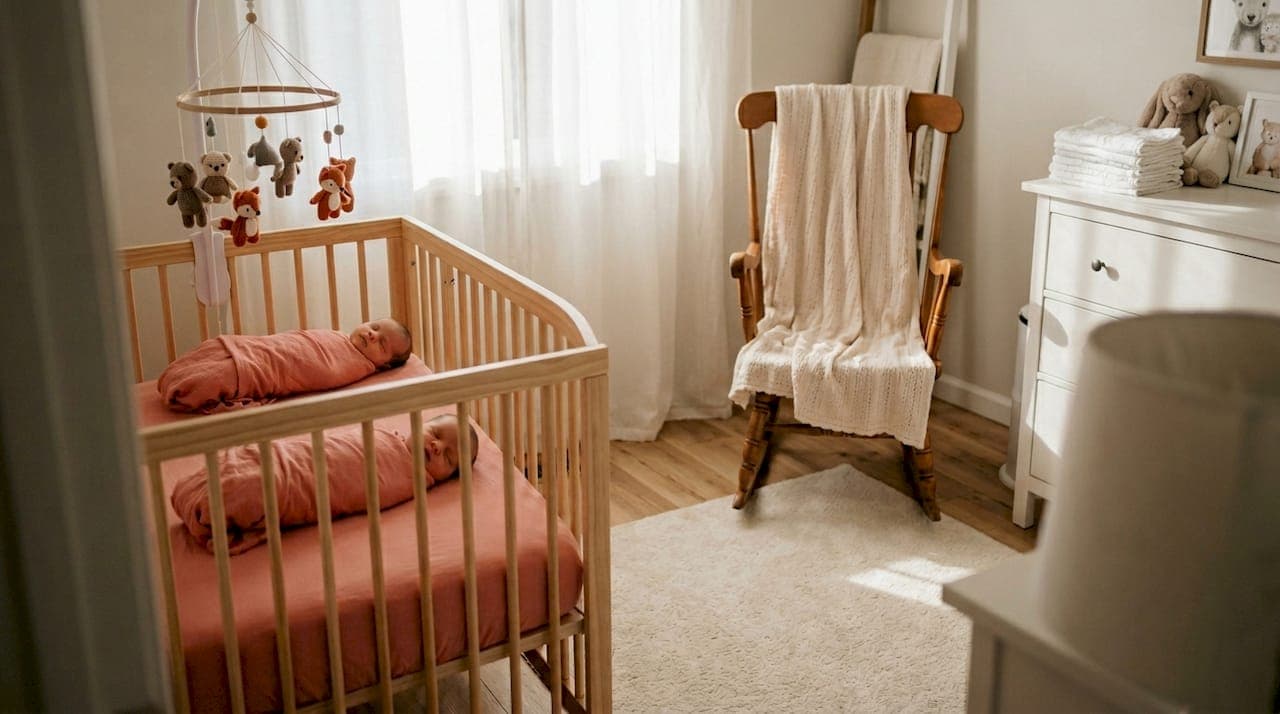
Most new parents of twins expect their babies to sleep in sync. After all, they shared a womb for nine months. The reality of newborn twin sleep cycles is more complicated, and honestly, more manageable once you understand what’s actually happening. Each twin runs on their own internal clock, waking frequently, cycling through light and deep sleep every 40 to 60 minutes, and showing sleep readiness at slightly different times. This guide breaks down the biology, the cues to watch for, and the practical strategies that help you build sleep routines for twins that actually work.
Table of Contents
- Key takeaways
- Understanding newborn twin sleep cycles
- Reading newborn twin sleep cues
- Syncing twin babies’ sleep schedules
- Safe sleep for newborn twins
- Managing your own well-being through twin sleep cycles
- My honest take on twin sleep in the newborn phase
- Explore more twin sleep resources at Twinsandcounting
- FAQ
Key takeaways
| Point | Details |
|---|---|
| Sleep cycles are short and frequent | Newborn twins cycle through sleep every 40 to 60 minutes, making frequent waking completely normal. |
| Twins are individuals at bedtime | Each twin may show different sleep cues and readiness, even if born minutes apart. |
| Syncing schedules is possible | Aligning wake times and naps within 10 to 20 minutes reduces chaos without forcing rigid uniformity. |
| Safe sleep means separate surfaces | Each twin needs their own firm, flat sleep surface, per AAP guidelines, regardless of how tempting co-bedding looks. |
| Parental self-care is non-negotiable | Sharing night duties and accepting help protects your health and your babies’ safety. |
Understanding newborn twin sleep cycles
Here is the first thing to get clear: newborn sleep is nothing like adult sleep. You and I move through sleep cycles that last roughly 90 minutes. Newborns, including twins, cycle every 40 to 60 minutes, which is why they seem to wake the moment you finally close your eyes. They are not doing it to you. Their brains are simply not wired yet for longer stretches.
Newborns need 14 to 17 hours of sleep every day, but that sleep is spread across many short periods. Between cycles, they are awake for only 45 to 90 minutes before needing to sleep again. That window is called a wake window, and it is one of the most useful concepts you will use in the early weeks.
Another critical piece: newborns do not have a mature circadian rhythm. That internal 24-hour clock that tells your body when to be alert and when to wind down does not develop until around 3 to 4 months of age. This means sleep training in the traditional sense is off the table for now. The focus in these early weeks should be on sleep hygiene, reading cues, and preventing overtiredness.
Where twins add a layer of complexity is in their individuality. Even identical twins can have noticeably different sleep temperaments. One may resettle easily between cycles while the other needs more help. One may show sleepy cues earlier than the other. This is normal, and it does not mean your routine is broken.
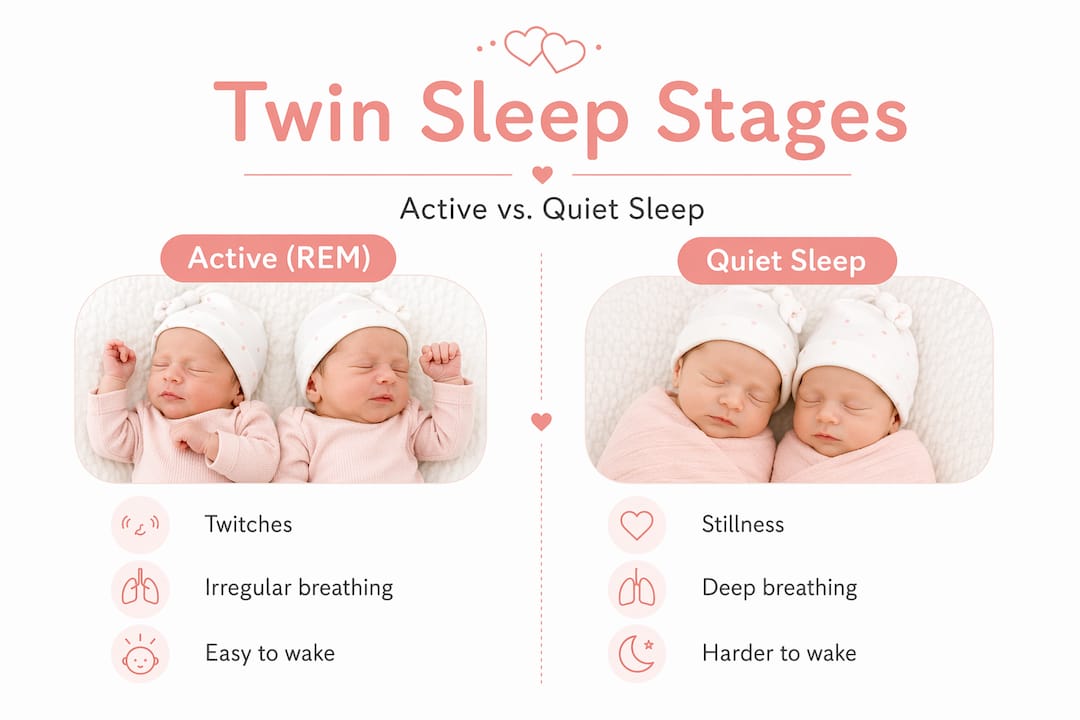
| Twin sleep stage | Typical duration | What to expect |
|---|---|---|
| Active (REM) sleep | 50% of sleep time | Twitching, irregular breathing, light sleep |
| Quiet (non-REM) sleep | 50% of sleep time | Still, deeper sleep, harder to wake |
| Full sleep cycle | 40 to 60 minutes | Partial waking between cycles is normal |
| Wake window (newborn) | 45 to 90 minutes | Sleep cues appear near the end of this window |
Pro Tip: Keep a simple log for the first two weeks, noting when each twin wakes, feeds, and shows sleepy cues. Patterns emerge faster than you expect, and that data becomes your scheduling foundation.
Reading newborn twin sleep cues
Catching a sleepy cue early is one of the most powerful things you can do for your twins’ sleep quality. Overtiredness is the enemy. When a baby crosses from tired into overtired, the body releases cortisol to compensate, making it much harder to settle and stay asleep.
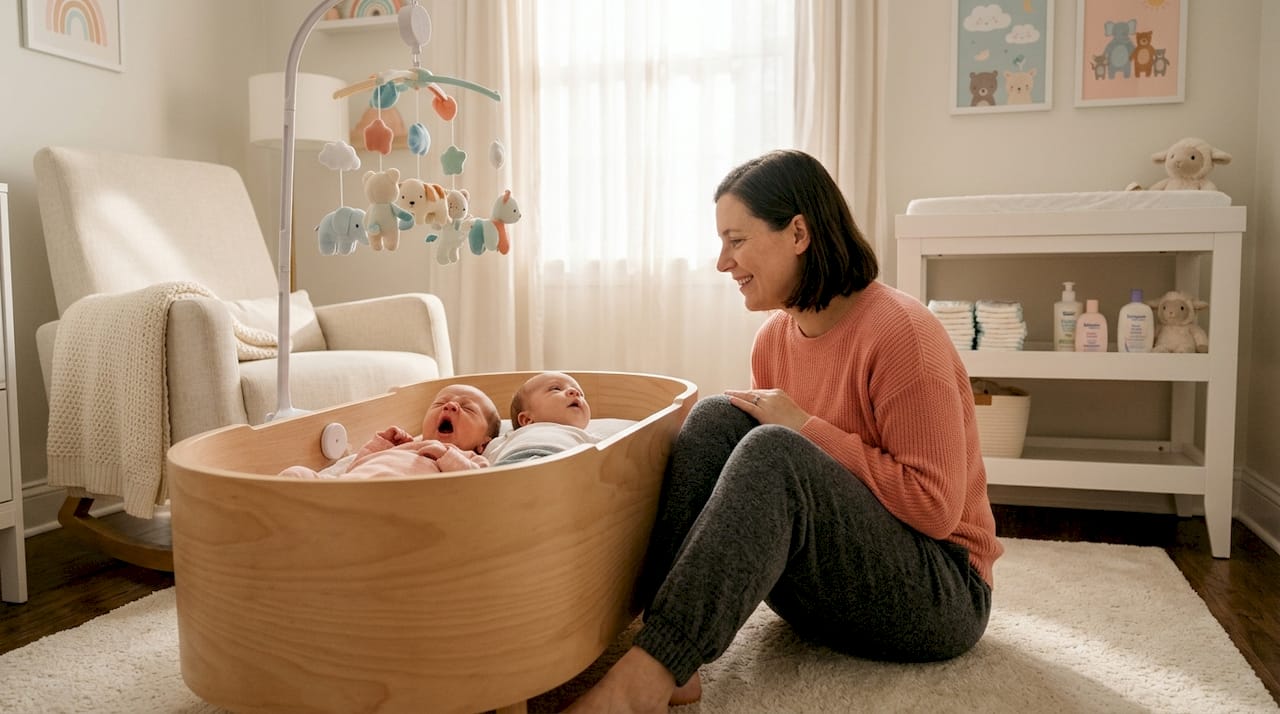
The challenge with twins is that you are reading two babies at once. Knowing the difference between early and late cues gives you a head start.
Early sleepy cues to watch for:
- Slowing body movements, less active kicking or arm waving
- Reduced eye contact or a slightly glazed look
- Turning the head away from stimulation
- A brief yawn or two
- Quieting down after a period of alertness
Late sleepy cues that signal overtiredness:
- Crying or fussing that escalates quickly
- Arching the back or rubbing the eyes
- Difficulty latching or feeding
- Pulling at ears
- Inconsolable fussiness despite no obvious need
Catching early cues and responding promptly shortens the time it takes to settle each twin and reduces the chance of a full overtired meltdown. When both babies hit late cues at the same time, you are managing two crying infants simultaneously. That is a situation worth preventing.
The practical reality is that your twins will not always show cues at the same moment. One may be ready to sleep while the other is still alert and content. Treating each twin as an individual while gently nudging them toward a shared schedule is the balance you are working toward.
Pro Tip: If Twin A shows early cues but Twin B is still awake and happy, begin Twin A’s wind-down routine quietly. A dim room and gentle rocking can start the process without disrupting Twin B.
Syncing twin babies’ sleep schedules
Getting your twins onto a synchronized schedule is not about forcing them into identical rhythms. It is about narrowing the gap between their routines so you get predictable windows of rest. Aligning sleep schedules within 10 to 20 minutes is a realistic and effective target.
Here is a step-by-step approach to building that alignment:
- Start with feeding. Feed both twins at the same time from day one, even if one wakes naturally and you need to gently rouse the other. Feeding drives sleep timing in newborns, so synced feeds create synced drowsiness.
- Use a consistent wind-down sequence. Bedtime routines that signal sleep, such as a warm bath, dimmed lights, and a lullaby, help both twins associate those cues with sleep. Keep the sequence short, around 10 to 15 minutes.
- Track wake windows for each twin. If Twin A wakes from a nap 20 minutes before Twin B, note that. When Twin B wakes, begin the shared activity period together so they approach the next nap at roughly the same time.
- Gently wake the longer sleeper. This feels counterintuitive, but waking a twin who has slept significantly longer than their sibling keeps the schedule from drifting apart. Do it gently, with light and soft talking rather than a sudden disturbance.
- Adjust based on individual cues. If one twin consistently shows sleepy cues earlier, shift their nap start by 5 to 10 minutes rather than waiting and risking overtiredness.
| Approach | Best for | Trade-off |
|---|---|---|
| Strict simultaneous schedule | Maximum parental rest windows | May not honor individual sleep readiness |
| Flexible synced schedule (10 to 20 min window) | Balancing individual needs with routine | Requires more active monitoring |
| Fully individual schedules | Respecting unique rhythms | Minimal parental downtime, harder to sustain |
For deeper guidance on keeping twins on schedule, Twinsandcounting has a dedicated resource that walks through the specifics week by week.
Safe sleep for newborn twins
Safe sleep guidelines exist for every baby, and twins come with a few extra considerations worth knowing clearly.
- Separate sleep surfaces are required. The AAP recommends that each twin has their own firm, flat sleep surface, such as a bassinet or crib. No sharing a sleep space, regardless of how peaceful it looks or how much they slept together in the womb.
- Room sharing is recommended. Having both twins in your room for the first six months reduces risk. This does not mean bed-sharing. It means cribs or bassinets in your room.
- Co-bedding carries real risk. Some hospitals practice co-bedding for premature twins in the NICU, but at home, the risks outweigh the benefits. If you have questions about twin bed-sharing safety, it is worth reading through the specifics before making any decisions.
- Back positioning is non-negotiable. Every sleep, every time, both twins sleep on their backs on a firm surface free of loose bedding, pillows, or positioners.
- Separate spaces for naps reduce disruption. Using separate rooms or Pack ‘n Plays for daytime naps helps prevent one twin’s waking from pulling the other out of sleep. At night, colocating cribs in your room builds a sense of togetherness without the safety risk.
Pro Tip: Place a white noise machine between the two cribs at a consistent volume. It masks the sounds of one twin stirring and gives both babies a consistent auditory sleep cue they will begin to associate with rest.
Managing your own well-being through twin sleep cycles
Let’s be direct about something: parenting twins on broken sleep is genuinely hard. Parental exhaustion is amplified with twins, and running on empty affects your judgment, your mood, and your ability to read your babies’ cues accurately. Taking care of yourself is not a luxury. It is part of taking care of them.
Here are practical ways to protect your well-being during the newborn phase:
- Split the night into shifts. One parent handles the midnight to 3 a.m. window while the other sleeps. Then switch. Even four uninterrupted hours makes a measurable difference in cognitive function.
- Tandem feed when possible. Whether breastfeeding or bottle feeding, feeding both twins at the same time cuts your overnight time in half. It takes practice, but it is worth the learning curve.
- Accept help without guilt. Overnight support from a family member, postpartum doula, or newborn care specialist is not a sign of failure. Overnight help directly supports infant safety by keeping caregivers alert and responsive.
- Lower the bar on everything else. The house does not need to be clean. Meals can be simple. The only job right now is keeping two babies fed, safe, and rested, and keeping yourself functional.
Pro Tip: When you hit a rough patch and twins won’t nap, resist the urge to troubleshoot everything at once. Pick one variable, try it for two to three days, and then assess. Changing too many things at once makes it impossible to know what actually helped.
My honest take on twin sleep in the newborn phase
I have seen a lot of twin parents come into the newborn phase with a plan. A detailed, color-coded, perfectly timed plan. And I have watched almost every one of those plans get revised within the first week. That is not failure. That is information.
What I have learned, and what I wish more parents heard early, is that the goal in the newborn phase is not a perfect schedule. It is a flexible framework. You are not training your babies yet. You are learning them. Each twin is showing you who they are, how they signal tiredness, how quickly they resettle, and what helps them feel safe enough to sleep.
The parents who do best are not the ones with the strictest routines. They are the ones who treat their twins as individuals while holding the routine loosely. They adjust. They observe. They give themselves permission to get it wrong and try again tomorrow.
Self-care is not optional in this phase. I say that not as a platitude, but as a practical reality. A parent who is running on no sleep cannot read cues accurately. They cannot respond calmly. They cannot make good decisions. Protecting your rest is protecting your twins.
Progress in the newborn phase is measured in days and weeks, not hours. Give yourself that grace.
— Jay
Explore more twin sleep resources at Twinsandcounting
You do not have to figure this out alone. Twinsandcounting was built specifically for parents in exactly this situation, managing the care of two newborns simultaneously and looking for guidance that actually accounts for having twins, not just one baby.

Whether you are trying to get both babies sleeping longer at night, building a daytime nap structure that works, or just trying to survive the first six weeks, Twinsandcounting has resources that go deeper than general parenting advice. Start with the guide on getting twins to sleep through the night for a practical roadmap that builds on everything covered here. If you want a broader foundation, the complete twin care guide covers feeding, sleep, and daily routines in one place. The community and the expertise are there when you need them.
FAQ
What are normal newborn twin sleep cycles?
Newborn twins cycle through sleep every 40 to 60 minutes, spending roughly equal time in active (REM) and quiet sleep. Frequent waking between cycles is completely normal and expected in the first months of life.
How do I sync my twins’ sleep schedules?
Feed both twins at the same time from day one and use a consistent wind-down routine before each sleep period. Aligning nap and bedtime starts within 10 to 20 minutes of each other is a realistic and sustainable target.
When can I start sleep training my twins?
Sleep training is not recommended before three months of age because newborns have not yet developed a mature circadian rhythm. Focus on sleep hygiene, reading cues, and preventing overtiredness during the newborn phase.
Can newborn twins sleep in the same crib?
AAP guidelines recommend separate, firm, flat sleep surfaces for each twin. Room sharing with caregivers is encouraged, but bed-sharing between twins or with parents is not considered safe practice.
How do I read sleep cues when both twins need attention?
Watch for early cues like slowing movements, reduced eye contact, and quiet yawning in both babies. Begin the wind-down routine for whichever twin shows cues first, and start the other twin’s routine shortly after to keep their schedules close.