

Skin-to-skin feeding for twins, also called kangaroo care, is the practice of placing newborn twins directly on a caregiver’s bare chest to stabilize vital signs, trigger feeding reflexes, and build the deep bond that two babies need from day one. The role of skin to skin feeding twins plays in early development goes far beyond comfort. Research published in a 2025 Cochrane Review confirms that starting skin-to-skin contact within the first 10 minutes after birth increases exclusive breastfeeding rates by about one third compared to standard care. For twin parents managing double the feeds, double the needs, and often double the anxiety, this practice is one of the most evidence-backed tools you have.
What does the science say about skin-to-skin feeding benefits for twins?
The evidence supporting skin-to-skin contact for twins is specific, recent, and strong. A 2025 Cochrane Review found that early and uninterrupted skin-to-skin contact during the sensitive period after birth is a measurable lever to improve exclusive breastfeeding trajectory. Higher breastfeeding rates persist up to 6 months postpartum in skin-to-skin groups. That is a significant outcome for twin parents, who statistically face greater challenges maintaining milk supply and breastfeeding duration than parents of singletons.
A 2026 study published in MDPI Pediatrics found that daily skin-to-skin contact performed one to two times per day for at least 30 minutes over four weeks prolongs exclusive breastfeeding by approximately 9 days and continued breastfeeding by about 10 days. For twins, where feeding logistics are already complex, those extra days represent real progress in establishing milk supply and feeding confidence.
The physiological benefits extend well beyond breastfeeding. Skin-to-skin contact triggers oxytocin release in mothers, which promotes milk ejection, reduces maternal stress, and synchronizes the neuroendocrine systems of both mother and baby. For twins born prematurely, which happens in a significant proportion of twin pregnancies, the stakes are even higher. A review published in The Lancet found that kangaroo mother care practiced 8 to 24 hours daily significantly improves survival and neurodevelopment for preterm and low-birth-weight newborns. It also reduces mortality, infections, and hypothermia. If your twins arrived early, skin-to-skin contact is not optional. It is clinical care.

Pro Tip: Ask your NICU or postpartum nurse specifically about kangaroo care protocols for twins. Many hospitals have structured programs, and knowing the guidelines in advance helps you advocate for both babies from the start.
| Benefit | What the research shows |
|---|---|
| Breastfeeding initiation | Starting SSC within 10 minutes of birth raises exclusive breastfeeding rates by about one third. |
| Breastfeeding duration | Daily SSC for 4 weeks extends exclusive breastfeeding by approximately 9 days. |
| Physiological regulation | Skin-to-skin stabilizes heart rate, breathing, temperature, and metabolic function in newborns. |
| Preterm outcomes | Kangaroo mother care reduces mortality, infections, and hypothermia in low-birth-weight twins. |
| Maternal bonding | Oxytocin release during SSC improves milk ejection, reduces stress, and supports parental sensitivity. |
How does skin-to-skin feeding with twins differ from singleton care?
Caring for one newborn during skin-to-skin contact is already a physical and logistical commitment. With twins, the challenge doubles, and the approach needs to adapt. The good news is that Maryland Department of Health 2026 guidelines confirm that twins can be held skin-to-skin simultaneously or in rotation by a caregiver, including premature babies when medically stable. You are not choosing between your babies. You are choosing a method that works for your body and your situation.
Here is what twin-specific skin-to-skin care looks like in practice:
- Simultaneous holding: Both twins rest on your bare chest at the same time. This works well when babies are stable and you have a second person nearby for safety monitoring. Simultaneous SSC holding reduces interruptions and protects feeding reflex timing more effectively than separate sessions alone.
- Rotational holding: You hold one twin at a time for a focused session, then switch. Maryland Department of Health guidelines recommend around 15 minutes per baby when holding separately. This approach works well when one twin needs more support or when you are managing care solo.
- Partner involvement: Your partner or a support person can hold one twin while you hold the other. This is not a workaround. It is a genuine bonding opportunity for both caregivers and both babies.
- Scheduled sessions: Build skin-to-skin into your feeding routine rather than treating it as an add-on. Tying it to a feed means it happens consistently, which is what produces the documented benefits.
- One-on-one time: Short, focused SSC sessions daily are critical for individual development and bonding. Even 15 minutes of undivided contact with each twin matters.
The biggest mistake twin parents make is assuming they cannot do skin-to-skin well because they have two babies. Consistent, structured protocols with staff training reproducibly increase breastfeeding duration and maternal confidence. You do not need to be perfect. You need to be consistent.
What are safe and practical techniques for skin-to-skin feeding twins?
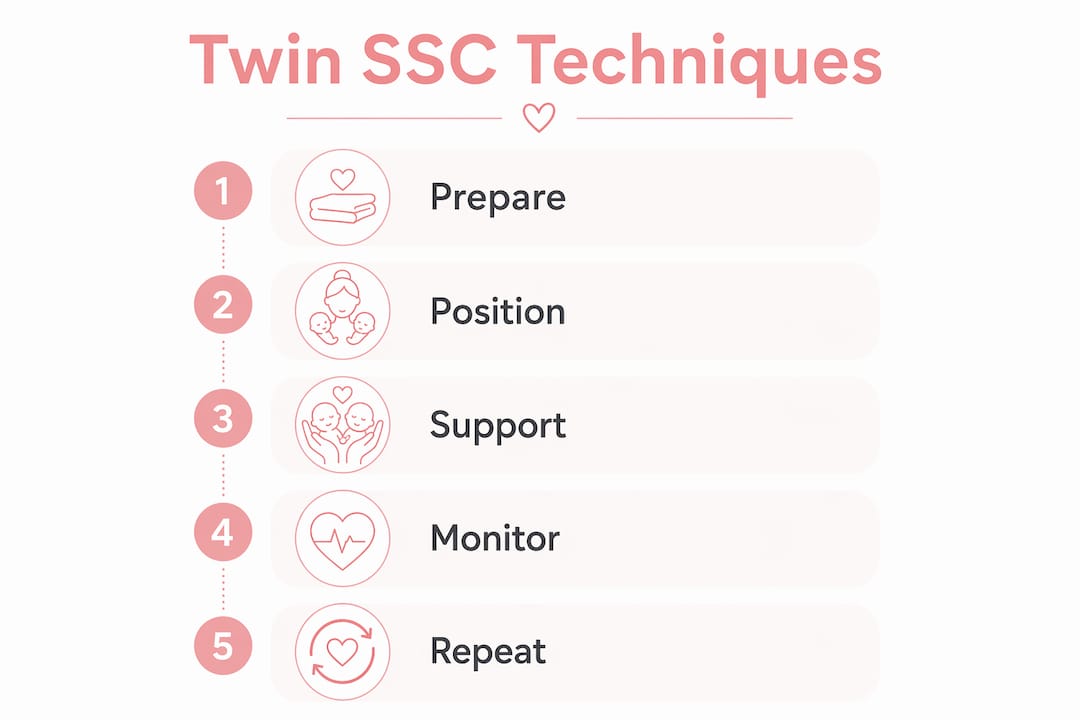
Getting the mechanics right protects your babies and makes the practice sustainable. Here is a step-by-step approach based on clinical protocols and the MDPI clinical practice guidance on SSC safety.
- Prepare your space before you start. Have a reclining chair or hospital bed ready, a warm blanket for each baby’s back, and a support person nearby if possible. Coordination with healthcare staff is critical to proper simultaneous positioning, thermal protection, and monitoring sensitivity during the neonatal period.
- Position each baby upright on your chest. The baby’s head should be turned to one side with the ear against your chest. Hips should be flexed in a frog-leg position. This keeps the airway open and supports natural feeding reflexes.
- Cover babies’ backs with a warm blanket. Twins lose body heat faster than singletons because they are often smaller. A blanket over each baby’s back maintains temperature without overheating.
- Time your sessions strategically. Strategically timed SSC sessions minimize setup breaks that disrupt babies’ natural feeding reflexes, maximizing feeding success when both babies are stable.
- Watch for feeding cues during the session. Rooting, sucking motions, and hand-to-mouth movements are signals to offer the breast or bottle. Skin-to-skin naturally brings these cues forward.
- Continue at home after discharge. The benefits of skin-to-skin do not stop at the hospital door. Daily sessions at home, even as babies grow, continue to support bonding, feeding, and your confidence as a parent. For guidance on feeding premature twins at home, Twinsandcounting has a dedicated practical guide.
Pro Tip: If one twin is in the NICU and one is not, ask whether you can do skin-to-skin with both on the same visit. Many NICUs support this, and it helps you maintain a consistent routine for both babies from the start.
Real-world barriers do exist. Research published in a 2026 disparities study found that language discordance and workflow challenges contribute to unequal access to skin-to-skin care in hospital settings. If you feel your care team is not prioritizing SSC for your twins, ask directly. You have every right to advocate for this practice.
How does skin-to-skin feeding build emotional bonds and parental confidence with twins?
The emotional dimension of twin skin-to-skin bonding is just as real as the physiological one. When you hold your babies skin-to-skin, your body releases oxytocin, often called the bonding hormone. This hormone promotes milk ejection, reduces your stress response, and increases your sensitivity to each baby’s cues. For twin parents who often feel stretched thin between two infants, this neurological reset matters.
Skin-to-skin contact also reduces newborn crying and promotes calm in both babies. A calmer baby is easier to read, and a calmer parent is more confident. That confidence compounds over time. Parents who practice consistent skin-to-skin contact report feeling more capable and less overwhelmed by the demands of twin care. The importance of skin contact for twins extends to the parent’s mental health, not just the babies’ development.
One concern many twin parents share is whether divided attention means divided bonding. It does not. Twin parents can optimize bonding through alternating or simultaneous SSC sessions, countering the misconception that having two infants reduces bonding capacity. Each one-on-one session, however brief, registers as a full bonding experience for that baby. You are not splitting the bond in half. You are building two full bonds, one moment at a time.
For parents managing twin premature feeding challenges, the emotional stakes are even higher. Skin-to-skin contact gives you something concrete to do during a time that can feel helpless. It is one of the most powerful ways to show up for your babies when other interventions are out of your hands.
Key takeaways
Skin-to-skin feeding is the single most evidence-backed practice twin parents can use to support breastfeeding, stabilize their babies’ physiology, and build lasting bonds with both infants simultaneously.
| Point | Details |
|---|---|
| Start within 10 minutes of birth | Early SSC raises exclusive breastfeeding rates by about one third compared to standard care. |
| Daily sessions extend breastfeeding | Thirty minutes of SSC once or twice daily over four weeks adds approximately 9 days of exclusive breastfeeding. |
| Twins can be held simultaneously | Maryland Department of Health 2026 guidelines confirm simultaneous or rotational SSC is safe and effective for twins. |
| Oxytocin drives bonding and milk supply | SSC triggers oxytocin release, improving milk ejection, reducing stress, and strengthening parental sensitivity. |
| Rotational care builds individual bonds | Short, focused one-on-one sessions with each twin daily support individual development and bonding. |
What I have learned about skin-to-skin feeding with twins
The parents I see struggle most with skin-to-skin are not the ones who lack information. They are the ones who set an impossible standard for themselves. They imagine they need to hold both babies simultaneously, perfectly positioned, for 30 minutes, twice a day, while recovering from birth and running on no sleep. That picture is not real, and chasing it leads to giving up entirely.
What actually works is smaller than you think. A 15-minute session with one twin while your partner holds the other is not a compromise. It is the practice. Nursing twins skin to skin does not require a perfect setup. It requires showing up consistently, even imperfectly.
The other thing I want you to hear is this: the benefits of skin-to-skin are not locked behind a specific window. Yes, the first hour after birth matters. But the research on daily SSC shows that consistent practice over weeks produces real, measurable gains. If your start was complicated by a NICU stay, a difficult delivery, or simply not knowing, you have not missed your chance. Start today with whatever you have.
Your healthcare team is your biggest asset here. Ask your lactation consultant, your NICU nurse, or your pediatrician to walk you through positioning for two. The teamwork that makes twin skin-to-skin work is the same teamwork that makes twin parenting work. You do not have to figure this out alone.
— Jay
How Twinsandcounting supports your twin feeding journey

Twinsandcounting is built specifically for parents like you. Whether you are still expecting or already in the thick of newborn twin care, the site offers practical, twin-specific guidance that goes beyond generic parenting advice. From twin care tips that cover feeding and bonding strategies to scheduling support for solo parenting days, every resource is designed with two babies in mind. If you are working on building a sustainable skin-to-skin routine alongside everything else that comes with twin newborn care, the ultimate twin care guide on Twinsandcounting is a strong next step. You deserve support that actually fits your reality.
FAQ
What is the role of skin-to-skin feeding for twins?
Skin-to-skin feeding, also called kangaroo care, stabilizes twins’ heart rate, breathing, and temperature while triggering feeding reflexes and promoting breastfeeding. It also builds the emotional bond between parent and each baby through oxytocin release.
Can you do skin-to-skin with both twins at the same time?
Yes. Maryland Department of Health 2026 guidelines confirm that twins can be held skin-to-skin simultaneously or in rotation, including premature babies when medically stable. Simultaneous holding reduces interruptions and protects feeding reflex timing.
How long should skin-to-skin sessions be for twins?
Clinical guidance recommends at least 30 minutes per session once or twice daily to extend breastfeeding duration. When holding twins separately, around 15 minutes per baby is effective for bonding and physiological regulation.
Does skin-to-skin help with breastfeeding twins specifically?
Yes. A 2025 Cochrane Review found that starting SSC within 10 minutes of birth raises exclusive breastfeeding rates by about one third. Daily sessions over four weeks extend exclusive breastfeeding by approximately 9 days, which is significant for twin parents managing milk supply for two.
What if one or both twins are in the NICU?
Kangaroo mother care is supported in most NICU settings for medically stable preterm twins. A Lancet review found that 8 to 24 hours of daily SSC significantly improves survival and neurodevelopment for preterm newborns. Ask your NICU care team about their specific SSC protocol for twins.