
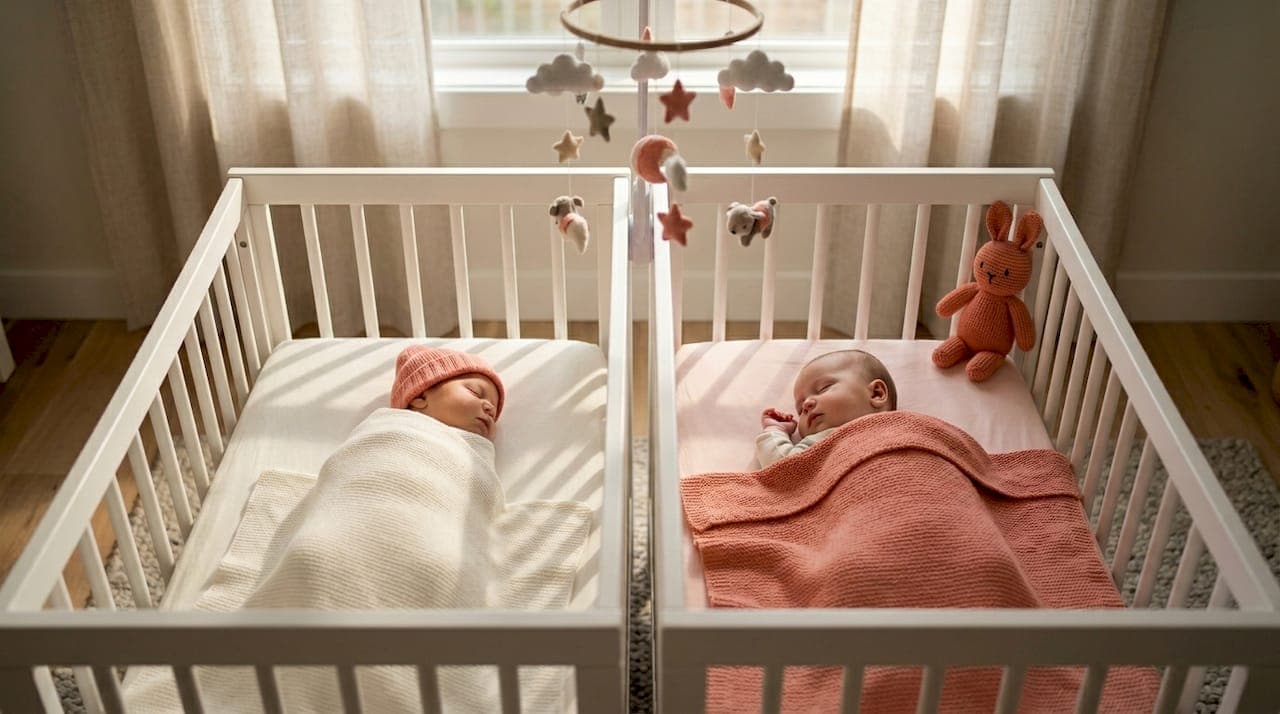
Twins waking each other up is primarily caused by overlapping sleep cycle transitions and learned sleep associations, not an unavoidable biological trait. When one twin surfaces from a light sleep phase and lacks the skills to resettle independently, the noise or movement triggers the other. Sleep consultants like Taking Cara Babies and Mindful Sleep Consulting confirm that most twins can learn to sleep through each other’s sounds with the right environment and scheduling. The good news: this is a solvable problem. With consistent routines, smart crib placement, and white noise, you can dramatically reduce mutual night waking.
Why do twins wake each other up during sleep?
Twin mutual night waking happens at the intersection of sleep biology and learned behavior. Every baby, twin or not, cycles through light and deep sleep roughly every 45 to 60 minutes. At the end of each cycle, babies briefly rouse. If a twin has a sleep association like needing rocking or feeding to resettle, that brief rouse becomes a full wake. The crying then pulls the other twin out of their own light phase.
The problem compounds when twins’ sleep cycles are slightly misaligned. Twin A wakes at minute 47, cries for two minutes, and that noise lands exactly when Twin B is in their lightest sleep phase. This is why twin night waking causes can feel relentless in the early months. It is not random. It is a predictable chain reaction tied to cycle timing.
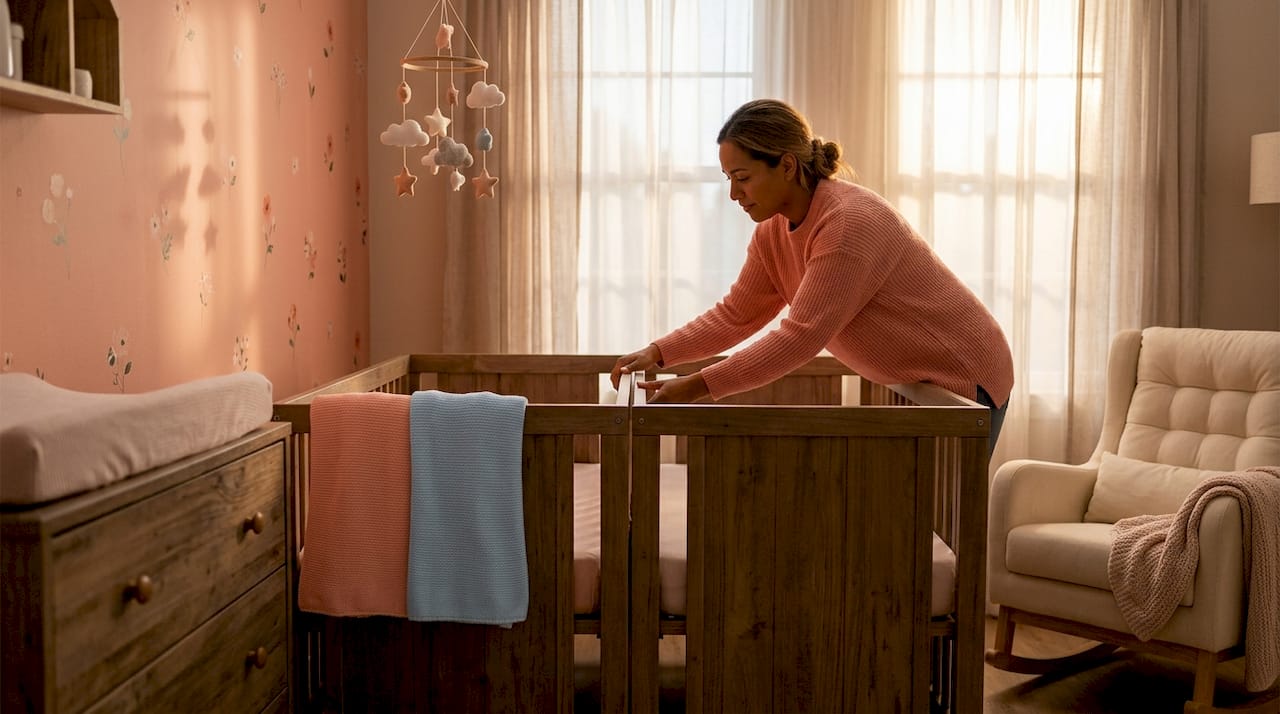
Mindful Sleep Consulting makes a critical point: mutual waking is more about learned behaviors and developing independent sleep skills than inherent twin dynamics. This reframes the problem entirely. You are not fighting biology. You are teaching two babies a skill.
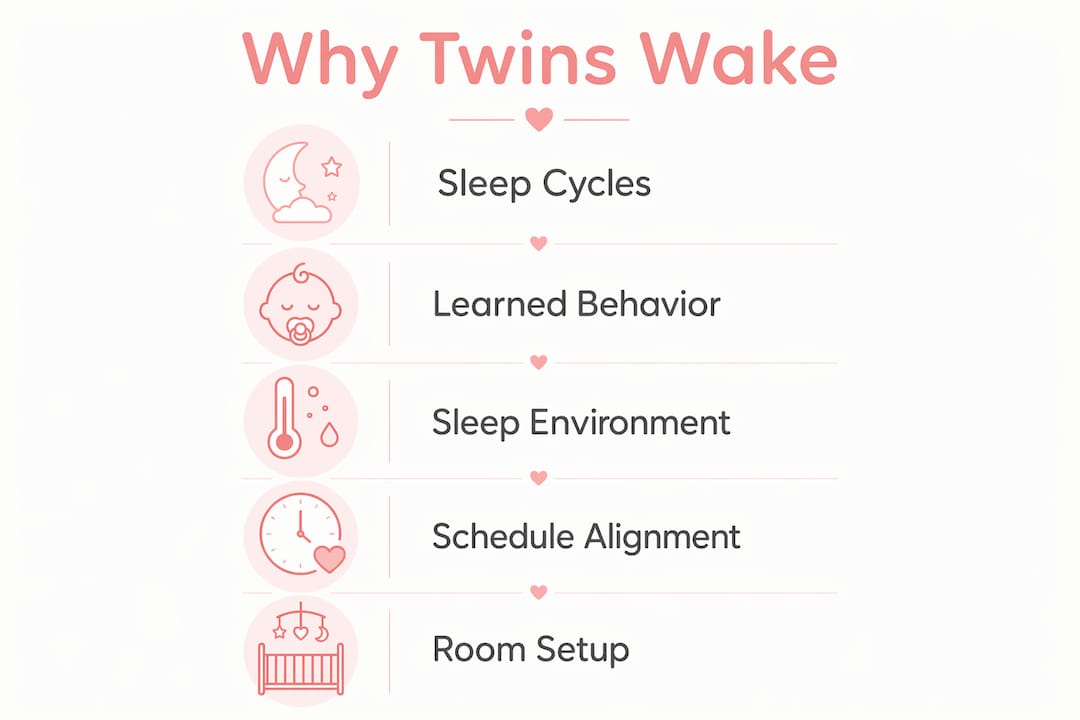
Here are the core triggers behind twins waking each other:
- Sleep cycle overlap: Both twins surface from light sleep around the same time, and one’s noise catches the other mid-rouse.
- Sleep associations: One twin cries for a comfort prop (feeding, rocking, a pacifier), and the sound wakes the other before you can respond.
- Misaligned schedules: When twins nap or go to bed at different times, their cycles drift apart, increasing the chance of one waking the other at the worst moment.
- Developmental regressions: At 4 months, 8 months, and 18 months, sleep cycles reorganize. Both twins may regress simultaneously, amplifying mutual disturbances.
“Parents worry that twins wake each other all night, but habituation occurs allowing them to sleep through sibling sounds.” — Taking Cara Babies
That word “habituation” is the key. Repeated exposure to a sibling’s sounds, combined with environmental controls, teaches twins to sleep through the noise. It takes time, but it happens.
How does the sleep environment affect twins waking each other?
The physical setup of your twins’ sleep space is one of the fastest levers you can pull. White noise machines are described as non-negotiable by sleep consultants for twins, and for good reason. White noise masks the sharp, startling quality of a sibling’s cry. It does not eliminate the sound, but it reduces the contrast between silence and crying, which is what jolts a sleeping baby awake.
Crib placement matters just as much. Placing cribs on opposite sides of the room reduces direct sound transmission. Sound intensity drops significantly with distance, so even a few extra feet between cribs gives the sleeping twin a better chance of staying asleep. Combining distance with white noise creates a genuine acoustic buffer.
Here is a practical setup sequence to reduce sibling sleep disturbances:
- Position cribs on opposite walls. Maximize the distance between sleep spaces within the room.
- Place a white noise machine between the cribs or near each crib. A machine near each baby is more effective than one in the center of the room.
- Use blackout curtains. Light is a secondary wake trigger, especially during early morning waking. Removing it reduces the chance that one twin waking early pulls the other into full alertness.
- Keep the room temperature consistent. Discomfort from heat or cold is an independent wake trigger that compounds the problem.
- Avoid mobiles or light-up toys that activate on sound. These reward crying with stimulation, reinforcing the wake cycle.
Pro Tip: Run white noise during naps at a slightly higher volume than at night. Daytime naps involve lower sleep drive, making twins more vulnerable to waking from sibling sounds. The extra masking during naps pays dividends in nap length and mood.
Routine alignment is the other half of the environmental equation. Keeping twins’ schedules within 10 to 20 minutes of each other reduces the window where one twin is in deep sleep while the other is in a light phase. When their cycles run close together, they tend to surface and resettle at roughly the same time, which means less mutual disruption.
Room sharing vs. separate rooms: which reduces mutual waking?
This is the question every twin parent eventually faces. The answer depends on your stage of sleep training and your long-term goals.
| Arrangement | Pros | Cons |
|---|---|---|
| Shared room, separate cribs | Supports habituation over time; easier schedule alignment; meets AAP safe sleep guidelines | Short-term disruption while habituation develops; requires white noise and crib placement strategy |
| Separate rooms during sleep training | Faster settling for each twin; reduces immediate mutual waking | Retraining often needed when reunited; logistically demanding for parents |
| Nap separation, shared room at night | Reduces daytime mutual waking; preserves nighttime habituation | Requires a second sleep space (pack ‘n play); more transitions for parents to manage |
The American Academy of Pediatrics recommends room sharing without bed-sharing for all infants, including twins. Separate cribs in the same room is the safest arrangement and also the one most compatible with long-term sleep success. You can read more about the specifics at Twinsandcounting’s guide on sharing a room.
Separate rooms can speed up initial sleep training because each twin learns to settle without the other’s sounds as a variable. However, retraining is often necessary when you reunite them. Babies learn the rules of their sleep environment. When the environment changes, the rules reset. This is not a failure. It is just how infant sleep learning works.
Nap separation is a practical middle ground. Separating twins for naps, even while keeping them together at night, reduces the most vulnerable sleep period without requiring a full room separation. Naptime carries lower sleep drive and higher sensitivity to disturbance, making it the hardest period to manage in a shared space.
What practical strategies reduce twins waking each other at night?
Knowing the causes is only useful if it leads to action. These strategies address twin early morning waking causes and nighttime disruptions directly.
-
Align schedules within 10 to 20 minutes. If one twin wakes earlier from a nap, add 10 to 15 minutes to their next wake window to gradually resync. Aligned cycles mean aligned sleep phases, which means less mutual waking.
-
Use white noise consistently. Run it every sleep period, not just at night. Consistency matters because babies learn environmental cues. White noise becomes a sleep signal as much as an acoustic buffer.
-
Teach independent settling. This is the single most impactful change you can make. A twin who can resettle without a prop will not cry long enough to wake the other. Work on this skill during the easiest sleep period first, typically the first nap of the day.
-
Separate for naps when mutual waking is severe. A pack ‘n play in a bathroom or closet with white noise is enough. You do not need a dedicated second room.
-
Avoid waking one twin to feed unless medically necessary. The instinct to “wake to feed” to keep schedules aligned is understandable, but it adds a wake event that may not have happened naturally. Check with your pediatrician before making this call.
-
Respond quickly when one twin wakes. Speed limits the duration of crying, which limits the acoustic exposure to the sleeping twin. A fast response in the early weeks reduces the chance of a chain reaction.
-
Track wake times for one week. Patterns in twin early morning waking causes often reveal a specific sleep cycle issue, like a 45-minute nap intruder or a consistent 5 a.m. light-phase wake. Knowing the pattern tells you where to intervene. Twinsandcounting’s guide on keeping twins on schedule walks through this in detail.
Pro Tip: When one twin consistently wakes 20 to 30 minutes before the other, try synchronizing their wake times by waking the earlier riser slightly later or the later riser slightly earlier over several days. Gradual resynchronization reduces the cycle gap that causes chain-reaction waking.
Key takeaways
Twins waking each other is a learned behavior problem rooted in sleep cycle timing and sleep associations, and it responds directly to environmental controls, schedule alignment, and independent settling skills.
| Point | Details |
|---|---|
| Sleep cycles drive mutual waking | Twins surface from light sleep every 45 to 60 minutes; misaligned cycles increase the chance of chain-reaction waking. |
| Sleep associations amplify the problem | A twin who needs rocking or feeding to resettle will cry longer, giving the other twin more time to wake fully. |
| White noise is non-negotiable | Place a machine near each crib to mask sibling sounds and reduce the acoustic contrast that startles sleeping babies. |
| Schedule alignment is the fastest fix | Keeping routines within 10 to 20 minutes of each other synchronizes sleep phases and reduces mutual disturbances. |
| Nap separation is a practical middle ground | Separating twins for daytime sleep reduces the most vulnerable wake period without requiring a full room change. |
What I’ve learned from watching parents navigate this
Here is the honest truth: the parents who struggle most with twins waking each other are usually the ones waiting for the problem to resolve on its own. I understand the impulse. You are exhausted, and the idea of actively sleep training two babies simultaneously feels impossible. But passive waiting tends to deepen sleep associations, not dissolve them.
What I have seen work, consistently, is starting with the environment before tackling behavior. Get the white noise right. Move the cribs apart. Align the schedules. These changes cost you nothing in terms of emotional energy, and they often reduce mutual waking by 40 to 60 percent before you ever touch a sleep training method. That reduction makes the behavioral work feel manageable rather than overwhelming.
The other thing I want you to hear: your twins will habituate. I have watched families go from three mutual wake-ups a night to zero within three to four weeks, simply by combining white noise, schedule alignment, and faster parental response. The process is not linear. Week two often feels worse than week one. But the trajectory is real, and it is in your favor.
Trust the process. Trust your twins. They are more capable of learning independent sleep than most parents expect.
— Jay
How Twinsandcounting can help you get there
If you are in the thick of twin sleep disruptions right now, you do not have to figure this out alone. Twinsandcounting is built specifically for parents managing the double demands of twin care, with guides that go beyond generic baby sleep advice.

Start with the 9 important tips for twins, which covers sleep, feeding, and daily routines in one practical resource. If nighttime waking is your main challenge right now, the Twinsandcounting guide on getting twins to sleep through the night walks through schedule building and sleep training methods step by step. You have already done the hardest part by understanding why this is happening. Now it is time to act on it.
FAQ
Why do twins wake each other up at night?
Twins wake each other at night primarily because of overlapping light sleep phases and learned sleep associations. When one twin lacks the skill to resettle independently, their crying reaches the other during a vulnerable sleep cycle transition.
Do twins eventually stop waking each other up?
Yes. Habituation develops over time as twins are repeatedly exposed to each other’s sounds in a well-managed sleep environment. Most twins in shared rooms learn to sleep through sibling noises within a few weeks of consistent environmental controls.
Should I separate twins to stop them from waking each other?
Separation can reduce immediate mutual waking, but retraining is often needed when twins are reunited. Nap separation is a lower-stakes middle ground that addresses the most vulnerable sleep period without a full room change.
What is the best white noise setup for twins sharing a room?
Place a dedicated white noise machine near each crib rather than one in the center of the room. Running it at a consistent volume for every sleep period, naps included, gives the best results for masking sibling sounds.
Is it safe for twins to share a room?
The AAP recommends room sharing with separate cribs as the safest arrangement for twins. Bed-sharing is strongly discouraged. Separate sleep surfaces in the same room meet both safety and practical sleep management goals.