

Burping twins after simultaneous feeding is best handled with a staggered, sequence-based routine that reduces fussiness and protects your sleep. Most new twin parents assume they need to burp both babies at exactly the same moment. That assumption leads to dropped babies, missed burps, and a lot of unnecessary stress. The smarter approach, endorsed by twin care experts, is to burp the faster feeder first, place that baby safely, then burp the second. A cause-and-effect feeding routine rather than a rigid clock schedule produces better infant behavior, easier burping, and less spit-up overall.
Why burping twins after simultaneous feeding is different
Trapped air causes discomfort, fussiness, and spit-up in any infant. With twins, the challenge multiplies because two babies feed at different speeds, swallow different amounts of air, and signal discomfort at different moments. You cannot treat twin burping like a copy-paste version of single-baby care.
Feeding twins simultaneously introduces a specific set of pressures that single-baby parents never face:
- Mismatched feeding speeds: One twin almost always finishes before the other. Forcing the faster eater to wait leads to frustration and more air swallowing.
- Synchronized discomfort: Both babies may need attention at the same time, which is physically impossible for one person to manage perfectly.
- Fatigue compounding errors: Sleep-deprived parents rushing through burping sessions skip steps that matter.
- Positional limits: Holding two babies over your shoulder simultaneously is unsafe and ineffective.
The feeding tempo difference between twins is the core reason a staggered burping method outperforms any attempt at true simultaneous burping. Recognizing each baby’s individual pace is the first practical skill you need to build.
Proper burping after tandem feeding prevents three common problems: prolonged crying from gas pain, frequent spit-up that disrupts sleep, and a feeding cycle that never feels finished. Getting this right early sets the tone for the entire newborn phase.
What tools and setup make tandem feeding safer?
The right equipment cuts your feeding and burping time significantly. Tandem feeding can reduce a session from nearly two hours down to roughly 45 minutes when you use proper positioning tools. That time savings is not trivial when you are running on broken sleep.

| Tool | Purpose | Key benefit |
|---|---|---|
| Twin Z pillow | Supports both babies during tandem feeding | Frees your hands for burping prep |
| Dual bouncy seats | Safe resting spot between burps | Keeps one baby secure while you burp the other |
| Burp cloths (6+ on hand) | Protects clothing during burping | Reduces laundry interruptions mid-session |
| Supportive armchair or nursing chair | Stable base for lap-sitting burp position | Reduces parental back strain |
| Bottle warmer (if bottle feeding) | Prepares both bottles simultaneously | Cuts prep time before feeding begins |
Never prop bottles during tandem feeding. Bottle propping is unsafe and removes your ability to monitor each baby’s swallowing and air intake. A partner or helper during early weeks makes the burping sequence far smoother, especially at night.
Pro Tip: Set up your burping station before the feeding starts. Place two burp cloths on each shoulder, position the bouncy seat within arm’s reach, and have a firm pillow ready for lap sitting. Thirty seconds of prep saves five minutes of scrambling mid-burp.
The goal of your setup is simple: one baby always has a safe place to rest while you give full attention to the other. That principle drives every equipment choice on the list above.
How to burp twins after simultaneous feeding: step by step
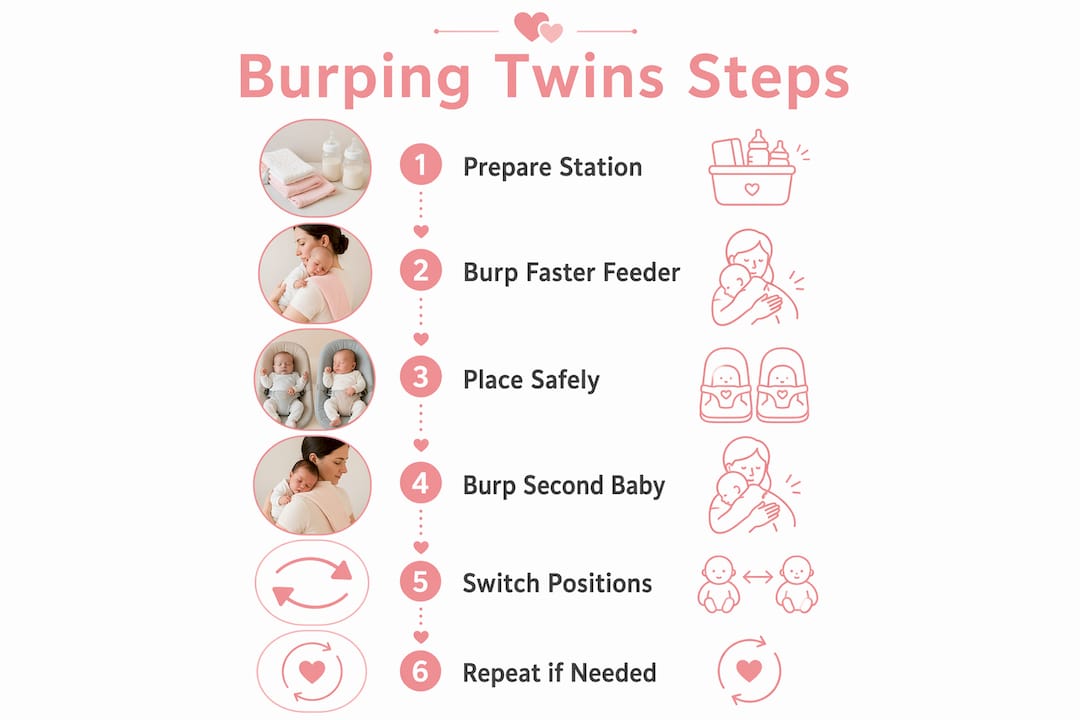
The staggered burping method is the most practical approach for parents managing two babies alone or with one helper. Attempting intense simultaneous burping is stressful and rarely effective. Follow this sequence instead.
- Identify the faster feeder. Watch which baby finishes or slows down first. That baby gets burped first, every time.
- Burp baby one over your shoulder. Hold the baby upright against your chest, chin resting on your shoulder. Pat or rub the mid-back firmly but gently for 1–2 minutes.
- Place baby one safely. Lay the first baby on their back in the bouncy seat or on a firm, flat surface. Do not leave them on an elevated surface unattended.
- Burp baby two using the lap-sit position. Sit the second baby upright on your lap, supporting the chin and chest with one hand. Lean them slightly forward and pat the back with your free hand. This position works well for babies who resist the over-shoulder hold.
- Return to baby one for a settling burp. Once baby two is settled, go back and give baby one a final gentle pat session if they seem unsettled or gassy.
- Watch for completion cues. A successful burp sounds audible. Relaxed body posture, unclenched fists, and calm facial expression all signal that trapped air has been released.
Pro Tip: If a baby resists burping after two minutes, try switching positions. Move from over-the-shoulder to lap-sit, or try holding the baby face-down across your forearm with their head near your elbow. A change in angle often releases a stubborn burp within 30 seconds.
The over-shoulder and lap-sit positions are the two most reliable burping techniques for infants. The face-down forearm hold works as a useful third option for gassy or colicky babies. Rotate through all three before concluding a burp session.
Keeping both twins on the same schedule is what makes this staggered sequence repeatable. When both babies feed at the same time, you always know which one finishes first, and the routine becomes predictable within a few weeks.
What are the most common burping challenges with twins?
Even with a solid routine, problems come up. Knowing how to read them quickly saves you from long crying sessions and wasted energy.
- One twin finishes early and becomes restless. Place the faster feeder in the bouncy seat with a pacifier if needed. A few minutes of calm waiting does not harm the baby and gives you time to finish feeding the second twin before starting burps.
- Signs of unrelieved gas. Watch for a hard, distended belly, legs pulling toward the chest, and high-pitched crying that does not stop after feeding. These signs mean the burp session needs more time or a different position.
- Reflux-sensitive babies. Keep a reflux-prone twin upright for at least 20 minutes after feeding before laying them flat. The lap-sit position works better than over-the-shoulder for babies with reflux because it applies less pressure to the abdomen.
- Burp resistance. Some babies simply do not burp loudly or easily. Partial burping is sufficient when the baby appears content and shows no signs of gas pain. You do not need a perfect, audible burp every single time.
- Parental energy depletion. Night feeds are the hardest. Give yourself permission to do a shorter burp session at 2:00 AM if both babies seem settled. Chasing a perfect burp at 3:00 AM while exhausted helps no one.
The wake one, wake both rule is the single best tool for preventing the worst-case scenario: one baby waking to feed while the other just fell asleep. Transitioning to this rule by weeks 3–4 helps you gain 2–3 hour night sleep stretches and makes the burping sequence far more manageable.
Staying calm during a difficult burping session matters more than technique. Babies sense tension. A slow breath and a steady hand often work better than switching positions repeatedly.
How do you know burping is working, and when does it get easier?
Effective burping produces clear signals. The baby relaxes visibly, stops squirming, and either releases an audible burp or passes gas. Crying that was building during feeding settles within a few minutes of a successful burp session. If crying continues past 10 minutes after feeding ends, gas is likely still trapped and a position change is needed.
The good news is that burping gets easier as your twins grow. By 6–8 weeks, babies feed more efficiently and swallow less air. You can shorten the burp sequence and spend less time on each baby. Many parents reach a rhythm of 2–3 hour feed cycles with about 90 minutes of active time between burp-and-settle cycles.
Pro Tip: Track your twins’ feeding and burping patterns in a simple notes app for the first four weeks. You will spot which twin consistently needs more burping time, which position works best for each, and what time of day gas problems peak. That data makes every session faster.
Watch for these signs that your burping routine is working well:
- Both babies settle within 10 minutes of feeding ending
- Spit-up frequency decreases over the first two months
- Night feeds become shorter as burping needs reduce
- You feel confident moving through the sequence without checking a guide
If one twin consistently shows signs of severe gas pain, excessive spit-up, or arching the back during feeds, speak with your pediatrician. These can be signs of reflux or a feeding issue that needs clinical attention. The signs that twins are feeding adequately are worth reviewing alongside your burping progress to make sure both babies are thriving.
Key Takeaways
The most effective approach to burping twins after simultaneous feeding is a staggered sequence that starts with the faster feeder, uses safe positioning between burps, and adapts as babies mature.
| Point | Details |
|---|---|
| Stagger, don’t simultaneous burp | Burp the faster feeder first, place safely, then burp the second baby. |
| Use the right equipment | Twin Z pillows and bouncy seats create safe resting spots that make the sequence possible alone. |
| Partial burps are acceptable | A content baby with no gas signs does not need a perfect audible burp every time. |
| Routine beats rigid scheduling | A cause-and-effect sequence (feed, burp, settle) produces better results than clock-based timing. |
| Burping needs decrease by 6–8 weeks | Adapt your routine as babies mature and swallow less air during feeds. |
What I’ve learned about burping twins that no one tells you
I want to be honest with you about something most twin parenting content gets wrong. The advice to “burp both babies at the same time” sounds efficient on paper. In practice, it produces two half-burped babies, one stressed parent, and a feeding session that never truly ends. The staggered method feels slower at first. It is not. It is faster because it actually works.
The second thing I have seen parents struggle with is the belief that every burp must be loud and complete. That standard is exhausting and unnecessary. A baby who is calm, relaxed, and not showing gas signs after a gentle two-minute pat session is fine. You are not failing if you do not hear a burp. You are reading your baby correctly.
What actually builds confidence in those early weeks is consistent twin care routines rather than perfect technique. When the sequence is predictable, your body learns it. Your hands move faster. Your babies learn what comes next. That predictability reduces fussiness more than any single burping trick.
Give yourself permission to try different positions, adjust the sequence, and drop steps that do not work for your specific babies. No two sets of twins are identical. The routine you build in week two will look different from the one you use in week eight. That is not failure. That is parenting twins.
— Jay
More twin feeding and care support from Twinsandcounting
Burping is just one piece of the twin care puzzle. Once you have your feeding and burping sequence dialed in, the next step is building a full care routine that keeps both babies comfortable and gives you real rest.

Twinsandcounting has pulled together essential twin care tips that cover feeding schedules, sleep strategies, and the practical logistics that make twin parenting sustainable. Whether you are solo parenting or working with a partner, these guides are built specifically for the twin experience, not adapted from single-baby advice. You will also find honest guidance on twin parent self-care because keeping yourself functional is part of keeping your babies healthy.
FAQ
How do you burp two babies at the same time?
True simultaneous burping is rarely practical or effective. The recommended method is staggered: burp the faster feeder first, place that baby safely in a bouncy seat, then burp the second baby.
What is the best burping position for newborn twins?
The over-the-shoulder hold and the lap-sit position are the two most reliable techniques for newborn twins. The face-down forearm hold works well as a backup for gassy or resistant babies.
How long should you burp a twin after feeding?
Aim for 1–2 minutes per position. If no burp occurs and the baby appears content with no gas signs, a partial burp is acceptable. Burping needs decrease significantly by 6–8 weeks as babies feed more efficiently.
Does the wake one, wake both rule help with burping twins?
Yes. Keeping both twins on the same feeding schedule means both need burping at roughly the same time, making the staggered sequence predictable and repeatable rather than reactive.
When should I call the pediatrician about burping issues?
Contact your pediatrician if one or both twins show persistent arching of the back during feeds, excessive spit-up after every session, or a hard distended belly that does not resolve after burping. These can indicate reflux or another condition that needs clinical evaluation.