
You are not imagining how hard the nights are. Twin overnight sleep patterns push even the most prepared parents to their limits, because you are managing two completely separate little people who did not read the same sleep manual. The good news? There is a real developmental arc at work here. Understanding what typical infant sleep consolidation looks like for twins, and knowing which strategies actually move the needle, makes the whole experience feel far less like chaos and far more like something you can work with.
Table of Contents
- Key takeaways
- Typical twin overnight sleep patterns by age
- Safe sleep setups for twins overnight
- Strategies for syncing the twin sleep schedule
- Sleep training methods that work for twins
- Overnight challenges unique to twins
- My honest take on managing twin sleep
- How Twinsandcounting can help you tonight
- FAQ
Key takeaways
| Point | Details |
|---|---|
| Sleep duration decreases with age | Twins sleep 16-17 hours as newborns, gradually consolidating to 12-13 hours by 12 months. |
| Safe sleep comes first | Room-sharing without bed-sharing on firm, flat surfaces is the safest overnight setup for twins. |
| Synchronization is possible | Keeping feedings and routines within a 10-20 minute window is the most effective way to align twin schedules. |
| Sleep training takes longer with twins | Expect more time and patience than with singletons, and plan for two-adult nights when starting. |
| Individual differences are normal | Twins will not always sleep identically, and forcing perfect alignment can create more stress than it solves. |
Typical twin overnight sleep patterns by age
When people ask “how do twins sleep?”, the honest answer is: just like any other baby, but twice. The clinical term for what you are tracking is infant sleep consolidation, the gradual process by which fragmented newborn sleep organizes into longer stretches with fewer night wakings. Twins follow the same developmental path as singletons, but parents face the added complexity of two children at different points in that path on any given week.
Here is what the research shows:
| Age range | Total daily sleep | Longest overnight stretch | Avg. night wakings |
|---|---|---|---|
| 0-2 months | 16-17 hours | 2-3 hours | ~1.7 per night |
| 3-5 months | 14-15 hours | 4-5 hours | ~1.2 per night |
| 6-8 months | 13-14 hours | 5-6 hours | ~1.0 per night |
| 9-12 months | 12-13 hours | 8-9 hours | ~0.7 per night |
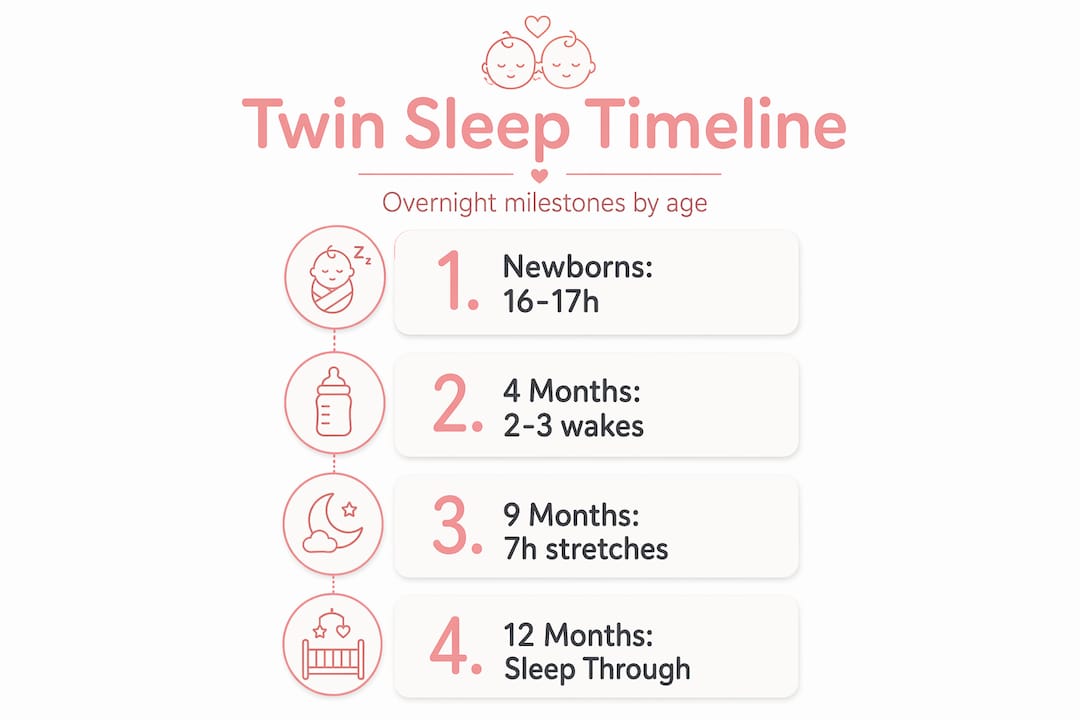
According to pediatric sleep research, newborns average 16-17 hours of sleep daily, with that number dropping to 12-13 hours by 12 months. Night wakings also decline significantly across the first year, from roughly 1.7 per night in the earliest weeks down to about 0.7 by the time a baby reaches 12 months.
What this means for you practically:
- Twin bedtime patterns in the newborn phase will feel relentless. Two-hour wake windows and frequent feeds are normal, not a sign something is wrong.
- The nocturnal habits of twins often diverge in the middle months (3 to 6 months) even when you are doing everything the same for both babies.
- Daytime naps decrease in number as overnight sleep consolidates. Two naps typically replace three by around 6 to 8 months.
- The twin newborn sleep schedule shifts considerably between months two and four. That transition period is genuinely the hardest stretch for most parents.
The most reassuring thing you can hold onto: sleeping through the night becomes progressively more common by the one-year mark. You are not stuck here forever.
Safe sleep setups for twins overnight
Before any scheduling strategy matters, the sleep environment has to be right. This is not optional, and it is worth getting very specific about what “safe” actually means for twins sharing a room.
The American Academy of Pediatrics (AAP) recommends back sleeping for all infants on firm, non-inclined surfaces. According to AAP safe sleep guidelines, room-sharing without bed-sharing reduces SIDS risk by up to 50%. That is a significant number, and it is the single most impactful change you can make.
Here is what a safe twin sleep environment looks like:
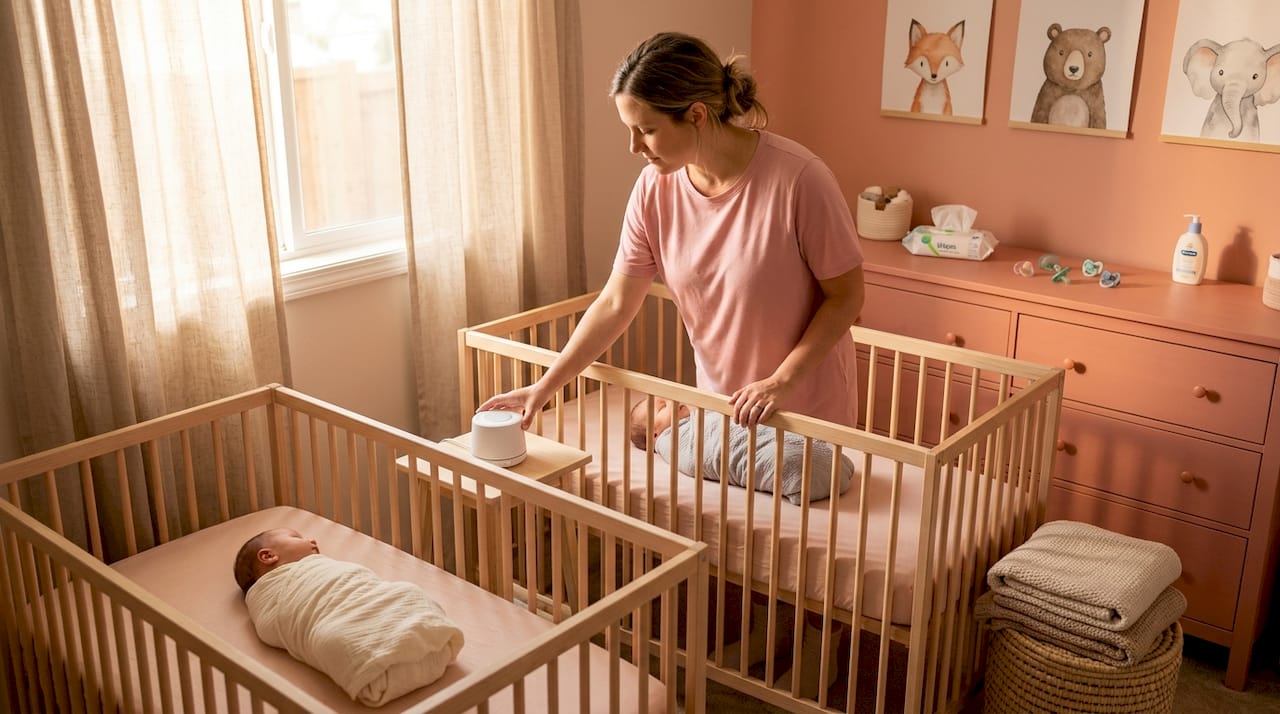
- Separate sleep surfaces. Each twin needs their own firm, flat space. A shared crib works briefly in the newborn phase, but separate cribs in the same room is the recommended setup beyond the first few weeks.
- No soft bedding. No pillows, no blankets, no bumper pads. A sleep sack is the safest way to keep babies warm without adding suffocation risk.
- Back position only. Every sleep, every time. Once babies can roll both ways independently, you do not need to reposition them, but always start them on their backs.
- Clear of loose items. Stuffed animals, positioners, and wedges do not belong in the sleep space, no matter how well-intentioned.
A note on co-bedding: placing newborn twins together in one crib is common and some research suggests it may help regulate body temperature and reduce stress in the earliest days. It is not a long-term solution, though. Once babies begin rolling or showing increased movement, separate surfaces are the only safe option.
Pro Tip: Place white noise between the two cribs rather than outside the room. A machine positioned centrally creates a sound buffer between the babies and is far more effective at masking one twin’s cries from the other.
Strategies for syncing the twin sleep schedule
Synchronization is the holy grail of twin parenting, and it is completely achievable with the right approach. The key insight that most sleep guides miss: successful sleep synchronization depends on linking feeding and soothing cycles as a sequence, not on watching the clock obsessively.
Here is a practical framework for building a synchronized sibling sleep routine:
- Use a “wake one, wake both” rule for night feeds. If one twin wakes to feed in the early months, wake the other within 10 to 15 minutes. This keeps schedules aligned metabolically and prevents one twin from being up every 90 minutes through the night.
- Start every bedtime sequence together. Bath both babies, dress both in pajamas, feed both in the same 20-minute window. The sequence itself becomes the sleep cue, not just the timing.
- Build a predictable bedtime routine that takes 20 to 30 minutes. Something like bath, massage, pajamas, feeding, and one short calming activity. Consistent bedtime routines cue the brain for sleep and help prevent overtiredness, which is one of the main reasons twins fight sleep at night.
- Use white noise strategically. White noise masks one twin’s crying from the other and creates a neutral audio environment that signals sleep time. Keep it at a safe volume, roughly 50 to 60 decibels, about the level of a soft shower.
- Anchor wake time, not just bedtime. Consistent morning wake times regulate the circadian clock faster than evening adjustments alone. Getting both babies up at the same time each morning sets the entire day’s schedule in motion.
- Allow a 10 to 20 minute window. Perfection is not the goal. If one twin is asleep ten minutes before the other, that counts. Rigid same-minute timing creates unnecessary stress for you and the babies.
Pro Tip: If you are managing twins solo at night, set up feeding stations in advance. Two nursing pillows, two pre-made bottles if formula-feeding, and everything within arm’s reach mean you can tandem feed without getting up multiple times.
Sleep training methods that work for twins
Sleep training with two babies requires everything a singleton approach requires, plus patience you did not know you had. The commonly used methods all work for twins with some adaptation.
The four main approaches you will encounter are the No Tears method, the Chair Method, Pick Up Put Down, and the Ferber method (graduated extinction). Each has specific pros and cons when you are coordinating two babies. Sleep training should generally start between 4 and 6 months, when babies are developmentally ready for longer independent sleep stretches.
- No Tears works well for sensitive parents or twins who escalate quickly when left. It is slower but gentler. The downside with twins is that you may spend two to three weeks going back and forth between cribs.
- The Chair Method (also called Sleep Lady Shuffle) involves gradually moving your chair farther from the crib each night. With twins, you sit between both cribs and offer minimal reassurance to each.
- Ferber involves timed check-in intervals that get progressively longer. Many twin parents find this the most practical approach because it gives you a structured timeline and reduces the number of room entries.
- Pick Up Put Down is most effective under five months and tends to become counterproductive as babies get older and more stimulated by being held.
A critical note: twins often take longer to sleep train than singletons because one baby’s crying genuinely disrupts the other. Plan for this. Temporary room separation during the initial training period can help, then reunite them once each baby has learned to self-soothe.
Pro Tip: If at all possible, have two adults present for the first three to five nights of any sleep training method. One person cannot effectively manage check-ins for two babies simultaneously while staying calm and consistent.
Overnight challenges unique to twins
One of the most frustrating scenarios twin parents face is the chain reaction: Twin A wakes, cries, wakes Twin B, and now you have two upset babies at 2 a.m. This is a normal feature of twin overnight life, not a permanent sentence.
Some practical ways to reduce and manage it:
- Use strategic crib placement. Positioning cribs farther apart in the room reduces sound transmission. Separate cribs with white noise between them form a simple barrier that makes a real difference.
- Respond quickly to the waking twin. The faster you settle the waking baby, the lower the chance they wake their sibling. Speed matters more than method here.
- Resist the urge to rescue the sleeping twin. If Twin B does not wake immediately, do not check on them. Movement and noise near a sleeping baby is more likely to wake them than leaving them undisturbed.
- Accept that some differences are permanent. Some twins simply have different sleep temperaments. One might be a deeper sleeper from birth. Forcing both into an identical schedule when one is genuinely not ready creates more overnight chaos, not less.
Recognize that comparing overnight waking differences to twin temperament alone is a mistake. Always check the sleep environment first. A rolled blanket, an uncomfortable temperature, or an unsafe positioning issue can look exactly like a fussy temperament problem.
My honest take on managing twin sleep
I’ve talked with hundreds of twin parents, and the pattern I keep seeing is this: the ones who struggle most are the ones waiting for twin sleep to look like singleton sleep. It does not, and expecting it to is the fastest route to burnout.
What I’ve found actually helps is lowering the bar for what a “good night” means. If both babies slept in three-hour stretches and you got four hours total, that is a win. Progress is not linear. A week of great sleep can be followed by a regression that feels like you are back at week two.
The other thing I want to say plainly: do not compare your twins to each other harshly. I’ve seen parents panic because Twin A is sleeping six hours and Twin B is still waking three times at eight months. That can be completely within normal range. Each baby is developing uniquely, even when they are genetically identical.
You will get through the hard nights. The exhaustion is real. So is the progress. Build your community, take the help when it is offered, and please stop trying to do every night shift alone. Asking for support is not weakness. It is the only way to stay functional enough to actually enjoy these two remarkable people you are raising.
— Jay
How Twinsandcounting can help you tonight
If you are staring at this article at 3 a.m. while one twin finally sleeps and the other is making worrying noises, you belong here. Twinsandcounting was built specifically for moments like this one.

The site offers detailed, twin-specific guidance you will not find on general parenting resources. From getting both babies to sleep through the night to building a schedule that actually holds past week three, every resource is designed with the reality of two babies in mind. You can also explore nine proven strategies for managing twin care across sleep, feeding, and daily routines. You do not have to piece this together alone.
FAQ
What are normal twin overnight sleep patterns?
Newborn twins wake frequently, averaging about 1.7 times per night in the first two months. By 12 months, night wakings drop to roughly 0.7 per night as sleep consolidates into longer stretches.
Should twins share a crib at night?
Co-bedding is sometimes used in the newborn phase but is not recommended long-term. The AAP advises separate sleep surfaces in the same room for the safest overnight setup.
How do you sync twin sleep schedules?
Keep feeding and bedtime routines within a 10 to 20 minute window for both twins, and wake both babies for night feeds in the early months to prevent schedules from drifting apart.
When can twins sleep through the night?
Most babies, including twins, begin sleeping through the night more consistently around 9 to 12 months. Individual variation is normal, and breastfed twins may have more night wakings than formula-fed babies.
What do you do when one twin wakes the other?
Respond quickly to the waking baby to settle them before the noise escalates. Using white noise between cribs and keeping cribs spaced apart significantly reduces these chain-reaction wake-ups over time.