

A twin split schedule is a caregiving strategy where twins’ sleep and feeding times are intentionally staggered to distribute care responsibilities and reduce parental exhaustion. Rather than waking and feeding both babies at the exact same moment, you offset their routines by 15–30 minutes or divide overnight duties into caregiver shifts. The goal is simple: make twin care survivable. Twinsandcounting hears from parents every week who are drowning in simultaneous demands, and the split schedule is one of the most practical tools available to bring order back to the chaos.
What is a twin split schedule and how does it work?
A twin split schedule staggers twins’ sleep and feeding times rather than fully synchronizing them, aiming to make care manageable by distributing demands across time. The most common variation offsets each baby’s routine by 15–30 minutes. That small gap means you are never handling two hungry, crying babies at the exact same second.
The second major variation is the night shift system. One caregiver takes all overnight duties from 8 PM to 1 AM, and the other takes over from 1 AM to 8 AM. Dividing night duties into time blocks like these gives each parent a protected sleep stretch, which is the difference between functioning and burning out.

A third approach is task-based division. Instead of splitting by time, one parent handles feeding while the other manages diapering, burping, and resettling. This works especially well for breastfeeding families where one parent cannot take over feeds but can handle everything else.
Here is a simple example of how a staggered morning routine might look:
- 6:00 AM: Baby A wakes. Feed, diaper, and resettle Baby A.
- 6:20 AM: Baby B wakes. Feed, diaper, and resettle Baby B.
- 7:30 AM: Baby A goes down for first nap.
- 7:50 AM: Baby B goes down for first nap.
- 8:00 AM: Parent gets a short rest window before the cycle repeats.
Pro Tip: Write your shift agreement down before the first night. Verbal plans fall apart at 3 AM when everyone is exhausted. A simple note on the fridge keeps both caregivers accountable.
The primary goal of any twin schedule is protecting family rest and functionality, not enforcing rigid timing. Keep that priority front and center when you build your plan.
Twin split vs. synchronized schedule: which is better?
Synchronized scheduling means feeding and putting both twins to sleep at the same time. The twin split schedule means staggering those same events. Both approaches work. The right choice depends entirely on your family’s caregiving setup.
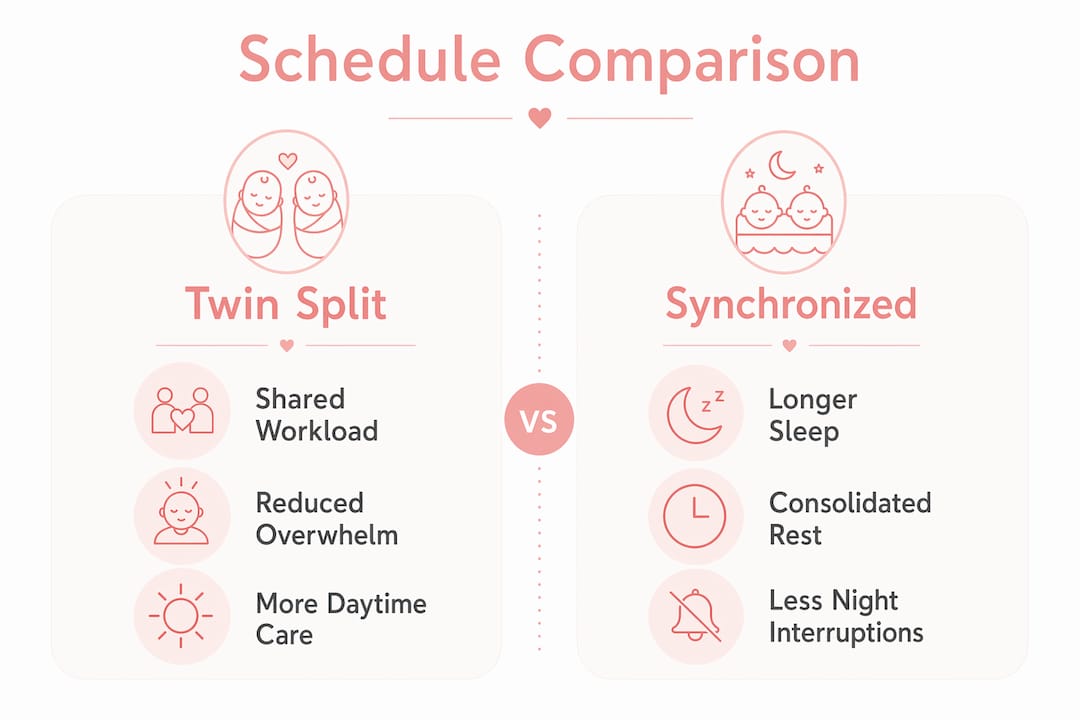
Synchronizing twins’ sleep cycles tends to yield about 5.1 hours of uninterrupted parental sleep compared to 3.2 hours with an unsynchronized approach. That is a meaningful difference when you are running on empty. Parents using synchronization report longer consolidated rest because both babies are down at the same time.
The split schedule trades that consolidated rest for something different: shared workload and reduced simultaneous pressure. You are never managing two babies in crisis at once. That trade-off matters most when you have two caregivers available and one of them needs a real sleep block to function the next day.
Here is a direct comparison to help you decide:
| Factor | Synchronized Schedule | Twin Split Schedule |
|---|---|---|
| Parental sleep quality | Longer uninterrupted stretches | Shorter but more evenly distributed |
| Simultaneous demands | High (both babies need care at once) | Low (staggered timing reduces overlap) |
| Best for | Single caregivers or solo parents | Two-caregiver households |
| Flexibility | Less flexible, requires strict timing | More flexible, adapts to baby cues |
| Workload distribution | Concentrated bursts | Spread across shifts or tasks |
Key advantages of the split approach include:
- Reduced caregiver fatigue during overnight hours when both parents share the load
- Lower simultaneous demand so you can give each baby focused attention
- Flexible timing that adapts to each twin’s individual wake windows and cues
- Task division options that let non-nursing partners contribute meaningfully at night
The synchronized approach wins on total sleep time. The split approach wins on sustainability when two caregivers are present. Many families at Twinsandcounting end up blending both, syncing during the day and splitting overnight duties.
How to use a twin split schedule: practical steps
Building a workable split schedule starts with one honest conversation: who is available, when, and for how long. Two working parents have different constraints than one stay-at-home parent. Your schedule has to fit your actual life, not an idealized version of it.
Step 1: Map your wake windows. Wake windows are the stretches of time a baby can stay awake between sleep periods, and they increase with age. A newborn might manage 45–60 minutes awake. A four-month-old can handle 90 minutes. Adjust your stagger timing in 15-minute increments as your twins grow. Ignoring wake windows is the single most common reason split schedules fall apart.
Step 2: Build around activity sequences, not clock times. Routines built around consistent sequences of feed, diaper, burp, and sleep matter more than hitting a specific time on the clock. When timing floats due to a fussy baby or a longer feed, the sequence keeps both twins and parents grounded.
Step 3: Assign your shifts or tasks. Decide whether you are splitting by time block or by task. Write it down. Revisit it every two weeks as the babies change.
Step 4: Build in a handoff ritual. A five-minute overlap at shift change lets the incoming caregiver get a quick update. You will catch problems faster and avoid duplicate efforts.
Step 5: Plan for drift. Schedules shift. Babies grow. Build a review point into your calendar every two weeks so small drifts do not become full collapses.
Pro Tip: Use a shared notes app like Google Keep or Apple Notes to log each baby’s last feed, diaper, and sleep time. Both caregivers stay informed without waking each other up to ask.
Check out the twin newborn sleep guide at Twinsandcounting for age-specific wake window charts that make Step 1 much easier.
What are the biggest challenges with split schedules?
Split schedules work well in theory. In practice, several predictable problems come up. Knowing them in advance means you can solve them before they derail your routine.
-
Schedule drift. Babies’ natural rhythms shift constantly, especially during growth spurts and teething. Growth spurts and regressions cause schedule drift, and parents who agree in advance to adapt shifts based on baby needs rather than rigid timing avoid burnout and schedule collapse.
-
Wake window mismanagement. Split scheduling without managing wake windows often fails because babies’ sleep pressures get out of sync, leading to longer bedtimes and more night waking. Keep wake windows consistent even when other timing floats.
-
Caregiver fatigue and resentment. An unbalanced split feels unfair fast. Revisit your division of labor regularly. If one person is consistently getting less sleep, adjust the shift boundaries.
-
Bedtime resistance. When one twin’s schedule drifts earlier or later than the other’s, bedtime can stretch into a long, frustrating process. Watch for signs of overtiredness like eye rubbing, fussiness, and reduced activity, and move bedtime earlier before resistance builds.
-
Communication breakdown. Two caregivers managing separate shifts need to stay aligned. A missed handoff note or an assumed task can mean a baby goes too long without a feed or both parents attempt the same task at once.
The fix for most of these problems is the same: adaptive communication and a willingness to tweak the plan continuously as babies grow. No split schedule survives contact with real twins without regular adjustment. That is not failure. That is the process.
When you need to re-synchronize twins after a period of drift, do it gradually. Shift one twin’s timing by 10 minutes every two days rather than forcing an abrupt change. Abrupt resets cause more resistance than the drift itself.
For a deeper look at overnight patterns, the twin overnight sleep patterns guide at Twinsandcounting covers what to expect at each stage and how to adjust your approach accordingly.
Key takeaways
A twin split schedule works best when wake windows stay consistent, caregivers communicate clearly, and the plan adapts as babies grow.
| Point | Details |
|---|---|
| Split schedule definition | Stagger twins’ feeds and sleep by 15–30 minutes or divide overnight care into caregiver shifts. |
| Wake windows are non-negotiable | Managing consistent wake windows prevents sleep pressure drift and reduces night waking. |
| Synchronized sleep yields more rest | Synced schedules average 5.1 hours of uninterrupted sleep versus 3.2 hours for split approaches. |
| Task division beats time division | Splitting by task (feeding vs. diapering) works better for breastfeeding families than strict time blocks. |
| Flexibility prevents collapse | Agreeing in advance to adapt shifts during regressions and growth spurts protects the whole system. |
What i have learned from twin split schedules
By Jay
After working with hundreds of twin families, the pattern I see most often is this: parents spend the first two weeks trying to follow a split schedule perfectly, then abandon it entirely when it stops working. The problem is not the schedule. The problem is treating it like a fixed contract instead of a living document.
The families who thrive with split scheduling are not the ones with the most detailed plans. They are the ones who check in with each other every few days and ask one simple question: is this still working? That question alone prevents most of the burnout I see.
The other thing I would push back on is the idea that synchronized scheduling is always the gold standard. Yes, it produces longer sleep stretches on paper. But for a family where one parent works nights or one caregiver is recovering from a C-section, synchronization can be physically impossible. The split schedule is not a compromise. For many families, it is the right tool.
Be patient with yourself. You are managing two separate human beings with two separate nervous systems. Some days the schedule holds. Some days it does not. Both outcomes are normal.
— Jay
Find more support for your twin routine
Managing two babies on any schedule takes more than a good plan. It takes the right resources behind you.

Twinsandcounting is built specifically for parents in your position, with guides covering everything from night feeding strategies to full care routines. If you are just getting started or feeling overwhelmed, the 9 essential tips for twin care is the best place to begin. It covers the practical foundations that make every schedule, split or synchronized, more manageable from day one.
FAQ
What is the twin split schedule definition?
A twin split schedule is a caregiving routine that staggers twins’ sleep and feeding times by 15–30 minutes or divides overnight care into caregiver shifts, rather than handling both babies simultaneously.
Is a split schedule better than a synchronized schedule for twins?
Synchronized schedules produce longer uninterrupted sleep stretches, averaging 5.1 hours versus 3.2 hours for split approaches. Split schedules work better for two-caregiver households where sharing the overnight workload is the priority.
How do wake windows affect a twin split schedule?
Wake windows are the time a baby stays awake between sleep periods, and ignoring them causes sleep pressure to drift out of sync between twins. Keeping wake windows consistent while allowing other timing to float is the key to a stable split schedule.
Can a solo parent use a twin split schedule?
A solo parent can use a staggered timing approach to reduce simultaneous demands during the day, though the night shift system requires two caregivers. The solo parenting twins guide at Twinsandcounting covers adapted strategies for single-caregiver households.
How do i fix schedule drift in a twin split routine?
Shift one twin’s timing by 10 minutes every two days to gradually re-synchronize without triggering resistance. Agreeing in advance to adapt shifts during growth spurts and regressions prevents drift from becoming a full schedule collapse.