

Twin pregnancies require extra monitoring because they carry a significantly higher risk of complications than singleton pregnancies, and early detection is the single most effective tool for protecting both mother and babies. Over 50% of twin births occur before 37 weeks, compared to roughly 10% for singletons. That gap alone explains why specialized clinical standards exist specifically for twin care. Whether you are newly pregnant with twins or preparing for life with two newborns, understanding the medical rationale behind increased surveillance helps you show up as an informed, confident parent.
Why twins need extra monitoring: the core health risks
Twin pregnancies carry a distinct set of risks that make routine prenatal care insufficient on its own. The most significant is preterm birth. More than half of twin births are preterm, and cervical length scans between 16 and 20 weeks are standard practice to catch early warning signs. Gestational diabetes screening between 24 and 28 weeks is also part of the clinical protocol for twin pregnancies.
Beyond preterm birth, twins face a higher rate of growth restriction, preeclampsia, and gestational diabetes than singletons. These conditions can develop quickly and without obvious symptoms, which is exactly why frequent checkups matter. Waiting for symptoms to appear is not a safe strategy when two babies are involved.

The most serious complication unique to twins is twin-to-twin transfusion syndrome, or TTTS. TTTS occurs when blood flow between twins sharing a placenta becomes unequal, causing one twin to receive too much blood and the other too little. Left undetected, TTTS can be life-threatening for both babies. Specialized ultrasounds are the primary tool for catching it early.
During labor, the risks do not stop after the first baby is born. The second twin’s condition can change rapidly after the first delivery, which is why twin births require continuous electronic fetal monitoring and a specialist team on standby. This level of clinical attention reflects just how different twin care requirements are from a standard birth.
Key risks that require active monitoring include:
- Preterm birth: Affects more than half of all twin pregnancies
- Twin-to-twin transfusion syndrome (TTTS): Occurs in monochorionic twins sharing a placenta
- Preeclampsia: Elevated blood pressure that can escalate without warning
- Fetal growth restriction: One or both twins may not grow at the expected rate
- Gestational diabetes: Screened between 24 and 28 weeks as standard practice
How does chorionicity change your monitoring schedule?
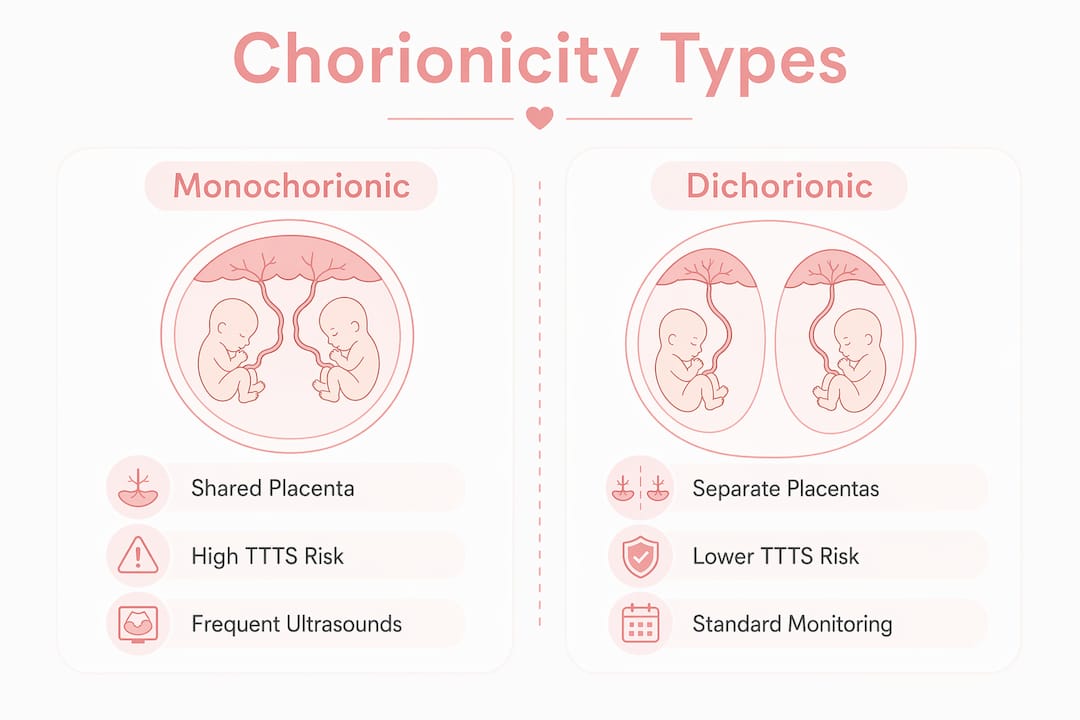
Chorionicity refers to whether twins share a placenta (monochorionic) or each have their own (dichorionic). Early determination of chorionicity is the single most important factor in planning your monitoring schedule. It dictates how often you will have ultrasounds and what your care team will be watching for at each visit.
Monochorionic twins
Monochorionic twins share one placenta, which creates a direct physical connection between them. Ultrasound monitoring every two weeks starts at 16 weeks for monochorionic twins. Each scan checks for signs of TTTS, fluid level imbalances, and growth differences between the two babies. Missing even one scan in this schedule carries real risk.
Dichorionic twins
Dichorionic twins each have their own placenta, which reduces but does not eliminate the risk of complications. Scans for dichorionic twins typically begin around 24 weeks and occur every four weeks. Growth, placental health, and fluid levels are still assessed at each visit, but the urgency of the schedule is lower than for monochorionic pairs.
| Feature | Monochorionic twins | Dichorionic twins |
|---|---|---|
| Placenta | Shared | Separate |
| Scan frequency | Every 2 weeks from 16 weeks | Every 4 weeks from 24 weeks |
| TTTS risk | Yes, requires active surveillance | No |
| Overall risk level | Higher | Moderate |
Pro Tip: Ask your OB or midwife to confirm chorionicity at your first ultrasound, ideally before 14 weeks. This single piece of information shapes your entire prenatal monitoring plan.
What practical challenges come with monitoring twin babies after birth?
The monitoring demands do not end at delivery. Postpartum care for twin babies is intensive, and the challenges of raising twins in those first weeks are real. Pediatric checkups happen more frequently for twins, especially if they were born preterm or at low birth weight. Weight gain, feeding output, and developmental milestones all need to be tracked for two babies simultaneously.
Feeding is one of the most demanding areas. Tracking feeding schedules, diaper output, and weight gain for two newborns requires a level of detail that can feel relentless. A feeding log or tracking app is not optional for most twin parents. It is the difference between catching a problem early and missing it entirely.
Safe sleep is another area where twin-specific guidance matters. AAP guidelines are clear: twins must sleep on separate, firm, flat surfaces. Co-bedding is not recommended, regardless of how convenient it might seem in the middle of the night. Preterm birth and low birth weight, both more common in twins, increase the risk factors that safe sleep practices are designed to address. For a deeper look at setting up safe sleep environments, Twinsandcounting has a detailed guide on safe sleep for twins.
A numbered approach to postpartum monitoring helps parents stay organized:
- Track every feeding. Log the time, duration, and which baby fed. This data helps your pediatrician spot weight gain issues fast.
- Monitor diaper output daily. Wet and dirty diapers are the clearest early indicators of adequate feeding and hydration.
- Attend all scheduled pediatric visits. Twin babies often need more frequent weight checks than singletons, particularly in the first month.
- Watch for developmental differences. Twins can develop at different rates. Flag any significant gaps to your pediatrician early.
- Prioritize your own mental health. Parental mental load with twins is heavier than most parents anticipate. Professional postpartum support is a necessity, not a luxury.
Pro Tip: Set up a shared digital log with your co-parent or support person so both of you can see feeding and sleep data in real time. This prevents double-feeding one baby and missing the other.
What strategies actually help parents manage twin monitoring demands?
Managing the monitoring demands of two babies requires a system, not just good intentions. The most effective strategy is twin-chronization, which means aligning both babies’ feeding and sleep schedules. When both babies eat and sleep at the same time, you create windows to rest, track data, and function as a human being. Without schedule alignment, you are essentially running two separate newborn care operations simultaneously.
Lactation consultants with experience in multiples are a genuinely underused resource. Breastfeeding twins involves different positioning, supply demands, and timing than feeding a single baby. A consultant who has worked with multiples will give you practical guidance that general breastfeeding advice simply does not cover. Twinsandcounting covers postpartum support resources specifically designed for parents of multiples.
Knowing when to call the doctor is a skill worth developing early. For twin babies, the thresholds for concern are lower than for singletons, particularly if they were born preterm. Fever, poor feeding, unusual lethargy, or significant weight loss in either baby warrants a call, not a wait-and-see approach.
Key strategies that reduce the monitoring burden:
- Use a tracking app. Log feeds, diapers, and sleep for both babies in one place. Many apps allow two profiles under one account.
- Wake both babies for feeds. If one twin wakes to eat, wake the other. This keeps schedules aligned and prevents one baby from falling behind on intake.
- Build a support network early. Monitoring two differing developmental trajectories is a major stressor. Friends, family, and professional support all reduce the load.
- Know your pediatrician’s after-hours line. Twin parents use it more than singleton parents. Have the number saved before you leave the hospital.
Pro Tip: Schedule both twins with the same pediatrician at the same appointment time. This saves you from making two separate trips and lets the doctor compare growth and development side by side.
Key takeaways
Twin pregnancies and infancy require a higher level of medical and parental monitoring because the risks of complications are substantially greater than in singleton pregnancies, and early detection is the most effective way to protect both babies.
| Point | Details |
|---|---|
| Preterm birth risk is high | Over 50% of twin births are preterm, making prenatal surveillance non-negotiable. |
| Chorionicity determines scan frequency | Monochorionic twins need scans every 2 weeks from 16 weeks; dichorionic twins every 4 weeks from 24 weeks. |
| Safe sleep rules are strict | AAP guidelines require separate, firm sleep surfaces for each twin, with no co-bedding. |
| Postpartum tracking is critical | Feeding logs and diaper counts for two babies help catch health issues before they escalate. |
| Twin-chronization reduces exhaustion | Aligning both babies’ schedules is the most effective way to manage simultaneous care demands. |
Why I think parents underestimate the monitoring piece
Most parents I talk to come into twin pregnancy focused on logistics: two car seats, two cribs, double the diapers. The monitoring side catches them off guard. Not because they are not paying attention, but because nobody tells them clearly enough how different the clinical picture is for twins.
The chorionicity conversation is a perfect example. I have seen parents reach 20 weeks without fully understanding whether their twins are monochorionic or dichorionic, and therefore without understanding why their scan schedule looks so different from what their friends experienced. That gap in understanding creates anxiety. Knowing the reason behind every extra scan, every additional blood draw, every specialist referral makes the whole process feel less like something happening to you and more like something you are actively managing.
The postpartum monitoring piece is where I see the most underestimation. Parents expect the hard part to end at delivery. For twin parents, a new kind of hard part begins. Tracking two babies’ intake, output, weight, and development simultaneously is genuinely demanding work. The parents who handle it best are not the ones who try to do it all from memory. They are the ones who build systems, ask for help early, and treat professional support as a tool rather than a sign of struggle.
Proactive monitoring does not mean living in fear. It means you catch problems when they are small, which is exactly when they are easiest to fix. That is the real reason why twins need extra monitoring. It is not about worst-case scenarios. It is about giving two babies the best possible start.
— Jay
Twinsandcounting has the twin care resources you need
Raising twins is double the work and double the reward. Getting the monitoring piece right, both prenatally and after birth, sets the foundation for healthier babies and a more confident you.

Twinsandcounting is built specifically for parents navigating the unique demands of twin care. From practical tips for caring for twins to expert guidance on feeding, sleep, and developmental milestones, the site covers what generic parenting resources miss. Whether you are still pregnant or already in the thick of newborn twin life, you will find real, specific advice that actually applies to your situation. Explore the guides, connect with the community, and know that you are not doing this alone.
FAQ
Why do twins need more prenatal appointments than singletons?
Twin pregnancies carry a higher risk of preterm birth, growth restriction, and complications like TTTS, all of which require regular ultrasound surveillance to detect early. Singleton pregnancies do not carry the same level of risk, so their monitoring schedules are less intensive.
What is twin-to-twin transfusion syndrome?
TTTS is a condition where blood flow between monochorionic twins becomes unequal through shared placental vessels, causing one twin to receive too much blood and the other too little. It is detected through ultrasound and requires prompt medical intervention.
How often should monochorionic twins have ultrasounds?
Monochorionic twins require ultrasound monitoring every two weeks starting at 16 weeks to screen for TTTS and other complications related to their shared placenta.
Can twins share a sleep surface in the same crib?
AAP guidelines recommend against co-bedding for twins. Each baby needs a separate, firm, flat sleep surface to reduce the risk of suffocation and other sleep-related hazards, particularly given the higher rates of preterm birth and low birth weight in twins.
When should twin parents seek postpartum professional support?
Postpartum professional support, including lactation consultants and mental health counselors, is recommended from the start rather than as a last resort. The mental and physical demands of monitoring and caring for two newborns simultaneously make early support a practical necessity.