
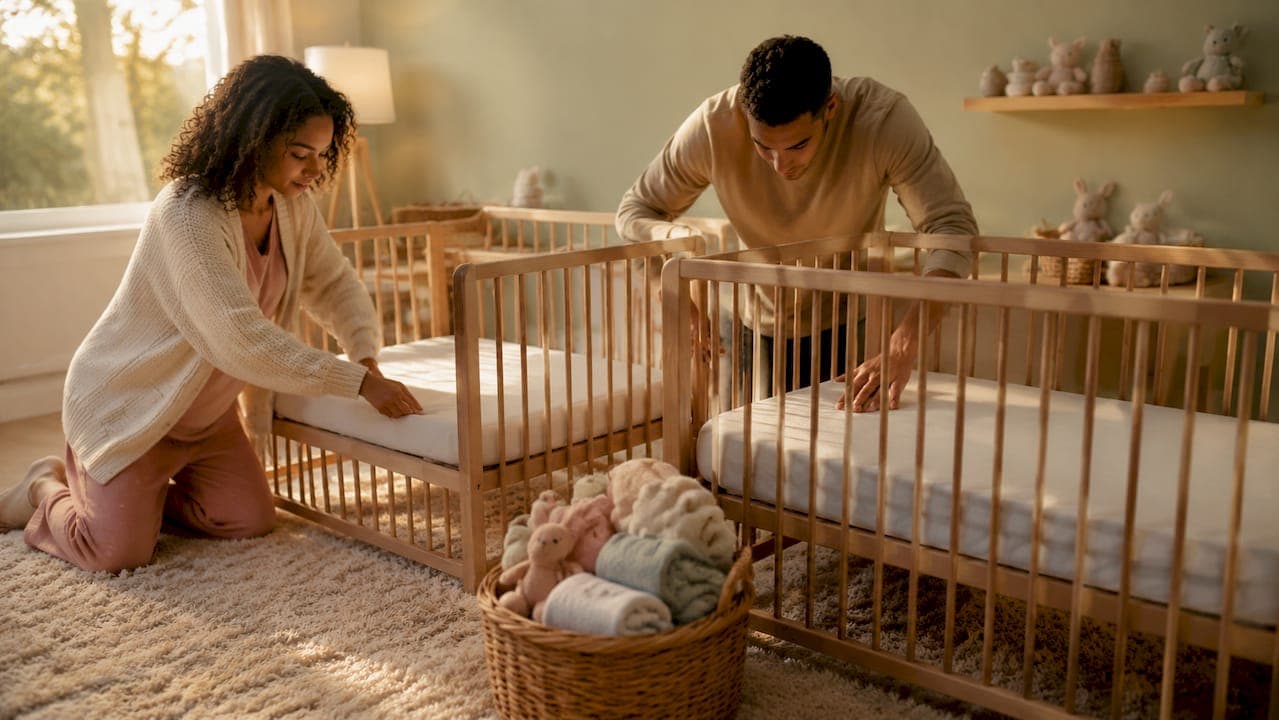
Safe sleep for twins is defined as placing each baby separately on a firm, flat, bare surface on their back, every single time they sleep. The American Academy of Pediatrics (AAP) sets the standard here, and those guidelines apply to each twin individually, not as a shared arrangement. Safe sleep twins explained simply means the same rules, twice the setup. You get double the joy with twins, but you also get double the responsibility when it comes to protecting their sleep environment. This guide walks you through exactly what the AAP recommends, why co-bedding is riskier than it looks, and how to build a sleep setup that works for your family without cutting corners.
What are the aap’s safe sleep guidelines for twins?
The AAP’s safe sleep guidance applies to each twin individually, with no exceptions for multiples. Every recommendation that applies to a singleton baby applies to both of your babies, separately and simultaneously. That framing matters because it removes any temptation to treat twins as a special case that earns a workaround.
Here is what the AAP requires for every sleep period:
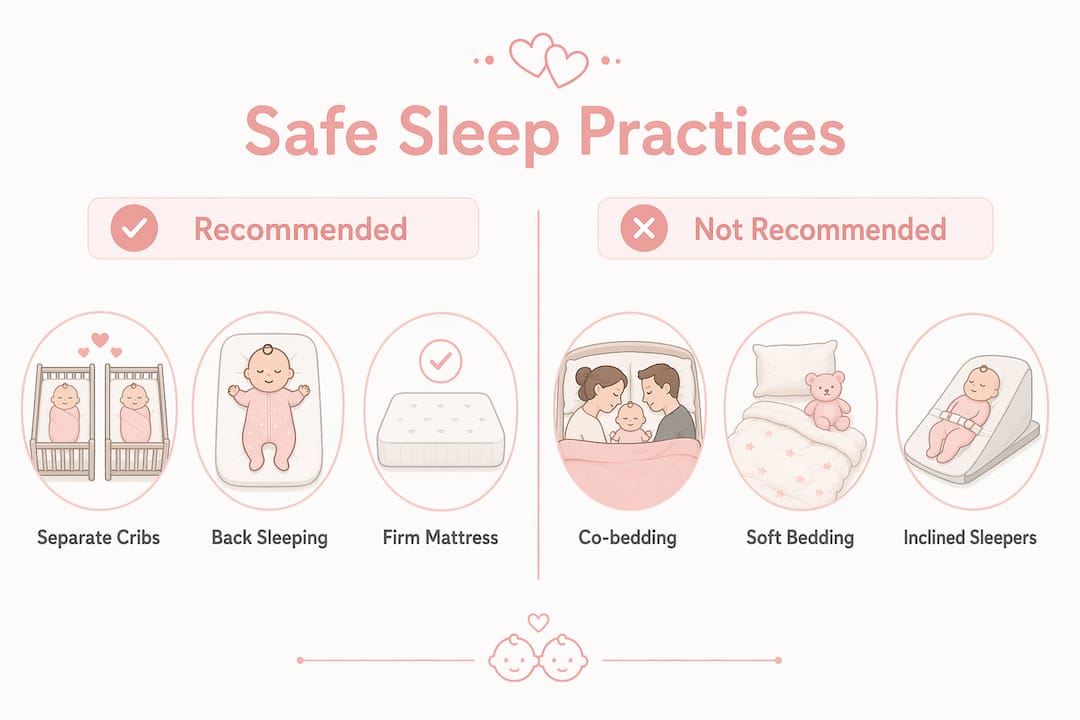
- Back to sleep, every time. Place each twin on their back for every nap and every nighttime sleep, from birth until their first birthday.
- Firm, flat, non-inclined surface. Each baby needs their own crib, bassinet, or play yard with a firm mattress. The surface must be flat, not angled.
- Bare sleep space. No pillows, blankets, bumper pads, stuffed animals, or positioners inside the sleep area. A fitted sheet is the only item that belongs in the crib.
- Room-sharing, not bed-sharing. The AAP recommends room-sharing for at least 6 months, ideally up to one year. Your babies sleep in your room, but in their own separate sleep surfaces.
- No co-bedding. Placing both twins in the same crib or bassinet is not recommended, either in the hospital or at home.
These guidelines are not suggestions. They are the evidence-based foundation for reducing sudden infant death syndrome (SIDS) and suffocation risk. When you have two babies, you apply this checklist twice.
Pro Tip: Set up both cribs before your twins arrive. Having the environment ready removes the temptation to improvise at 3 a.m. when you are exhausted and one baby falls asleep on the couch.
Does co-bedding twins increase risk?
Co-bedding is the practice of placing both twins in the same sleep surface, and it is more common than most parents realize. Babies spent nine months side by side in the womb, so putting them together after birth feels natural and even comforting. The problem is that the risks are real and well-documented.
“Parents often resort to co-bedding to improve sleep, but this practice increases risk and is not a harmless alternative according to pediatric experts.” — Twin Infancy Sleep Insights
When two babies share a sleep surface, one twin can accidentally roll toward the other and cover their face. Airway obstruction is the primary danger, and it can happen quickly and silently. The AAP does not recommend bed-sharing under any circumstance for twins, and the risk is even higher when one or both babies are premature or low birth weight.
Some international parenting communities take a softer stance on co-sleeping, which can create confusion for parents who encounter conflicting advice online. In the United States, the AAP and the Centers for Disease Control and Prevention (CDC) are clear: separate sleep surfaces are the standard. Bed-sharing increases the risk of accidental rolling or covering of babies during adult sleep, and exhaustion makes managing those hazards nearly impossible. Twin parents are among the most sleep-deprived caregivers on the planet. That reality makes the risk even harder to manage safely.
Pro Tip: If you find yourself falling asleep while feeding a twin in bed, place the baby back in their crib the moment you feel drowsy. A baby in a safe crib is always safer than a baby in an adult bed with a sleeping parent.
How do you set up a safe sleep space for two babies?
Setting up a safe twin sleep environment takes planning, but it is completely manageable. The goal is a setup that makes the right choice the easy choice, especially at 2 a.m. when your brain is running on empty.
Follow these steps to build a safe sleep environment for both babies:
- Buy two identical cribs or bassinets. Using two separate sleep surfaces is the single most important structural decision you will make. Identical setups also make it easier to build consistent routines for each baby.
- Place both cribs in your bedroom. Room-sharing without bed-sharing is the AAP standard for at least the first six months. Having both cribs in your room keeps your babies close without sharing your sleep surface.
- Strip the cribs bare. Fitted sheet only. No bumpers, no positioners, no sleep wedges. If a product is marketed to keep your baby in a specific position, it does not belong in the crib.
- Avoid inclined sleepers and loungers for sleep. Inclined sleepers have caused infant deaths due to airway obstruction. Consumer Reports has documented ongoing fatalities linked to recalled inclined sleep products. These items may be fine for supervised awake time, but they are not safe for unsupervised sleep.
- Transfer sleeping babies immediately. If a twin falls asleep in a swing, car seat, or bouncer, transfer them to a firm flat surface right away. Anything that is not a flat, firm crib mattress is an awake-only zone.
- Dress babies in a sleep sack instead of blankets. A wearable blanket keeps your babies warm without loose fabric in the sleep space. Overheating is a known SIDS risk factor, so keep the room between 68°F and 72°F.
- Build a two-crib workflow for nighttime care. A dedicated crib for each baby means you can feed, soothe, and return each twin quickly without disrupting the other. This workflow reduces the chaos that leads to unsafe shortcuts.
Understanding twin overnight sleep patterns also helps you anticipate when both babies are likely to need attention, so you can plan your setup accordingly.
Does room-sharing without bed-sharing actually reduce SIDS risk?
Room-sharing with separate sleep surfaces is one of the most evidence-backed interventions in infant sleep safety. The data is not subtle.
| Sleep Arrangement | SIDS Risk Level | AAP Recommendation |
|---|---|---|
| Room-sharing, separate surface | Reduced by up to 50% | Strongly recommended for 6–12 months |
| Bed-sharing with adults | Significantly increased | Not recommended under any circumstance |
| Co-bedding twins | Increased (airway obstruction risk) | Not recommended in hospital or at home |
| Separate rooms, own crib | Baseline risk | Acceptable after 6 months |
Room-sharing reduces SIDS risk by about 50% compared to babies sleeping in a separate room. That reduction comes from proximity, not from sharing a surface. When your babies are close, you hear them more easily, respond faster, and are more likely to notice if something is wrong. For twin parents, this arrangement also makes nighttime feedings far more manageable. You do not have to walk down a hallway twice. You can learn more about room-sharing for twins and how to set it up practically without sacrificing your own sleep quality.
The risks of bed-sharing go beyond SIDS. Adults can roll onto a baby without waking. Bedding can entangle or cover a small infant. These hazards multiply when there are two babies in the mix. Room-sharing gives you all the benefits of proximity with none of those dangers.
Key takeaways
Safe sleep for twins requires two separate, firm, flat, bare sleep surfaces in the parents’ room for at least the first six months, with no exceptions for co-bedding or bed-sharing.
| Point | Details |
|---|---|
| Separate surfaces are non-negotiable | Each twin needs their own firm, flat, bare crib or bassinet from day one. |
| Room-sharing cuts SIDS risk significantly | Keeping both cribs in your room reduces SIDS risk by up to 50% compared to separate rooms. |
| Co-bedding is not a safe shortcut | Placing twins together increases airway obstruction risk and is not recommended by the AAP. |
| Inclined sleepers are unsafe for sleep | Transfer any twin who falls asleep in an inclined product to a flat crib immediately. |
| Exhaustion increases unsafe choices | Planning your two-crib workflow in advance reduces the chance of making dangerous decisions at night. |
What i’ve learned about twin sleep safety that most articles skip
I have spent years reading the research on infant sleep safety and talking with parents of twins about what actually happens at 3 a.m. Here is what I think gets missed most often.
The “same rules, twice the setup” framing is genuinely useful, but it only works if you build the setup before the babies arrive. Parents who plan their two-crib workflow in advance almost always stick to safe sleep practices. Parents who improvise under exhaustion are the ones who end up with a baby in a bouncer all night or both twins crammed into one bassinet because it seemed easier in the moment.
The other thing I want to say directly: separate sleep spaces do not hurt bonding. Your twins will know each other. They will hear each other. They will grow up side by side. A firm, bare crib is not a barrier between them. It is protection. The twin sleep window concept is worth understanding too, because timing your twins’ sleep together is one of the most powerful tools you have for managing the workload without compromising safety.
The hardest part of safe sleep for twins is not understanding the rules. It is following them when you have not slept in 36 hours. That is why the physical setup matters so much. Make the safe choice the path of least resistance, and you will follow it even when you are running on fumes.
— Jay
Get more twin sleep support from Twinsandcounting
Managing two babies’ sleep safely is one of the most demanding parts of the first year. Twinsandcounting exists to make that challenge more manageable with guidance built specifically for twin parents, not adapted from singleton advice.

From practical twin care tips to detailed sleep schedules, Twinsandcounting covers the real-world logistics that generic parenting sites skip. If you want to go deeper on getting both babies sleeping longer and more safely, the guide on getting twins to sleep through the night is a strong next step. You have already done the hard work of understanding the safety foundation. Now build on it.
FAQ
What does safe sleep mean for twins specifically?
Safe sleep for twins means each baby sleeps alone, on their back, on a firm flat bare surface, in a separate crib or bassinet. The AAP applies the same guidelines to each twin individually, with no shared sleep surfaces permitted.
Can twins share a crib safely?
The AAP does not recommend co-bedding twins, either in the hospital or at home. Sharing a sleep surface increases the risk of airway obstruction and suffocation.
How long should twins room-share with parents?
The AAP recommends room-sharing with separate sleep surfaces for at least six months, ideally up to one year. This arrangement reduces SIDS risk by up to 50% compared to babies sleeping in a separate room.
Are inclined sleepers safe for twins to sleep in overnight?
Inclined sleepers are not safe for unsupervised sleep. Consumer Reports has documented infant deaths linked to inclined sleep products. If a twin falls asleep in one, transfer them to a flat crib immediately.
Does bed-sharing with twins ever become safe?
The AAP does not recommend bed-sharing under any circumstance for twins. The risk is especially high for premature or low birth weight babies, and exhaustion makes managing bed-sharing hazards reliably impossible.