
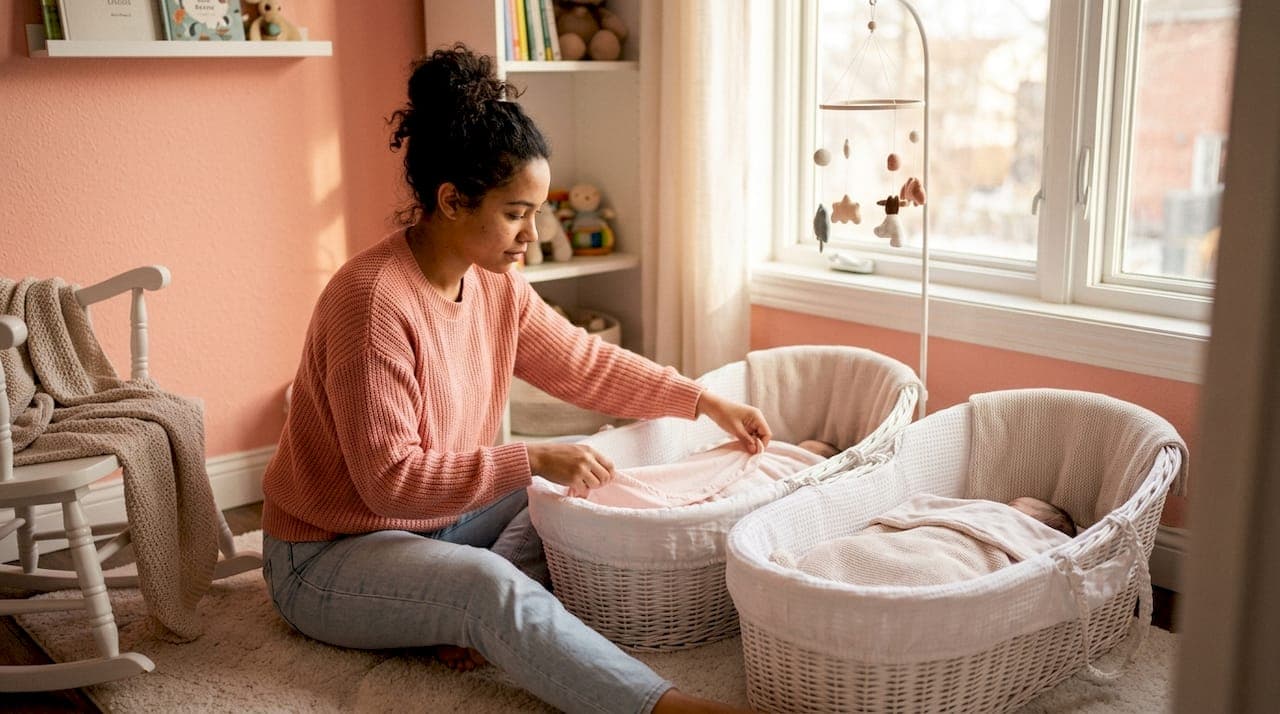
Bassinet sharing for twins is defined as placing both infants in the same bassinet sleep space, and leading medical authorities classify this practice as unsafe. The American Academy of Pediatrics and Twins Trust both mandate separate sleep surfaces for multiples, citing risks of airway obstruction, overheating, and sudden infant death syndrome (SIDS). Your twins spent nine months side by side in the womb, so the instinct to keep them close makes complete sense. The good news is that safe alternatives let you honor that closeness without putting either baby at risk. Twinsandcounting breaks down exactly what the guidelines say, what the real dangers are, and how to set up a sleep space that works for your family.
What is bassinet sharing for twins, and why is it unsafe?
Bassinet sharing for twins means both babies occupy the same sleep surface inside one bassinet. The core problem is space. A standard bassinet is designed for one infant. When two babies share it, neither has the firm, flat, unobstructed surface that safe sleep requires.
The specific risks fall into three categories:
- Airway obstruction. One twin can roll or shift toward the other, pressing against the sibling’s face or neck. Newborns lack the muscle control to reposition themselves.
- Overheating. Two bodies in a confined space generate more heat. Overheating is a recognized risk factor for SIDS, and twins sharing a bassinet amplify that risk significantly.
- Restricted movement. As babies grow, they move more during sleep. A shared surface limits safe movement and increases the chance of one twin becoming wedged against the bassinet wall or the other baby.
Pro Tip: If you are worried about your twins feeling separated, focus on room temperature, swaddling, and white noise. These environmental cues comfort newborns far more effectively than physical contact during sleep.
The American Academy of Pediatrics is unambiguous: newborn twins need separate firm, flat sleep surfaces from day one. This is not a guideline open to interpretation based on how small or calm your babies seem.
What do the current guidelines say about twin bassinet sharing?
The 2026 medical consensus on bassinet sleeping arrangements for twins is clear and consistent across major health organizations. Each twin must have its own sleep surface. Room-sharing is encouraged. Surface-sharing is not.
| Organization | Recommendation | Age Guidance |
|---|---|---|
| American Academy of Pediatrics | Separate, firm, flat sleep surfaces for each twin | Birth through at least 12 months |
| Twins Trust | No shared sleep surface; room-sharing encouraged | First 6 months minimum |
| The Lullaby Trust | Individual sleep spaces; parents in same room | First 6 months |
| Twin-specific bassinet manufacturers | Solid dividers required if twins share one unit | 0–5 months, until first milestone |
Room-sharing for the first six months is strongly recommended so parents can monitor both babies without bed-sharing. The distinction matters: being in the same room is protective. Being on the same sleep surface is not.
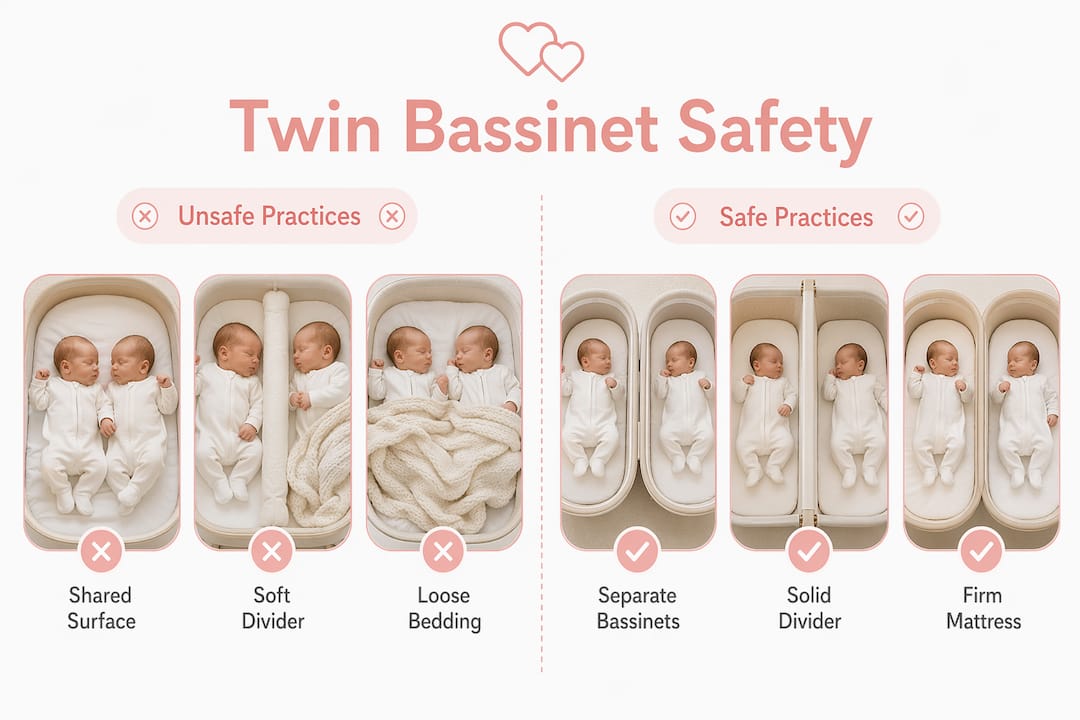
Twin-specific bassinets with solid dividers are a recognized middle ground. These units create two physically separated sleep spaces within one frame. The divider must be solid, not mesh or fabric that can compress. Most twin bassinets are suitable from birth through approximately 5 months, or until the first developmental milestone such as pushing up or rolling over.
Transition timing is governed by whichever twin reaches a milestone first. If Twin A starts pushing up at 4 months, both babies move to separate cribs immediately, even if Twin B shows no signs of rolling yet. Prompt transition is non-negotiable.
How can you safely arrange sleep spaces for twins?
Practical bassinet setup for twins comes down to two main options: a twin-specific bassinet with a solid divider, or two individual bassinets placed side by side. Both are safe when used correctly. Your choice depends on your nursery size, budget, and how long you want the setup to last.
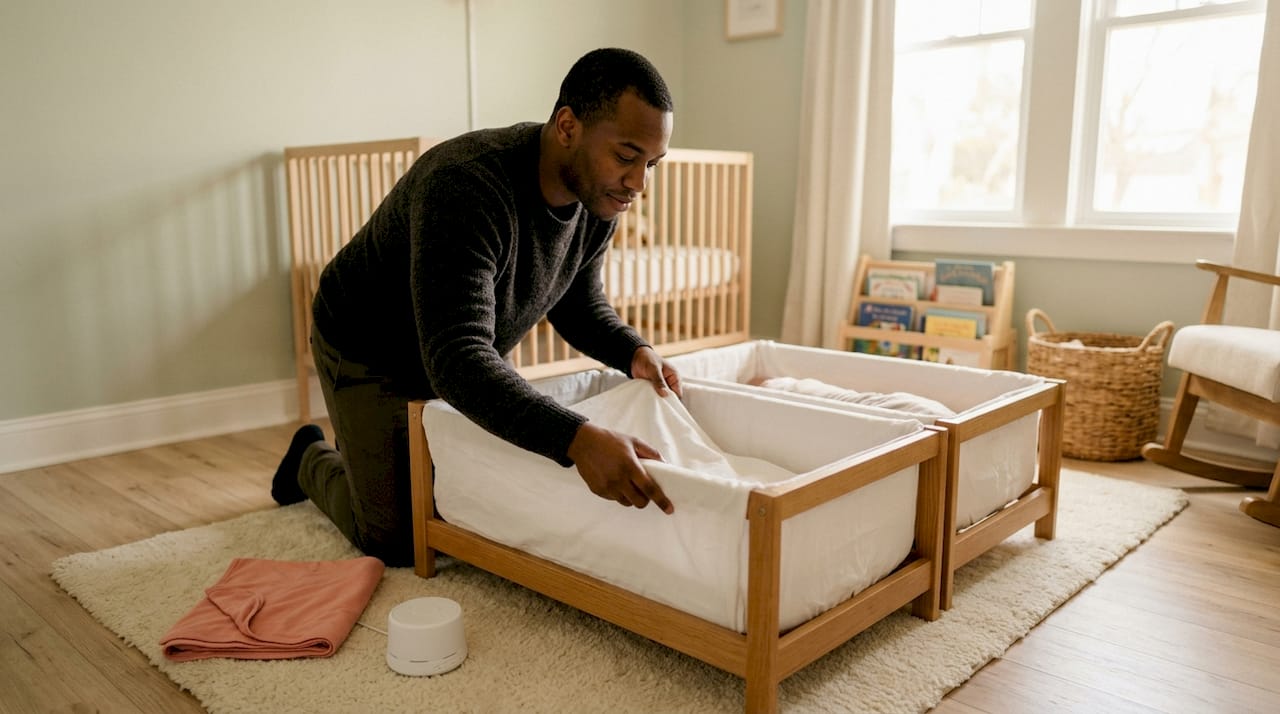
Twin-specific bassinets with dividers
These units hold both babies in one frame while keeping them physically separated. They work well in smaller nurseries because one unit takes up less floor space than two separate bassinets. The trade-off is a shorter usable window. Twin bassinets with Z-shaped frames can slide partially under a bed but still require at least 30 inches of clearance. Measure your space before purchasing.
Two individual bassinets side by side
Placing two standard bassinets next to each other gives each twin a fully independent sleep environment. This setup scales better as babies grow and lets you move one bassinet to another room if needed. The key rule: leave no gap between the bassinets that a baby could roll into, and keep both units flush against a wall or each other with no soft objects between them.
Pro Tip: Position both bassinets at the same height and angle so each twin has an identical view and environment. Mirrored placement supports synchronized sleep routines, which is one of the most effective tools for managing twin newborn sleep.
Here is a quick comparison of the two main approaches:
- Twin bassinet with divider: Lower footprint, one purchase, easier to monitor both babies at once. Limited to 0–5 months. Requires solid, non-compressible divider.
- Two individual bassinets: Longer usable life, fully independent surfaces, more flexible placement. Larger combined footprint. Slightly higher cost.
Whichever setup you choose, keep both sleep spaces free of loose blankets, pillows, positioners, and bumpers. A firm, flat, bare surface is the safest surface for any newborn.
What are the biggest misconceptions about twins sharing a bassinet?
The most common misconception is that twins need physical contact during sleep because they shared the womb. Parents hear this from well-meaning relatives, and it feels intuitively true. The biology does not support it as a sleep safety argument. The priority during sleep must be airway safety, not emotional closeness. The American Academy of Pediatrics is direct about it: infants should be placed “on their backs for sleep in their own sleep space with no other people.” Babies do not require physical contact to feel comforted while sleeping; what they need is a consistent, calm environment.
Newborns are soothed by warmth, familiar sounds, and gentle pressure from swaddling, not by sibling contact. Coordinated routines using mirrored swaddling, white noise, and identical sleep positioning deliver the comfort parents want their twins to feel, without the physical risk of a shared surface.
A second misconception is that a divider made of soft fabric or a rolled towel is sufficient. It is not. Only a solid, rigid divider that cannot compress under an infant’s weight counts as a true separation. Soft barriers shift, compress, and create exactly the kind of obstruction they are meant to prevent.
A third misconception is that co-bedding is only risky for larger babies. Newborns are the most vulnerable. Their airways are narrow, their muscle control is minimal, and their ability to signal distress is limited. The industry has shifted decisively toward side-by-side individual bassinets or divided twin units precisely because the risks are highest in the earliest weeks.
You are not failing your twins by keeping them in separate sleep spaces. You are protecting them.
Key Takeaways
Safe twin sleep requires separate surfaces from birth, and proximity can be achieved without compromising safety through divided twin bassinets or side-by-side individual units.
| Point | Details |
|---|---|
| Bassinet sharing is unsafe | Placing both twins on one surface raises the risk of airway obstruction, overheating, and SIDS. |
| Separate surfaces are mandatory | AAP and Twins Trust guidelines require each twin to have a firm, flat, individual sleep space. |
| Solid dividers are the standard | Twin bassinets must use rigid, non-compressible dividers. Soft barriers do not meet safety standards. |
| Transition at the first milestone | Move both twins to separate cribs the moment either baby begins pushing up or rolling over. |
| Routine replaces physical contact | Mirrored swaddling, white noise, and synchronized schedules comfort twins without co-bedding. |
What I’ve learned from watching parents navigate twin sleep safety
Parents who come to Twinsandcounting with bassinet questions almost always ask the same thing first: “Is it really that dangerous if they’re tiny and not moving yet?” My honest answer is yes, and the reason is not about the size of the babies. It is about the unpredictability of newborn movement and the speed at which situations change during sleep.
What I have seen consistently is that the parents who struggle most with separate sleep spaces are the ones who were not given a practical alternative. They were told “don’t do this” without being shown what to do instead. That gap is where the unsafe setups creep in. When you give parents a clear, workable arrangement, like two bassinets touching with white noise running and both babies swaddled identically, the resistance to separate surfaces drops almost immediately.
The other thing worth saying plainly: convenience is a real factor when you are managing two newborns on no sleep. A setup that feels slightly less convenient but keeps both babies safe is always the right call. You can read more about safe sleep for twins and co-sleeping alternatives to build a setup that works for your specific space and routine.
— Jay
Twin sleep resources at Twinsandcounting
Twinsandcounting was built specifically for parents managing two infants at once, and sleep safety is one of the most visited topics on the site.

If you want practical, tested guidance beyond the bassinet stage, the 9 important tips for twin care page covers sleep routines, feeding schedules, and developmental milestones in one place. Parents also find the twin overnight sleep patterns guide useful for understanding what to expect in the first months. Twinsandcounting’s community of twin parents shares real stories and real solutions, so you are never working through this alone.
FAQ
Is it ever safe for twins to share a bassinet?
No. Leading health organizations including the American Academy of Pediatrics classify shared bassinet sleep surfaces as unsafe for twins due to risks of airway obstruction and overheating.
What is the best bassinet setup for newborn twins?
The safest options are a twin-specific bassinet with a solid, rigid divider or two individual bassinets placed side by side with no gap between them.
How long can twins use a divided twin bassinet?
Most twin bassinets are suitable from birth through approximately 5 months. Both twins must transition to separate cribs as soon as either baby begins pushing up or rolling over.
Do twins need to sleep near each other for comfort?
Twins do not require physical contact during sleep. Mirrored swaddling, white noise, and synchronized routines provide equivalent comfort without the safety risks of a shared sleep surface.
What counts as a safe divider in a twin bassinet?
Only a solid, rigid divider that cannot compress under an infant’s weight meets safety standards. Rolled towels, soft fabric panels, and mesh barriers do not qualify as safe separators.