
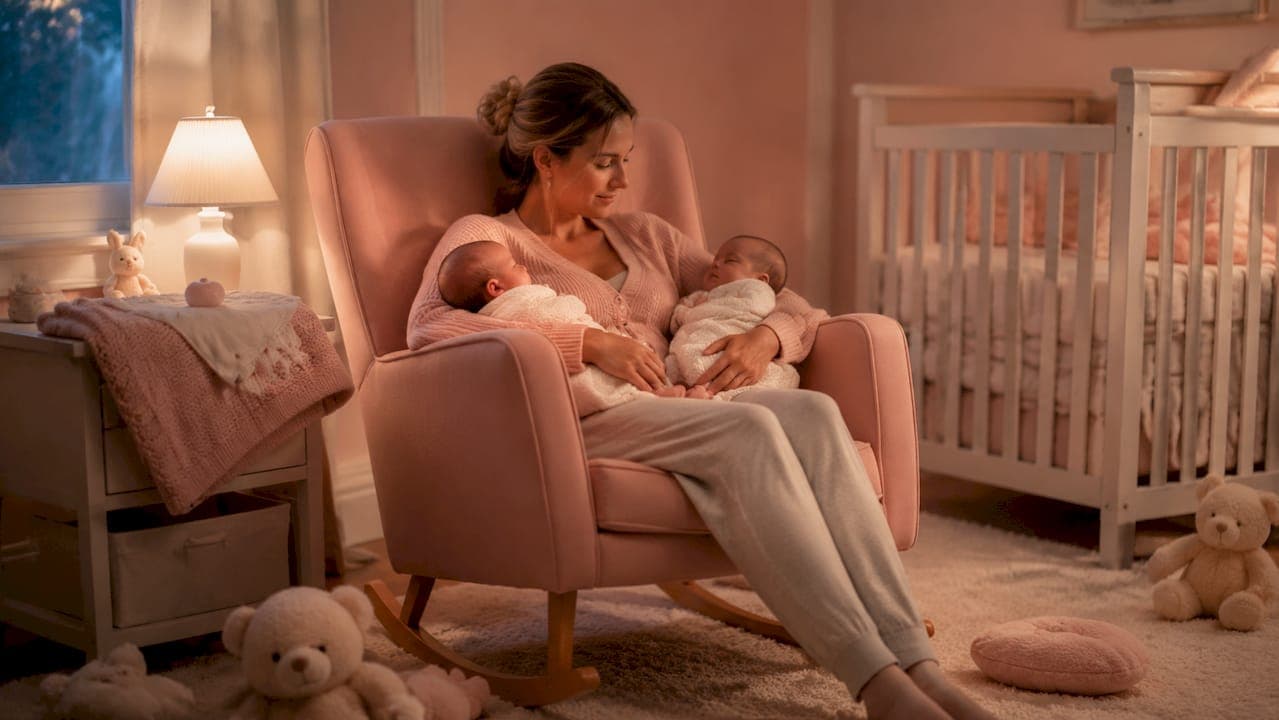
Sleep training twins simultaneously means coordinating both infants’ feeding, nap, and bedtime routines so their sleep-wake cycles align, giving you predictable rest and calmer nights. The industry term for this approach is synchronized sleep training, and it works by treating your twins’ schedules as one shared system rather than two separate problems. You do not need perfect synchronization every minute. You need coordinated routines, consistent cues, and a realistic plan built for two. This guide gives you exactly that.
How to start sleep training twins simultaneously
The right time to begin formal sleep training twins simultaneously is at 5 months adjusted age. Taking Cara Babies specifically recommends this milestone for formal training, while describing non-crying foundational routines for younger twins. Adjusted age matters because premature twins need extra developmental time before their nervous systems can handle the self-soothing process.
Before you begin formal training, build the foundation. Review twin overnight sleep patterns to understand what developmental stage each baby is at before you commit to a method. A solid foundation means both babies are feeding well, gaining weight appropriately, and showing signs of readiness.
Readiness signs to watch for in both twins:
- Able to stay awake for age-appropriate wake windows (roughly 1.5 to 2 hours at 5 months)
- No longer requires feeding every 2 hours through the night
- Shows a consistent drowsy cue such as eye rubbing or fussiness at predictable times
- Pediatrician has cleared both babies for sleep training
Pro Tip: If your twins were born premature, always calculate readiness using adjusted age, not birth age. A twin born 6 weeks early at 6 months old is developmentally closer to a 4.5-month-old.
Safe sleep is non-negotiable before, during, and after training. Babies must sleep on their backs on firm, flat surfaces clear of loose bedding, soft toys, and unapproved devices like sleeping pods. Each twin needs their own safe sleep space.
How do you synchronize feeding and sleep schedules for twins?
Synchronized feeding is the fastest lever you have for aligning twin sleep. Tandem feeding anchors both babies’ hunger cues at the same time, which means their sleep pressure builds together and their tired windows arrive together. Without feeding alignment, sleep alignment is nearly impossible to maintain.
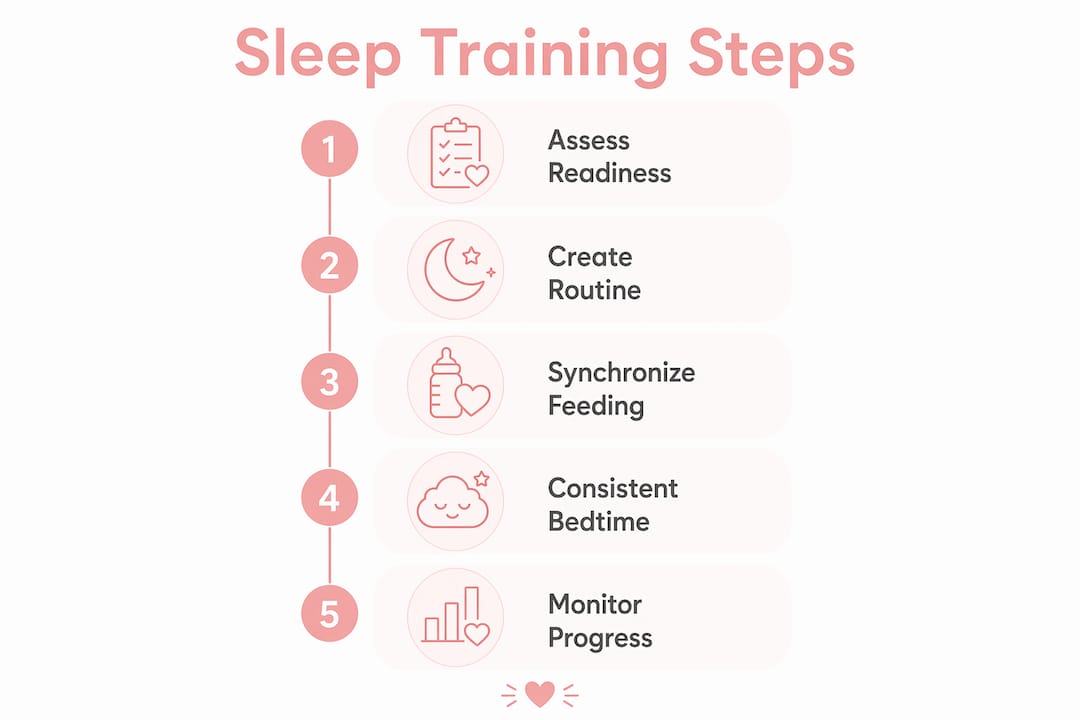
The most practical method for keeping schedules locked is the “wake one, wake both” rule. When one twin wakes to feed, wake the other twin immediately. This feels counterintuitive at 3 a.m., but it prevents the slow schedule drift that turns two manageable babies into two babies on completely opposite cycles.
Here is a step-by-step approach to synchronizing nap schedules:
- Set a consistent morning wake time. Choose a time between 6:00 and 7:30 a.m. and stick to it every day, even on weekends. This anchors the entire day’s schedule.
- Use wake windows, not the clock. At 5 months, most babies need 1.5 to 2 hours of awake time before the first nap. Watch both babies for tired cues and aim to put them down within the same window.
- Apply the 20-minute rule. Via Graces describes using a 20-minute wiggle room between twins’ wake times to set the next nap for both. If Twin A wakes from a nap 15 minutes before Twin B, you can let Twin B sleep up to 20 minutes longer before waking them.
- Wake the sleeping twin. Sleeping Baby Guide recommends waking the second twin within 15 to 30 minutes after the first wakes from a nap. This short window keeps the household rhythm intact without forcing rigid minute-by-minute timing.
- Feed both babies immediately after waking. This reinforces the eat-play-sleep cycle and keeps hunger cues aligned for the next sleep period.
Pro Tip: A twin nursing pillow like the Twin Z Pillow makes tandem feeding physically manageable and cuts feeding time nearly in half, which is critical for keeping both babies on the same cycle.
| Method | Best for | Trade-off |
|---|---|---|
| Wake one, wake both | Preventing schedule drift | Disrupts a sleeping twin |
| 20-minute nap rule | Gradual alignment | Requires consistent tracking |
| Tandem feeding | Anchoring hunger cues | Learning curve for positioning |
| Consistent morning wake time | Full-day schedule stability | Requires daily commitment |
For a deeper look at keeping both babies on track throughout the day, the same schedule strategies on Twinsandcounting walk through the full logistics.
Step-by-step coordinated sleep training methods for twins
Choosing the right twin sleep training method comes down to your temperament as a parent and the temperament of each baby. The two most practical options for twins are the Ferber method (graduated extinction) and the chair method (sleep lady shuffle). Both work for simultaneous training because they use predictable, repeatable responses that you can apply to two babies at once.
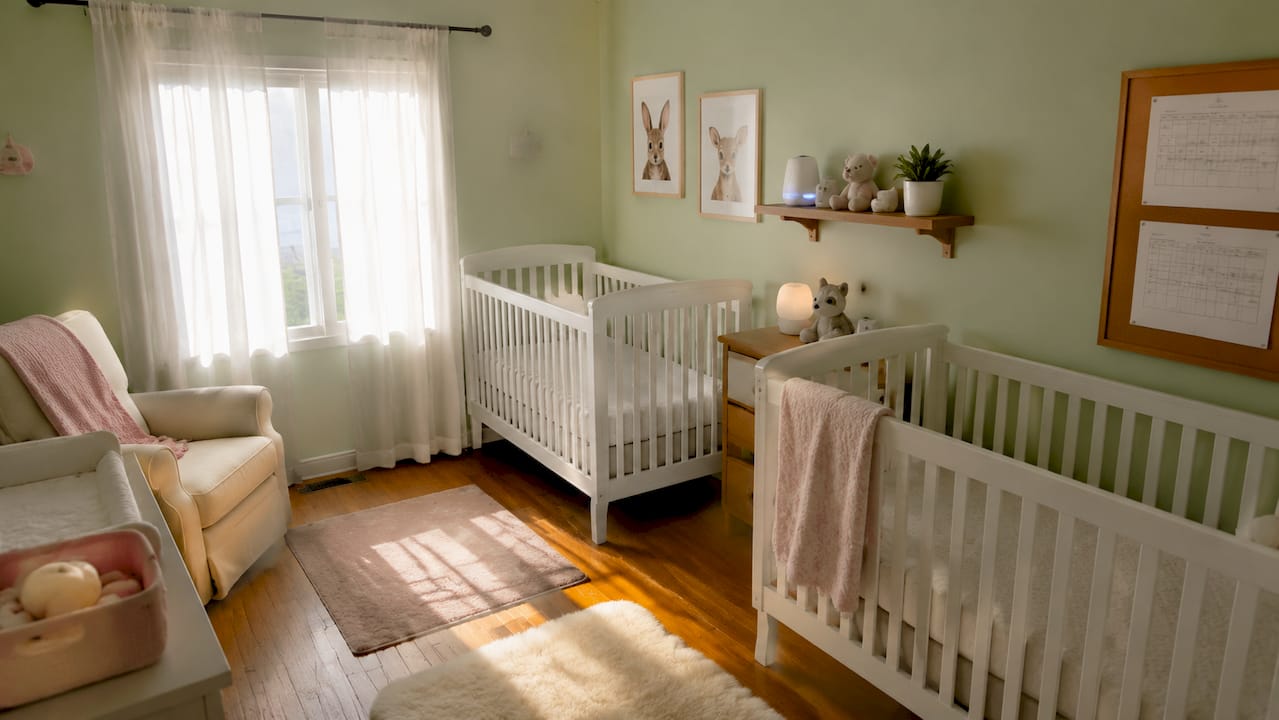
Using the Ferber method with twins:
The Ferber method uses brief interval check-ins at increasing time gaps, such as 3 minutes, then 5 minutes, then 10 minutes, to teach self-soothing without prolonged parental absence. With twins, you apply the same interval schedule to both babies. The key insight from The Baby Sleep Site is that coordinated check-ins prevent divergent sleep associations. If you respond differently to each twin, one baby learns that crying longer brings more attention, which undermines the entire process.
A practical nightly sequence for two:
- Begin the bedtime routine at the same time for both twins. Bath, lotion, pajamas, feeding, and a short wind-down activity like a song or dim lighting.
- Place both babies in their sleep spaces awake but drowsy. Say the same short phrase to each, such as “It’s sleep time. I love you.”
- Leave the room. Start your timer.
- At the first check-in interval, visit each baby briefly. Keep it under 60 seconds per baby. Pat gently, repeat your phrase, and leave. Do not pick them up unless safety requires it.
- Increase the interval with each round. Apply the same intervals to both babies regardless of which one is crying more.
- Log each night’s intervals and responses so you can track progress objectively.
Handling temperament differences:
Your twins are two separate people. One may settle within two nights while the other takes a week. Routine alignment over time is more practical than forcing identical outcomes on identical timelines. Adjust your emotional response, not your method. Stay consistent with the process even when results differ.
- If one twin is a lighter sleeper, place a white noise machine between their cribs or in the center of the room to muffle the other’s crying.
- If one twin escalates quickly, shorten their check-in intervals slightly without abandoning the method entirely.
- If both twins share a room, expect the first three nights to feel chaotic. Most families see meaningful improvement by night four or five.
What are the biggest challenges when training twins to sleep?
One twin waking the other is the most common obstacle parents face during simultaneous sleep training. The good news is that babies adapt to shared noise faster than most parents expect. White noise at 65 to 70 decibels played consistently throughout the night masks the sound of a crying sibling and reduces mutual wake-ups significantly.
“Successful simultaneous sleep training focuses more on coordinated routines and cues than forcing exact simultaneous sleep moments.” — Sleeping Baby Guide
When one twin’s wake time starts dictating the entire day without adjustment, schedules diverge fast. Applying wake window averages rather than following the earlier waker’s lead keeps both babies closer to alignment. If Twin A wakes 45 minutes before Twin B, do not start the day at Twin A’s wake time. Wait for Twin B within the 20-minute window, then begin the day together.
Common challenges and how to handle them:
- Night wakings: Apply the wake one, wake both rule. If one baby wakes to feed at night, wake the other within 15 minutes. Feeding them separately at different times rebuilds the schedule drift you worked hard to prevent.
- Nap refusal in one twin: Check whether that twin’s wake window has shifted. A baby refusing a nap is often undertired or overtired. Adjust their morning wake time by 15 minutes and reassess.
- Separation for sleep: Some families temporarily separate twins into different rooms during the initial training period. This reduces mutual disruption but requires you to do check-ins in two rooms. If you are parenting solo, the solo parenting schedule tips on Twinsandcounting offer a realistic plan for managing this alone.
- Safe sleep reminders: Never use sleeping pods, inclined sleepers, or soft bedding to manage positioning. Each baby needs a firm, flat, separate surface regardless of how tempting a shared sleep solution might seem.
For nap-specific struggles, the Twinsandcounting guide on what to do when twins won’t nap covers targeted fixes for the most common nap breakdowns.
Tools and routines that support twin sleep training success
The right tools reduce the physical and mental load of training two babies at once. A consistent twins bedtime routine is your most powerful tool, and it costs nothing. Predictable sequences, such as bath, feed, dim lights, white noise, and a short song, signal to both babies that sleep is coming. Repetition is the point. The routine should be identical every night.
| Tool | Purpose | Recommended use |
|---|---|---|
| White noise machine | Masks sibling crying and environmental noise | Run throughout the night at consistent volume |
| Twin nursing pillow | Enables tandem feeding to anchor schedules | Every feeding session during training period |
| Schedule tracking app | Logs wake times, feeds, and nap lengths | Daily during the first two weeks of training |
| Blackout curtains | Blocks light that disrupts nap timing | All sleep spaces, day and night |
Pro Tip: Apps like Huckleberry or Baby Tracker let you log both babies separately and compare their schedules side by side. Seeing the data removes the guesswork and shows you exactly where the schedules are drifting.
Managing your own sleep and stress during this period is not optional. Sleep deprivation impairs the consistency that makes training work. If you have a partner, split the check-in duties by night so each adult gets a longer sleep block. If you are parenting solo, prioritize napping when both babies nap, even if the house is not clean.
Key takeaways
Sleep training twins simultaneously works when you treat their schedules as one coordinated system, not two separate problems.
| Point | Details |
|---|---|
| Start at 5 months adjusted age | Begin formal training only after both babies show developmental readiness and safe sleep is established. |
| Feed together to sleep together | Tandem feeding and the wake one, wake both rule are the fastest ways to align sleep-wake cycles. |
| Use the 20-minute nap window | Wake the second twin within 15 to 30 minutes of the first waking to prevent schedule drift. |
| Apply consistent check-in intervals | Use the same Ferber-style intervals for both babies to avoid creating different sleep associations. |
| Routine beats rigid timing | Coordinated cues and predictable sequences matter more than forcing identical sleep moments every night. |
What I’ve learned from watching families train twins together
I want to be honest with you about something most sleep training content glosses over. The hardest part of training twins simultaneously is not the method. It is the emotional weight of hearing two babies cry, even briefly, while you stand in the hallway watching a timer. That experience is harder than any logistics problem, and no chart prepares you for it.
What I have seen work, consistently, is parents who commit to the process for a full week before evaluating results. Families who adjust the method after night two, or who respond inconsistently because one twin “seems different,” almost always extend the process by weeks. Consistency is not cruelty. It is the kindest thing you can do for two babies who need to learn a skill.
The other thing I want to push back on is the myth that twins must sleep in the same room to stay synchronized. Temporary separation during the first week of training often produces faster results because neither baby is disrupted by the other’s crying. Once both babies are sleeping through reliably, reuniting them in a shared room is straightforward.
Give yourself permission to not be perfect at this. You are managing two humans simultaneously, and that is genuinely hard. The parents who succeed are not the ones who execute flawlessly. They are the ones who stay calm, stay consistent, and keep going on the nights that feel impossible.
— Jay
Twinsandcounting has the resources to help you through this
Sleep training twins is one of the hardest milestones of the first year, and you should not have to piece together a plan from a dozen different sources.

Twinsandcounting is built specifically for parents of multiples, with guides that address the real complexity of managing two babies at once. Start with the complete night sleep guide for a step-by-step plan focused on getting both babies sleeping through the night. For a broader look at twin care strategies that go beyond sleep, the essential twin care tips page covers the practical foundations every twin parent needs. You do not have to figure this out alone.
FAQ
When should you start sleep training twins?
Formal sleep training is recommended from 5 months adjusted age. You can begin building foundational routines like consistent bedtimes and feeding schedules earlier without any formal training method.
Should twins sleep in the same room during sleep training?
Room-sharing is common but not required. Temporarily separating twins during the first week of training can reduce mutual disruptions and speed up the process. Once both babies sleep reliably, they can return to a shared space.
What do you do when one twin wakes the other at night?
Apply white noise at a consistent volume throughout the night to mask crying. If one twin wakes to feed, wake the other within 15 minutes using the wake one, wake both approach to prevent schedule drift.
How long does it take to sleep train twins simultaneously?
Most families see meaningful improvement within 5 to 7 nights of consistent training. Twins with different temperaments may reach full sleep independence at different rates, but the schedule alignment typically holds if you maintain consistent routines.
Is it safe to let twins cry during sleep training?
Brief, supervised crying during graduated check-in methods is considered safe for developmentally ready babies. Always confirm readiness with your pediatrician, and maintain safe sleep standards throughout. Each baby must sleep on their back on a firm, flat surface with no soft objects in the sleep space.