
The golden rule for syncing your twins’ daily routine
The single most effective method for syncing twin feeding and play schedules is this: when one twin wakes to eat, you wake the other one too. Every time. Healthcare providers affirm this as the golden standard for new parents of twins, and it works because it prevents their cycles from drifting apart hour by hour. A 30-minute offset today quietly becomes a full hour by the end of the week, and then you’re feeding someone constantly with no rest in between.
The backbone of the whole system is the eat-play-sleep cycle. Feed both babies, give them brief upright time to digest and interact, then put them both down together. Repeat. That rhythm, built around wake windows of 60–90 minutes for newborns, is what creates predictable gaps where you can actually breathe. Most families find the sync solidifies over the first 8–12 weeks, not overnight, so patience is part of the plan.
Here are the core steps to get started:
- Wake both babies at the same time, every time one wakes to eat
- Feed them simultaneously or as close together as possible
- Allow brief upright and play time after each feed
- Put both babies down for sleep at the same time
- Pick a consistent anchor time for the first morning feed (7:00 AM works well for many families)
- Track feedings and diaper output to spot any intake concerns early
- Adjust timing as wake windows lengthen with age
Why syncing helps and what to realistically expect
Getting both babies on the same schedule is the difference between drowning and swimming slowly. When their rhythms align, you get predictable rest windows instead of a revolving door of feeds all day and night. Reduced parental fatigue is the most immediate benefit, but there are others worth naming.

Syncing also improves feeding efficiency. When both babies are hungry at the same time, tandem feeding becomes possible, cutting your total feeding time roughly in half. Consolidated naps mean you can sleep, eat, or simply sit down without one baby always being awake. Over time, the predictability itself reduces anxiety because you stop guessing what comes next.
That said, perfect synchronization isn’t necessary. Being close in rhythm is enough. Twins are two separate people with slightly different hunger cues and sleep drives, and that’s completely normal. The goal is ballpark alignment, not military precision.
Practical benefits parents notice once sync takes hold:
- Longer stretches of uninterrupted sleep between feeding cycles
- Predictable nap windows that allow for personal rest or household tasks
- Easier tandem feeding once positioning is mastered
- Reduced stress from knowing roughly what comes next
- More focused one-on-one interaction during awake time
How to align twin feeding times step by step
Tandem feeding is the practical engine behind a synced schedule. A large twin-feeding pillow, the U-shaped kind with a firm foam core, enables you to feed both babies simultaneously in the football hold position, whether you’re breastfeeding or bottle-feeding. It reduces physical strain and cuts total feeding time significantly. If you had a C-section, wait about a week before using one; in the meantime, bed pillows propped on both sides work well for a double football hold.
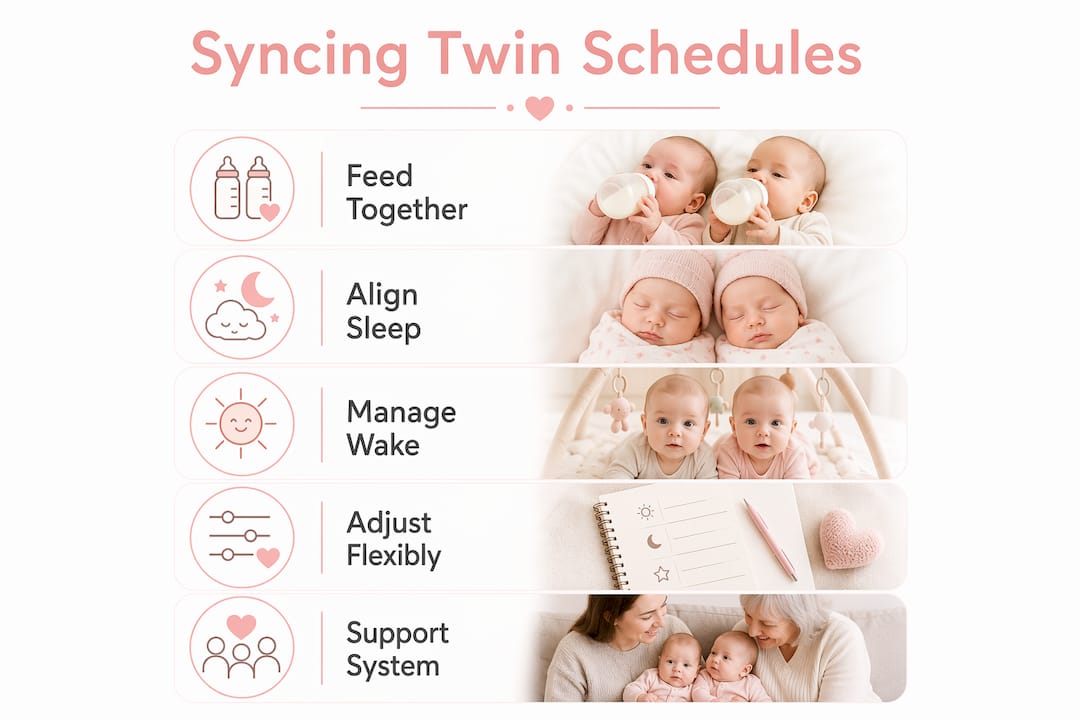
Waking a sleeping twin feels wrong at 2:00 AM. Do it anyway. Wait a few minutes after the first baby wakes, then gently rouse the second. You’re not harming them. Letting one sleep while the other feeds pushes their cycles further apart with every single pass. Tracking each feeding with a simple app or a paper chart also helps you monitor intake and diaper output, which your pediatrician will want to see at checkups.
For nighttime feeds specifically, keep things calm and low-stimulation. Dim lights, no singing, no conversation beyond what’s needed. That quiet consistency teaches both babies early that nighttime is for sleeping, not socializing. Longer overnight stretches follow naturally as they grow.
- Use a twin-feeding pillow for tandem feeding; alternate which baby gets which side each session
- Wait a few minutes after the first twin wakes before rousing the second
- Keep a feeding log or use a tracking app to monitor intake and wet diapers for both babies
- During night feeds, keep lights low and interaction minimal
- Split overnight feeding shifts with your partner so each of you gets a longer sleep stretch
- If one baby is bottle-fed, a partner or support person handling one baby during feeds speeds up the whole cycle
Pro Tip: Start tandem feeding with the twin who is fussier or has more latch difficulty. Getting that baby settled first means the second latch goes more smoothly, and the whole feed runs faster.
How to align your twins’ sleep schedules
Sleep syncing follows directly from feeding sync. When both babies eat at the same time, they hit their wake window limit at roughly the same time, which means they’re ready for sleep together. For newborns, that window is short: 45–60 minutes of total awake time in the first four weeks, including the feeding itself. By weeks 8–12, that stretches to 75–90 minutes with more genuine alert and interactive time appearing between feeds and naps.

A consistent bedtime routine matters more as babies move past the newborn stage. Bath, feed, dim lights, the same sequence every night. That repetition signals what’s coming and helps both babies wind down together. A white noise machine in the room supports this further by masking household sounds that might rouse one baby and then the other. The American Academy of Pediatrics recommends room-sharing for at least six months, and keeping twins in the same room with identical sleep spaces also supports synchronized sleep routines.
When one twin disrupts the sync, resist the urge to let the other drift onto a new timing. Keep waking the cooperative twin at the established times. A disruption is temporary; a desynchronized schedule takes real effort to rebuild.
- Respect wake windows: 45–60 minutes for newborns, growing to 75–90 minutes by weeks 8–12
- Apply the eat-play-sleep cycle to every nap and overnight period
- Use white noise to create a consistent sleep environment for both babies
- Put both babies down at the same time, even if one seems less tired
- Maintain a consistent bedtime sequence starting around 8:00 PM
- When one twin’s schedule shifts, hold the other twin’s timing steady
Pro Tip: If one twin starts waking earlier than the other, try a brief soothing response before feeding. Sometimes a few minutes of gentle settling gets them back to sleep without triggering a full feed cycle that pulls the other twin off schedule.
A sample synchronized daily schedule for twins
The eat-play-sleep framework gives each day a repeating structure, but the specific times shift as your babies grow. Anchor the first morning feed at a consistent time, and the rest of the day organizes itself around that starting point. Here’s a realistic sample timetable for weeks 2–12, showing how the rhythm evolves.
| Time Block | Activity | Practical Tip |
|---|---|---|
| 7:00 AM | Wake both babies, feed both (tandem if possible) | Hold the anchor time steady even on hard nights |
| 7:00 AM | Upright time, tummy time, gentle interaction | Strap one baby in a bouncy seat while burping the other |
| 7:00 AM | Both babies down for nap | Swaddle both; don’t wait for crying as a sleep cue |
| 10:00–10:30 AM | Wake both, feed both | By weeks 8–12, awake time after this feed lengthens |
| — | Both down for nap | White noise on; keep the room dim |
| — | Wake both, feed both | Afternoon feeds are a good time for visitor help |
| 8:00 PM | Bedtime routine begins: bath, feed, dim lights | Same sequence every night builds the sleep association |
| 7:00–8:00 PM | Both down for the night | By weeks 10–12, some families see a 4–5 hour first stretch |
| Overnight | One to two feeds, timing varies | Keep feeds quiet, dark, and brief |
By weeks 10–14, many twins start consolidating naps and overnight sleep improves. Schedules have a shelf life of a few weeks; just when you feel settled, the babies grow and the timing shifts. That’s development, not failure.
Staying flexible and taking care of yourself
Routines work best as adaptable frameworks, not rigid laws. Experts at UMass Memorial Health stress sustainability over clock-watching, and that perspective matters when you’re running on broken sleep. A schedule that works for your family is better than a perfect one that leaves you depleted.
A parent shift system is one of the most practical tools available. One parent handles the midnight feed, the other takes the 3:00 AM feed using expressed milk or formula. That split helps each caregiver secure a longer stretch of uninterrupted sleep during the newborn phase, which makes everything else more manageable. For breastfeeding parents, keeping milk supply stable while splitting overnight duties requires pumping to avoid engorgement, so plan that into the rotation.
Accepting help is not optional, it’s part of the strategy. Meals, laundry, grocery runs, holding a baby while you shower: all of it counts. The time-saving twin care routines that actually hold up long-term are the ones built around realistic support, not heroic solo effort.
- Set up a clear overnight shift system with your partner or a support person
- Accept help with meals, errands, and household tasks without guilt
- Rest when both babies sleep, even briefly
- Connect with other twin parents through community groups or online forums
- Breastfeeding parents: pump during skipped overnight feeds to protect milk supply
- Give yourself permission to adjust the schedule when it stops working
What to do when your twins won’t sync
Some twins resist syncing, and that’s not a sign you’re doing it wrong. Premature babies, babies with different temperaments, or twins with medical needs may simply run on different clocks for longer than expected. The strategy stays the same: keep waking the second twin when the first wakes, hold the anchor time, and give it time.
If one twin consistently wakes much earlier than the other, check whether a full feed is happening at each cycle. A baby who snacks rather than eating fully will be hungry again faster, pulling the schedule apart from the inside. Full feeds during the day are one of the most reliable ways to lengthen the gaps between cycles and bring both babies back toward the same rhythm.
When a growth spurt or illness throws the sync off entirely, ride it out without abandoning the framework. Return to the core rule as soon as both babies are stable. A few rough days don’t erase weeks of progress.
Building a support system that actually holds
Self-care for parents of twins isn’t a luxury. It’s what keeps the schedule functioning. Parents who are severely sleep-deprived make more errors, feel more overwhelmed, and are less able to respond calmly to two babies at once. Protecting your rest is directly connected to how well the routine holds.
Beyond the overnight shift system, lean on your wider support network. Friends, family, postpartum doulas, and pediatric sleep consultants are all real resources. For breastfeeding support specifically, connecting with a lactation consultant or exploring breastfeeding strategies for multiples can make a meaningful difference in the early weeks when supply and positioning feel overwhelming.
The twin parenting community is also worth finding. Other parents who have lived this specific experience offer a kind of practical reassurance that no article fully replaces.
Respecting that your twins are two different people
Twins share a birthday, a room, and often a feeding schedule, but they are individuals with distinct personalities, hunger patterns, and sleep drives. One may latch easily while the other struggles. One may settle quickly while the other needs more soothing. Recognizing those differences, rather than forcing identical responses, makes the whole routine more sustainable.
The goal of syncing is not to make your twins identical in behavior. It’s to align their rhythms closely enough that you get rest and they get consistent care. Within that framework, there’s plenty of room to respond to each baby’s cues individually. One twin may need an extra burp, a longer settle, or a slightly different hold. That’s not a schedule failure; that’s parenting two people at once.
As twins grow, their individual temperaments become more distinct. A schedule that treated them as interchangeable in the newborn phase will naturally need to flex to accommodate who they’re becoming.
How to communicate your schedule to caregivers and childcare providers
A written schedule is the single most useful thing you can hand to anyone caring for your twins. It doesn’t need to be elaborate: a one-page document with feeding times, nap windows, each baby’s cues for hunger and tiredness, and any specific notes (one baby needs to be burped twice, one settles faster with swaddling) covers most situations. The babysitter twin routines guide from Twinsandcounting walks through exactly what to include.
Walk any new caregiver through the schedule in person before leaving them alone with both babies. Watching the routine once is worth more than reading it three times. Make clear which twin is which (name tags on onesies work for newborns), and confirm that the caregiver understands the wake-both rule and why it matters.
For daycare or childcare center transitions, schedule a meeting with the lead provider before the babies start. Share the written schedule, ask how they handle syncing multiples, and confirm they can accommodate simultaneous feeding when possible. Most experienced infant care providers have strategies for twins, but they need your specific information to apply them well.
Key Takeaways
Syncing twin feeding and play schedules works because waking both babies to eat together, following an eat-play-sleep cycle, and holding a consistent anchor time aligns their rhythms and creates predictable rest windows for parents without specifying a time frame.
| Point | Details |
|---|---|
| Wake both twins together | When one wakes to eat, rouse the other immediately to prevent cycles from drifting apart. |
| Use eat-play-sleep as your framework | Feed, allow brief upright time, then put both babies down together every cycle. |
| Expect 8–12 weeks to solidify | Sync takes time; hold the framework through disruptions rather than abandoning it. |
| Flexibility protects the routine | Treat the schedule as an adaptable guide that evolves with your babies’ development. |
| Written schedules help caregivers | A one-page document with feeding times, nap windows, and individual cues keeps any caregiver on track. |
Raising twins is double the challenge and double the joy. If you’re looking for more practical guidance on managing two babies at once, the twin care tips at Twinsandcounting cover everything from feeding logistics to sleep training, written specifically for parents navigating exactly what you’re going through.