

Cluster feeding in twins is defined as a pattern where newborns feed frequently in short, repeated sessions, typically during late afternoon or evening hours, to boost milk supply and satisfy rapid growth needs. For parents of twins, understanding the role of cluster feeding twins means recognizing it as the biological engine behind your babies’ early weight gain, your milk production, and the foundation of a workable twin feeding schedule. Newborns typically feed 8–12 times per 24 hours, and with two babies, that number doubles in demand. The good news: cluster feeding is temporary, predictable, and manageable with the right strategies. This guide covers what cluster feeding means for twins specifically, how it supports growth and sleep, and exactly how to handle it without losing your mind.
What is the role of cluster feeding twins?
Cluster feeding serves three core functions for twins: it drives milk supply, supports growth spurts, and lays the groundwork for schedule synchronization. These three functions are inseparable. Miss one, and the others suffer.
Newborns have stomachs roughly the size of a marble at birth. They empty quickly, which is why frequent feeding signals the body to increase milk production to meet twins’ demand. For breastfeeding mothers of twins, this supply-demand feedback loop is not optional. It is the mechanism that determines whether you produce enough milk for two babies.

Cluster feeding also applies to formula-fed twins. The pattern of frequent, bunched feeds still occurs because it reflects the babies’ developmental rhythm, not just a breastfeeding phenomenon. Both breastfed and formula-fed twins will cluster feed during growth spurts, typically around weeks 2, 3, and 6.
The emotional dimension matters too. Cluster feeding provides comfort and regulation for newborns who are adjusting to life outside the womb. For twins who spent months in close proximity, the physical closeness of feeding sessions supports neurological calm. That is not a soft benefit. It directly affects how well your babies settle between feeds.
How does cluster feeding benefit twins’ growth and development?
Cluster feeding benefits twins in ways that go beyond simple calorie delivery. Here is what the research and clinical experience show:
- Milk supply calibration. The body produces milk based on how much is removed. Two babies removing milk more frequently during cluster feeding phases trains your supply to meet twin-level demand faster than a singleton feeding pattern would.
- Growth spurt support. Twins often experience growth spurts slightly earlier or more intensely than singletons due to their smaller birth weights. Cluster feeding provides the caloric density needed during these windows.
- Neurological comfort. Frequent feeding sessions reduce cortisol spikes in newborns. For twins, who may have experienced more stressful deliveries, this regulation effect is clinically meaningful.
- Schedule foundation. Babies who cluster feed predictably in the evening tend to consolidate sleep more effectively afterward. This is the biological basis for using cluster feeding to improve nighttime sleep stretches.
Cluster feeding is not a sign that your milk supply is failing or that your babies are not getting enough. It is a sign that the system is working.
Pro Tip: If you are unsure whether your twins are getting enough nutrition during cluster feeding phases, check out Twinsandcounting’s guide on signs of adequate feeding to track output, weight gain, and satisfaction cues.
What are effective strategies to manage cluster feeding twins?
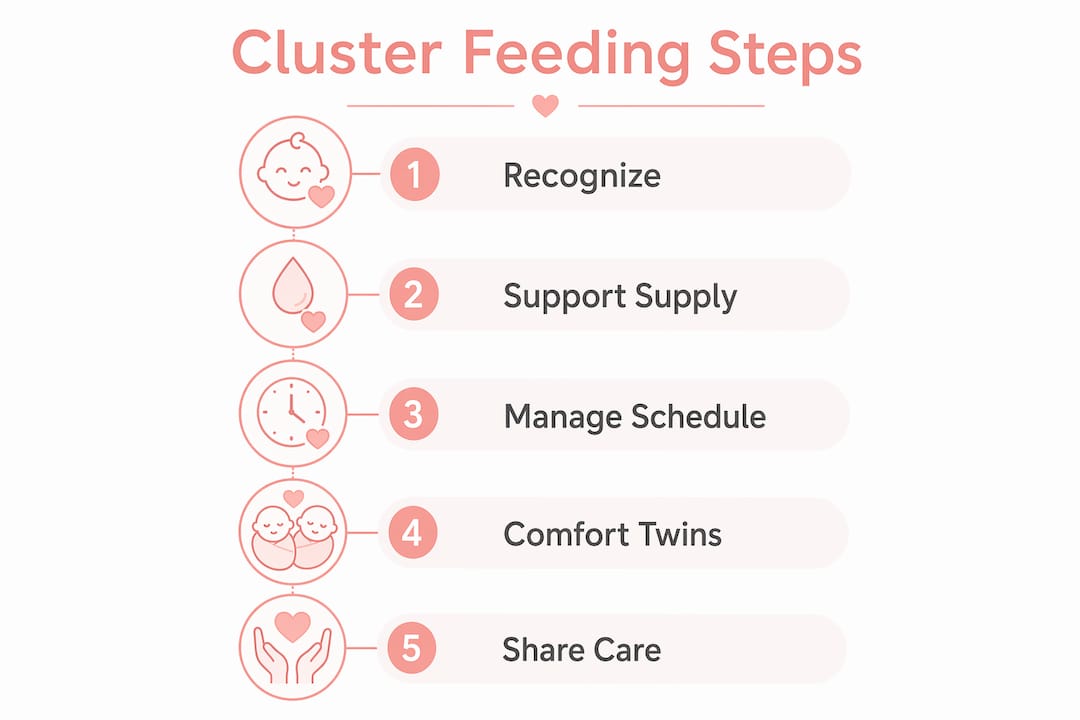
Managing cluster feeding with two babies is a logistics problem. Treat it that way, and you will reduce stress significantly. Here are the strategies that work.
1. Feed both twins simultaneously with tandem feeding
Tandem feeding means nursing or bottle-feeding both babies at the same time. Synchronized feedings produce predictable 45–90 minute gaps, especially in the first 8 weeks. Staggered individual feeding, by contrast, creates a continuous loop of feeding, burping, and settling with no rest window. A nursing pillow designed for twins, such as the My Brest Friend Twins Plus Deluxe, makes simultaneous breastfeeding physically manageable.
2. Wake the sleeping twin
This is the rule most new twin parents resist, and it is the one that matters most. Waking the sleeping twin when the other wakes to feed keeps your schedule aligned. Letting one twin sleep longer breaks synchronization and guarantees you will be feeding continuously with no gap for rest.
3. Adjust the schedule by age
Twin feeding schedules are not static. Use this framework as a starting point:
| Age | Feeding Frequency | Key Strategy |
|---|---|---|
| 0–4 weeks | Every 2–3 hours | Wake both twins; establish tandem feeding |
| 4–10 weeks | Every 2.5–3 hours | Begin loose synchronization; add dream feeds |
| 10–14 weeks | Every 3–4 hours | Extend nighttime intervals; maintain daytime sync |
| 4–6 months | Every 4 hours | Consolidate to 5–6 feeds per day |
Sample schedules show a transition to feeding every 3–4 hours by 10–14 weeks, with nighttime dream feeds bridging the longer gaps.
4. Use combination feeding without guilt
Combination feeding, which means supplementing breast milk with formula or exclusive pumping, is a valid and widely endorsed strategy for twin parents. It is not a failure. It is a system adjustment that protects your mental health and keeps both babies fed.
5. Build in shared caregiving shifts
Divide nighttime feeding duties between partners or support people. One adult handles all feeds during a set window while the other sleeps. This is not a luxury. It is a functional requirement during peak cluster feeding phases.
Pro Tip: For detailed night feeding logistics, Twinsandcounting’s guide on night feeding twins walks through shift structures and setup tips that reduce the 2 a.m. chaos.
How does cluster feeding influence twins’ sleep patterns?
Cluster feeding and sleep are directly connected. Newborn sleep cycles average 40–60 minutes, and cluster feeding creates bursts of feeding followed by longer sleep stretches. This is the mechanism you want to work with, not against.
When twins cluster feed in the evening, they typically consolidate into a longer initial sleep stretch of 3–4 hours. That window is your recovery time. Missing it by letting feeds drift out of sync means you lose the one predictable rest gap the biology offers you.
Here is how to protect both twins’ sleep and your own:
- Aim for loose synchronization. Complete rigid synchronization is rarely possible in the early weeks. Focus on nighttime alignment first. Daytime flexibility is acceptable and reduces burnout.
- Use dream feeds strategically. A dream feed at 10 or 11 p.m., where you gently feed a sleeping baby without fully waking them, can extend the overnight stretch by 1–2 hours. Twinsandcounting’s dream feeding guide covers this technique in detail.
- Implement parent shift systems. Parent shift systems where one parent sleeps while the other handles all feedings provide at least 6 hours of restorative sleep per parent. Six hours is the clinical threshold for cognitive function. Below it, decision-making and emotional regulation deteriorate, which affects your parenting capacity directly.
- Track patterns, not perfection. Keep a simple feeding log for the first 4–6 weeks. Patterns emerge within days, and seeing them on paper reduces anxiety significantly.
The connection between cluster feeding and sleep is not coincidental. It is the biological design. Work with it by protecting synchronization, and your twins will naturally consolidate sleep faster.
What common challenges arise with cluster feeding twins?
The most common challenge with cluster feeding twins is not the feeding itself. It is the exhaustion, the self-doubt, and the myths that surround it.
Myth: Cluster feeding means your milk supply is low. This is false. Cluster feeding boosts milk supply through the supply-demand feedback mechanism. Frequent feeding is the cause of increased supply, not a symptom of its absence.
Myth: Good parents can handle this alone. Cluster feeding twins is a two-person minimum operation during the newborn phase. Accepting help is not weakness. It is the only way to sustain the feeding schedule without collapse.
Here are the practical strategies that address the real challenges:
- Reframe the problem. Feeding twins is a logistics challenge, not a measure of your parenting skill. Systems, equipment, and shared shifts solve logistics problems. Guilt and self-criticism do not.
- Set up your feeding station before the cluster feeding window hits. Water, snacks, burp cloths, and your phone charger within arm’s reach before 4 p.m. means you are not scrambling when both babies want to feed simultaneously.
- Accept that tandem feeding has a learning curve. Most parents need 2–3 weeks to feel comfortable feeding both twins at once. That is normal. Tandem feeding is flexible, and feeding twins together at night while feeding separately during the day is a completely valid adaptation.
- Seek professional support early. A lactation consultant who has experience with multiples, such as those certified through the International Board of Lactation Consultant Examiners (IBCLC), can resolve latching issues and supply concerns before they become crises.
- Protect your mental health. The postpartum period with twins carries a higher risk of postpartum depression and anxiety. Cluster feeding intensity amplifies that risk. Naming the difficulty out loud and asking for help is the most practical thing you can do.
Pro Tip: If you are parenting twins with limited support, Twinsandcounting’s solo parenting schedule guide offers specific strategies for managing cluster feeding phases on your own.
Key takeaways
Cluster feeding twins is a temporary but intense phase that directly drives milk supply, supports growth spurts, and creates the conditions for longer sleep stretches when managed with synchronized feeding and shared caregiving shifts.
| Point | Details |
|---|---|
| Cluster feeding drives milk supply | Frequent feeding signals the body to produce more milk, which is critical for meeting twins’ combined demand. |
| Synchronization is the priority | Feeding both twins simultaneously cuts feeding cycles nearly in half and creates predictable rest windows. |
| Wake the sleeping twin | Keeping both twins on the same schedule protects nighttime alignment and parental sleep quality. |
| Combination feeding is valid | Supplementing with formula or pumping is a strategic choice, not a failure, and supports family well-being. |
| Reframe exhaustion as logistics | Cluster feeding challenges are solved with systems and support, not willpower or guilt. |
Jay’s take on surviving the cluster feeding phase
I want to be honest with you about something most articles skip. Cluster feeding twins is not just hard. It is a level of sustained physical and emotional demand that most people are genuinely unprepared for, even those who have parented singletons before.
The thing I have come to believe strongly is this: the parents who get through the cluster feeding phase with the least damage are not the ones who push hardest. They are the ones who build the simplest, most repeatable system and then protect it ruthlessly. That means waking the sleeping twin even when it feels cruel. It means accepting the formula top-up even when exclusive breastfeeding was the goal. It means handing the 3 a.m. feed to your partner and actually sleeping instead of lying awake listening.
What I have seen trip parents up most often is the belief that struggling means something is wrong with them. It does not. It means you have two newborns. The biology is working exactly as designed. Your job is to build a system around it, not to transcend it through sheer determination.
If exclusive breastfeeding does not work out, that is not the story of your failure. It is the story of two babies who were fed and a parent who made a smart call under pressure. Give yourself that.
— Jay
Find more twin feeding and sleep resources at Twinsandcounting
Cluster feeding is just one piece of the twin parenting puzzle, and you do not have to figure out the rest alone.

Twinsandcounting is built specifically for parents managing two babies at once, with guides covering feeding schedules, sleep strategies, and self-care through every stage of the first year. Whether you are deep in the newborn cluster feeding phase or trying to plan ahead, the twin care tips on the site give you concrete, twin-specific guidance you can use today. For sleep-specific support, the twin sleep schedule guide is a strong next step.
FAQ
What is cluster feeding in twins?
Cluster feeding in twins is a normal newborn pattern where babies feed frequently in short sessions, typically in the late afternoon or evening, to boost milk supply and support growth spurts. It applies to both breastfed and formula-fed twins.
How often do twins cluster feed?
Newborns typically feed 8–12 times per 24 hours, and cluster feeding concentrates several of those sessions within a 2–3 hour window. This pattern is most intense in the first 6–8 weeks and gradually spaces out as twins grow.
Should I wake my sleeping twin to feed?
Yes. Waking the sleeping twin when the other wakes to feed is the most effective way to keep your twin feeding schedule aligned and create predictable rest gaps for yourself. Letting one twin sleep longer breaks synchronization and leads to continuous, overlapping feeding cycles.
Does cluster feeding mean my milk supply is low?
No. Cluster feeding is the mechanism that builds milk supply, not a sign that supply is insufficient. Frequent feeding signals the body to produce more milk to meet the combined demand of two babies.
How long does cluster feeding last in twins?
Cluster feeding is most intense between weeks 1 and 8, with peaks during growth spurts at weeks 2, 3, and 6. Most twin parents see the pattern ease significantly by 10–14 weeks as feeding intervals naturally extend.