

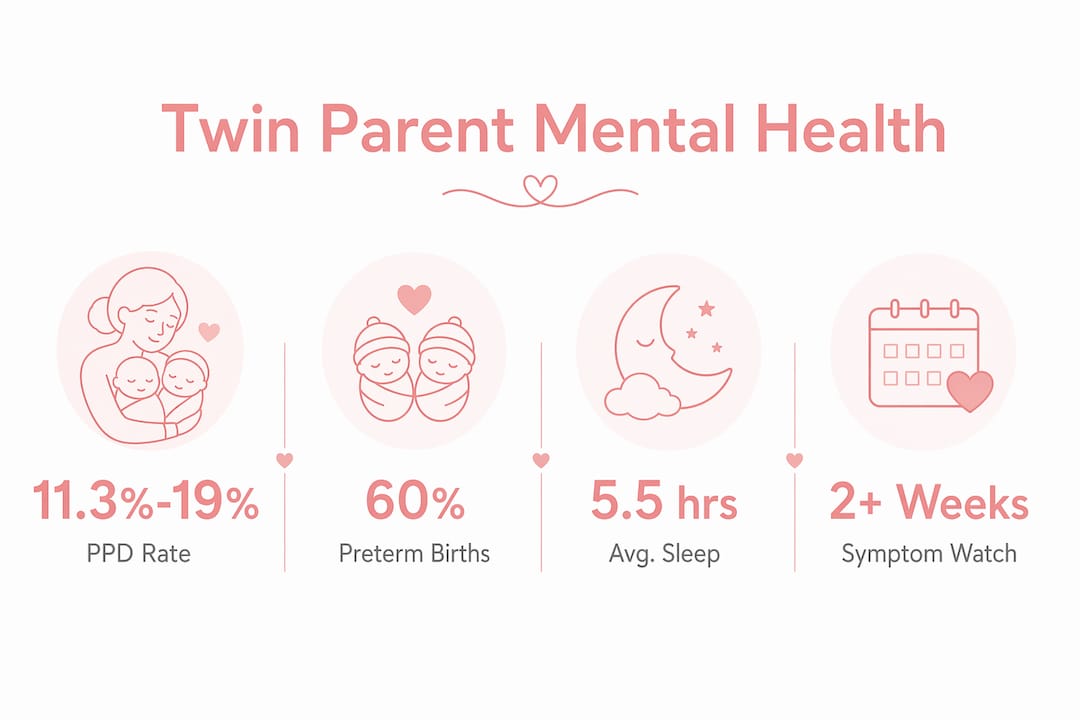
Twin parent mental health basics refer to understanding, recognizing, and managing the distinct psychological stresses that come with raising two babies at once. Parents of multiples face higher rates of postpartum depression than singleton parents, with moderate to severe PPD affecting 11.3% to 19% of mothers of multiples compared to 8.3% to 16% of singleton mothers. These challenges are clinically recognized and driven by real stressors: NICU stays, chronic sleep deprivation, financial pressure, and the physical demands of caring for two infants simultaneously. They are not a sign of parenting failure. Twinsandcounting exists to help you understand what you are facing and find real support.
What are the specific mental health risks twin parents face?
Twin parents carry a measurably heavier mental health burden than singleton parents, and the research is clear on why. A Canadian population cohort study found a 21% increased risk of severe maternal mental illness in the first year postpartum for mothers of twins, including emergency care and self-injury events. That number reflects real families under real pressure, not statistical noise.
The physical realities of a twin pregnancy set the stage early. About 60% of twins are born preterm, and roughly 43% of multiples babies spend time in the NICU compared to just 9% of singletons. A NICU stay separates parents from their newborns at the most vulnerable moment, creating grief, guilt, and fear that can seed postpartum depression and childbirth-related PTSD long before the babies come home.
Sleep deprivation compounds every other stressor. Mothers of twins average just 5.4 to 5.6 hours of fragmented sleep broken into roughly 15 episodes per 24 hours. That level of sleep disruption is strongly associated with postpartum depression and impairs the emotional regulation needed to cope with twin parenting challenges.

The risk peaks sharply around two months postpartum and tends to normalize after the first year. Knowing that timeline matters. It means the hardest stretch has a shape, and targeted support during those early months can make a lasting difference.
Key stressors that elevate mental health risk in twin parents include:
- Preterm birth and NICU stays that disrupt bonding and trigger trauma responses
- Chronic sleep fragmentation averaging under six hours per night
- Financial strain from doubled equipment, childcare, and medical costs
- Physical exhaustion from simultaneous feeding, soothing, and caregiving demands
- Social isolation as leaving the house with two infants becomes logistically difficult
Pro Tip: Track your mood for two weeks using a simple daily rating from 1 to 10. A consistent pattern below 5 is a concrete signal to bring to your doctor, not just a bad week to push through.
What coping strategies actually work for twin parents?
Effective coping for twin parents combines practical routine changes with deliberate social and professional support. No single strategy works alone. The parents who fare best build a layered system.
-
Synchronize feeding and sleep schedules. Feeding both babies at the same time, even if one needs waking, protects your rest windows. Twinsandcounting’s guide on synchronized nap strategies walks through exactly how to build this routine from the newborn stage.
-
Use tag-team shifts at night. Splitting the night into defined shifts, such as one partner taking 9 PM to 2 AM and the other taking 2 AM to 7 AM, creates predictable rest blocks. Predictability reduces anxiety even when total sleep hours remain low.
-
Join a peer support group for parents of multiples. Postpartum Support International (PSI) offers free 90-minute facilitated sessions for pregnant and postpartum parents of multiples, available in English, Spanish, and over 60 languages through the National Maternal Mental Health Hotline. Peer connection with people who genuinely understand your situation reduces isolation faster than general parenting groups.
-
Work with a perinatal mental health specialist. Professional therapy, particularly cognitive behavioral therapy (CBT) and interpersonal therapy, shows strong evidence for treating perinatal depression and anxiety. Seek a therapist who lists multiples experience specifically. Telehealth options remove the barrier of getting two babies out the door for an appointment.
-
Ask for specific help, not general help. “Can you come Tuesday at 10 AM and hold one baby while I shower?” gets a yes far more often than “I need help.” Concrete requests reduce the friction for your support network and get you actual relief.
-
Address financial stress directly. Contact your hospital’s social work department about NICU financial assistance programs. Many twin parents qualify for WIC, state childcare subsidies, or nonprofit diaper banks. Reducing financial pressure has a direct effect on mental health.
Pro Tip: Before your twins arrive, identify one person in your life who will be your designated “ask for help” contact. Brief them on what twin parenting actually involves so they show up ready, not guessing.
How does treating twins as individuals protect your mental health?
Treating twins as a unit is the path of least resistance, and it quietly increases parental stress over time. When you manage two children as one synchronized system, every deviation feels like a failure. One twin naps longer, eats less, or hits a milestone later, and suddenly the whole routine feels broken.
Expert guidance from Psychology Today is direct: treating twins as individuals supports their emotional development and reduces the pressure on parents to keep everything perfectly parallel. When you give yourself permission to respond to each child’s actual needs rather than a mirrored ideal, caregiving becomes more flexible and less exhausting.
Practical ways to build individual relationships with each twin include:
- One-on-one time, even 10 minutes daily with each child separately, builds distinct bonds and gives each twin your undivided attention
- Separate activities matched to each child’s temperament, such as one twin who loves music and one who prefers physical play
- Individual playdates as they grow, so each twin develops friendships outside the twin relationship
- Avoiding direct comparisons, such as “your sister already does this,” which increases anxiety for both parent and child
The fairness trap is real. Twin parents often feel compelled to give identical experiences, gifts, and attention to both children at all times. That pressure is self-imposed and unsustainable. Fostering individual identities benefits your twins’ long-term emotional health and frees you from an impossible standard.
Pro Tip: Name each twin’s strengths out loud to them separately. “You are so patient” to one and “You are so curious” to the other builds individual self-concept and breaks the habit of treating them as a matched set.
What signs of mental health struggles should twin parents watch for?
Postpartum depression and postpartum anxiety are distinct conditions, and twin parents are at elevated risk for both. Recognizing the difference helps you describe what you are experiencing to a provider and get the right support faster.
Signs of postpartum depression include:
- Persistent sadness or crying that does not lift
- Emotional numbness or feeling disconnected from your babies
- Loss of appetite or significant changes in eating
- Difficulty sleeping even when babies are asleep
- Feeling like your family would be better off without you
Signs of postpartum anxiety include:
- Uncontrollable worry, racing thoughts, and an inability to calm your mind
- Physical tension, heart racing, or shortness of breath without a medical cause
- Intrusive thoughts about harm coming to your babies
Intrusive thoughts are a symptom of anxiety, not a prediction of behavior. They are far more common than parents admit because stigma prevents disclosure. Telling your OB or therapist about intrusive thoughts is safe and necessary for proper treatment.
Postpartum psychosis is rare but requires emergency care. Symptoms include hallucinations, delusions, rapid mood swings, and confusion. Call 911 or go to the nearest emergency room immediately if these appear.
The National Maternal Mental Health Hotline operates 24 hours a day, 7 days a week and connects you to counselors who specialize in perinatal mental health. Do not wait for a scheduled appointment if you are in crisis.
Pro Tip: At your next OB visit, go beyond the standard Edinburgh Postnatal Depression Scale screening. Tell your provider you are a twin parent and ask specifically about anxiety symptoms. Standard screenings often miss anxiety in parents who are functioning on the outside.
Key Takeaways
Twin parent mental health requires proactive, layered support because the risks are measurably higher than for singleton parents and peak sharply in the first two months postpartum.
| Point | Details |
|---|---|
| PPD risk is elevated for twin parents | Mothers of multiples face 11.3%–19% PPD rates, higher than the 8.3%–16% seen in singleton parents. |
| NICU and preterm birth add trauma | About 60% of twins are born preterm, creating early bonding disruption that raises mental health risk. |
| Sleep fragmentation drives depression | Averaging 5.4–5.6 hours of broken sleep per night is strongly linked to postpartum depression. |
| Peer support reduces isolation fast | PSI offers free facilitated groups for parents of multiples in over 60 languages. |
| Individuality lowers parental pressure | Treating each twin as a separate person removes the impossible standard of perfect synchronization. |
What I’ve learned about twin parent mental health that most articles miss
Most mental health content for new parents treats twin parenting as singleton parenting with a volume knob turned up. It is not. The stressors are categorically different, and the gap between what twin parents experience and what they feel permitted to say is wider than most people realize.
What I have seen consistently is that twin parents delay seeking help because they believe their distress is logical. Of course you are exhausted. Of course you are anxious. Two babies. But logical distress and clinical depression are not mutually exclusive. The fact that your suffering makes sense does not mean it does not need treatment.
The most underused resource I point parents toward is proactive mental health care during pregnancy. If you know you are carrying twins, connecting with a perinatal mental health therapist before delivery is not pessimistic. It is preparation. You would not wait until a NICU crisis to learn about NICU support. The same logic applies here.
Community matters more than most parents expect. The specific relief of talking to someone who has also fed two babies at 3 AM and wondered if they made a terrible mistake is not replicable by general parenting advice. PSI’s multiples groups and local twin clubs provide that specific recognition. Use them early, not as a last resort.
You are not failing. You are doing one of the hardest things a parent can do, and the research confirms it is genuinely harder. That is not an excuse. It is a reason to get support without guilt.
— Jay
Twinsandcounting resources for twin parent self-care
Knowing what you are up against is the first step. Knowing what to do about it is the next one.

Twinsandcounting has built a library of guides written specifically for parents of multiples, not adapted from singleton parenting advice. The twin parent self-care guide covers practical strategies that fit real twin schedules, including rest-stacking, shift systems, and mental reset routines that take under five minutes. If isolation is your biggest struggle right now, the piece on why twin parenting feels isolating names exactly what you are experiencing and offers concrete connection strategies. These resources are free, specific, and written by people who understand that your situation is not standard.
FAQ
What is the postpartum depression rate for twin parents?
Mothers of multiples experience moderate to severe postpartum depression at rates of 11.3% to 19%, compared to 8.3% to 16% for singleton parents, with risk peaking sharply at two months postpartum.
When should a twin parent seek professional mental health help?
Seek help as soon as symptoms persist for more than two weeks, including sadness, anxiety, intrusive thoughts, or emotional numbness. Do not wait for symptoms to become severe before contacting a provider.
Are there free support groups specifically for parents of twins?
Yes. Postpartum Support International (PSI) offers free 90-minute facilitated online sessions for pregnant and postpartum parents of multiples, available in English, Spanish, and over 60 languages.
Does treating twins as individuals really reduce parental stress?
Yes. Releasing the pressure to synchronize every experience and milestone gives parents more flexibility in caregiving, which directly reduces anxiety and the sense of constant failure when one twin deviates from the other.
What is the fastest way to get mental health support as a twin parent in crisis?
Call the National Maternal Mental Health Hotline, which operates 24 hours a day, 7 days a week, and connects you immediately to perinatal mental health counselors trained to support parents of multiples.