

Managing twin schedules is exhausting for parents because it doubles every caregiving demand simultaneously, creating compounded sleep loss, nervous system overload, and a mental load that singleton parenting simply does not replicate. Parents of multiples lose an additional 1.5 hours of sleep per night during the first six months compared to singleton parents. That lost sleep accumulates fast, raising the risk of postpartum anxiety and depression. Add the physical cost of nursing or pumping for two infants, which can consume up to 25% of your daily caloric energy, and you have a caregiving load that is genuinely unlike anything else. Understanding why twin schedules exhaust parents is not just reassuring. It is the first step toward doing something about it.
Why are twin schedules so exhausting for parents?
Twin schedule exhaustion is defined by one core problem: two infants with separate biological rhythms who rarely align on their own. Newborn twins do not naturally synchronize their sleep, feeding, or wake cycles. Each baby follows its own neurological timeline, and those timelines frequently conflict. The result is a parent who is always “on,” with no reliable rest window in sight.
The first 6–8 months are the critical window for gentle schedule synchronization. Developmental pediatrics guidance supports a gradual approach during this period, nudging both babies toward shared rhythms without forcing rigid timing. The goal is predictable rest windows for you, not perfect clock alignment for them.
One of the most discussed tactics is the “wake the sleeping baby” strategy. When one twin wakes to feed, you wake the other. This feels counterintuitive, even cruel, but it prevents a cycle where you feed one baby, fall back asleep, and then wake again 45 minutes later for the second. Done consistently, it creates overlapping sleep windows that give you a real break.
The physical logistics compound the challenge further. Feeding two babies simultaneously requires positioning support, often a twin nursing pillow or two separate bottle setups, and the coordination of a surgeon. Feeding them separately doubles the time spent and cuts your rest window in half. Neither option is easy.

| Challenge | Singleton parent | Twin parent |
|---|---|---|
| Nighttime wake-ups | 1–3 per night | 2–6 per night (often staggered) |
| Feeding duration | 20–40 minutes per session | 40–80 minutes (sequential or tandem) |
| Parent rest window | 2–4 hours between feeds | Often under 90 minutes |
| Schedule predictability | Moderate by 3–4 months | Delayed, often 6–8 months |
| Mental load per feed | Monitor one baby | Monitor two separate states simultaneously |
Pro Tip: If your twins are on slightly different schedules, feed the hungrier baby first, then immediately wake the second. A 15-minute gap between feedings still gives you a shared sleep window. Perfect alignment is not the goal. A workable overlap is.
What makes twin parenting biologically and psychologically harder?
Twin parenting exhaustion goes beyond sleep deprivation. It is compounded by the challenge of simultaneously managing two immature nervous systems, which requires a fundamentally different approach than any singleton parenting advice covers. Your brain is tracking two separate babies, each with their own hunger cues, sleep signals, and distress patterns. That continuous dual monitoring is cognitively exhausting in a way that is hard to explain to anyone who has not lived it.
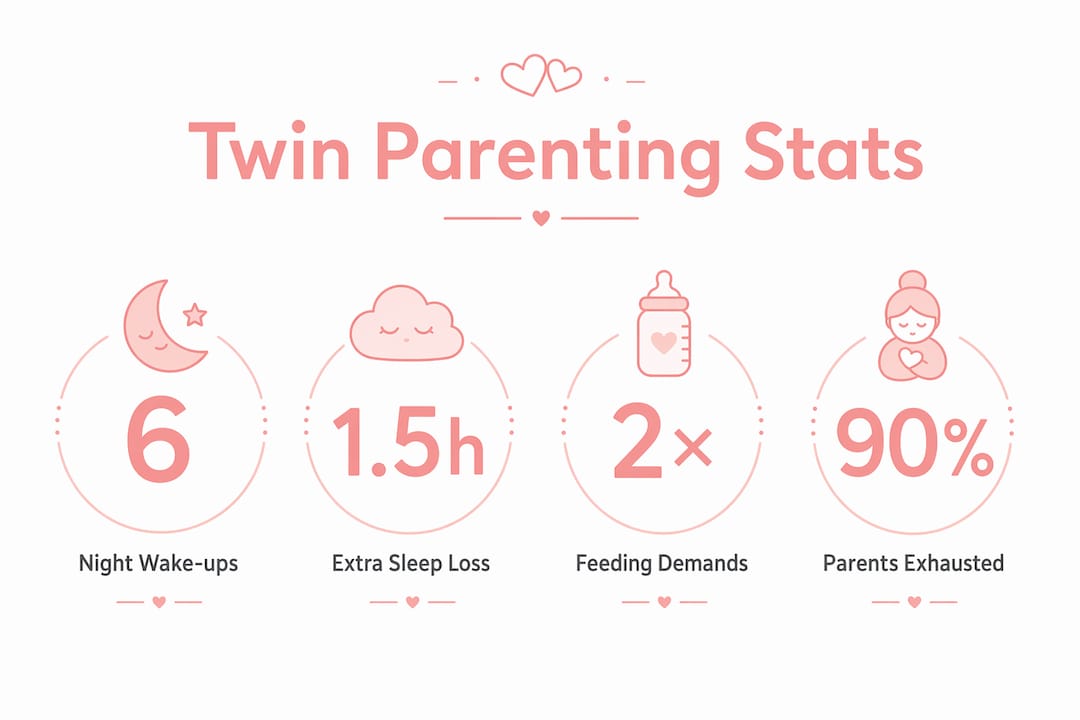
Sleep fragmentation is the hidden driver of this exhaustion. Newborn twins typically sleep 14–17 hours in fragmented periods with frequent feedings. The total sleep hours sound manageable. The fragmentation is what breaks you. Your brain never reaches the deeper, restorative sleep stages when it is interrupted every 60–90 minutes.
The psychological toll compounds the physical one. Here is what twin parents are managing simultaneously:
- Dual nervous system monitoring: Tracking hunger cues, sleep signals, and distress for two babies at once.
- Asymmetric guilt: Feeling like you are neglecting one baby while tending to the other.
- Unrealistic expectations: Believing you should have both babies on a perfect schedule by week four.
- Physical depletion: Nursing or pumping for two infants burns significantly more calories and demands more from your body than feeding one.
- Mental load doubling: Every decision, from feeding order to sleep position, is made twice, often under sleep deprivation.
“The pressure to synchronize twins can increase anxiety when parents expect immediate consistency. Newborn sleep patterns mature gradually, and immediate consistency is uncommon. Accepting that irregularity is natural reduces stress and improves caregiving resilience.” — Well Supported Family
Pro Tip: Lower your benchmark. If both babies slept for two consecutive hours and you got one of those hours yourself, that is a win. Measuring success against a perfect schedule will drain you faster than the babies will.
Practical strategies for managing twin schedules and reducing exhaustion
The single most effective shift you can make in the first 8–12 weeks is moving from a clock-based schedule to a sequence-based routine. Newborns’ circadian rhythms do not fully develop until 2–4 months of age. Forcing clock precision before then works against their neurology, not with it. An eat-play-sleep sequence, repeated consistently, gives your babies a predictable pattern without demanding impossible timing.
Here is a practical framework for reducing daily exhaustion:
- Adopt the eat-play-sleep sequence. Feed both babies, allow brief awake time, then put both down for sleep. Repeat. This sequence works with newborn biology instead of against it.
- Wake the second twin within 15 minutes of the first. A small gap is fine. A 45-minute gap means two separate wake-ups and no rest for you.
- Use white noise in the shared room. Consistent white noise reduces the chance that one baby’s crying wakes the other during light sleep transitions.
- Practice triage caregiving. Twin caregiving is triage, not simultaneous perfect care. Assess who needs immediate soothing, reassure the other with your voice or touch, and rotate. This is not neglect. It is sustainable caregiving.
- Check the quiet twin first. Checking on the quieter twin before tending to the crying one prevents inadvertent neglect and helps both babies develop self-soothing skills over time.
- Build in a daily handoff. If you have a partner, schedule one defined block each day where caregiving responsibility transfers completely. Even 90 minutes of uninterrupted rest changes your cognitive function for the rest of the day.
- Adjust without guilt during disruptions. Growth spurts, illness, and developmental leaps will break any rhythm you have built. Treat disruptions as temporary resets, not failures. The twin newborn sleep schedule you build at eight weeks will look different at sixteen weeks, and that is normal.
For parents managing twins without a partner present, the solo twin parenting tips at Twinsandcounting offer specific strategies for single-adult households where triage caregiving is the only option.
Common myths about twin schedules that make exhaustion worse
Several widely repeated beliefs about twin parenting actively increase exhaustion by setting impossible standards. Recognizing them helps you stop measuring yourself against a benchmark that does not exist.
- Myth: Twins should be on identical schedules by one month. Newborn sleep patterns mature gradually. Perfect synchronization is a myth, and chasing it in the early weeks creates anxiety without results.
- Myth: Treating twins identically is always the right approach. Twins are two separate people with different temperaments, hunger levels, and sleep needs. Forcing identical treatment ignores their individuality and often backfires when one baby’s needs genuinely differ.
- Myth: Waking a sleeping baby is harmful. Waking the sleeping twin to align feeding times is a deliberate, evidence-supported strategy. It is not cruelty. It is the difference between two separate wake-up calls and one shared feeding window.
- Myth: A schedule and a routine are the same thing. A schedule is clock-based. A routine is sequence-based. Routines are far more realistic for newborns whose circadian rhythms are still developing. The eat-play-sleep sequence is a routine, not a schedule, and it works precisely because it does not demand clock precision.
- Myth: If you are exhausted, you are doing it wrong. Exhaustion is the expected outcome of managing two infants’ conflicting needs. It reflects the reality of twin parenting, not a failure of your parenting skills.
Key Takeaways
Twin schedule exhaustion is a predictable, biological outcome of managing two separate nervous systems simultaneously, and it requires twin-specific strategies, not scaled-up singleton advice.
| Point | Details |
|---|---|
| Sleep loss is compounded | Twin parents lose an extra 1.5 hours of sleep per night in the first six months, accelerating exhaustion and anxiety risk. |
| Synchronization takes months | Gentle schedule alignment during the first 6–8 months creates rest windows without forcing unrealistic clock precision. |
| Routines beat schedules early on | The eat-play-sleep sequence works with newborn neurology; rigid clock schedules work against it before 2–4 months of age. |
| Triage caregiving is normal | Attending to the most distressed baby first, while reassuring the other, is sustainable and supports healthy attachment. |
| Expectations drive exhaustion | Unrealistic pressure to synchronize twins immediately increases parental anxiety and worsens the experience of exhaustion. |
What I have learned about twin exhaustion that no one tells you
The hardest part of twin parenting is not the sleep loss itself. It is the guilt that rides alongside it. You tend to one baby and feel the weight of the other watching. You finally get both down and lie awake wondering if you are doing enough. That guilt is its own form of exhaustion, and it is almost never discussed.
What I have found, both from experience and from the parents who share their stories, is that the parents who cope best are not the ones with the most perfect schedule. They are the ones who accepted, early on, that twin parenting is fundamentally asymmetric. You will not always give both babies equal attention in the same moment. You will not always feel like a good parent. Both of those things are true and neither of them means you are failing.
The nervous system overload that twin parents experience is real and documented. Knowing that does not make it easier in the 3:00 AM moment, but it does make it less personal. You are not struggling because you are weak. You are struggling because the demand is genuinely harder than what singleton parenting advice prepares anyone for.
Give yourself the same patience you give your babies. They are figuring out how to sleep. You are figuring out how to parent two of them at once. Neither of you has done this before.
— Jay
Support built specifically for twin parents
Twinsandcounting exists because generic parenting advice consistently misses the twin experience. The resources there address the specific realities of dual caregiving, from self-care practices for twin parents that actually fit into a twin household’s schedule, to real stories from parents who have been exactly where you are right now.

If you are in the thick of the first few months and feeling like you are barely holding on, you are not alone and you are not doing it wrong. Twinsandcounting’s community shares real twin parenting stories from parents who have navigated the same exhaustion and come out the other side with practical wisdom worth reading. The chaos does not last forever. The right support makes it shorter.
FAQ
Why do twin schedules exhaust parents more than singleton schedules?
Twin parents manage two separate, often conflicting biological rhythms simultaneously, which creates compounded sleep fragmentation and continuous dual nervous system monitoring. This level of cognitive and physical demand has no equivalent in singleton parenting.
When do twin babies naturally start to sync their schedules?
Most twins begin to show more predictable patterns between 6–8 months, though gentle synchronization efforts during this window help create earlier rest opportunities for parents.
Is it okay to wake a sleeping twin baby?
Waking the sleeping twin to align feeding times is a widely recommended strategy. It prevents staggered wake-ups that eliminate any rest window for parents and does not harm the baby.
What is the difference between a twin routine and a twin schedule?
A routine is sequence-based, such as eat-play-sleep, and works with a newborn’s developing neurology. A schedule is clock-based and is often unrealistic before babies develop circadian rhythms at 2–4 months of age.
How can twin parents reduce exhaustion without perfect schedule synchronization?
Triage caregiving, the eat-play-sleep sequence, white noise, and daily caregiver handoffs all reduce exhaustion without requiring perfect schedule alignment. Lowering expectations around synchronization also significantly reduces parental anxiety.