

Twin parent advocacy is defined as the deliberate effort parents of twins make to secure individualized care, resources, and support that reflect the distinct realities of raising multiples. It goes far beyond speaking up at a single doctor’s appointment. Advocacy for twin parents means actively shaping medical decisions, pushing for individual recognition in schools, and building networks that understand the twin experience from the inside out. Twinsandcounting exists precisely because these needs are real, specific, and often invisible to professionals trained on singleton parenting norms. If you have ever felt like the standard advice simply does not fit your family, you already understand why this matters.
What is twin parent advocacy and why does it matter?
Twin parent advocacy is the practice of informed, active participation in every system that affects your children’s health, development, and wellbeing. The term sits within the broader field of patient and family advocacy, but it carries a layer of complexity that general parenting support rarely addresses. Raising twins means navigating two developmental timelines simultaneously, often with medical histories that diverge from the first weeks of life.
The stakes are high from the start. Twin pregnancies classified as monochorionic diamniotic (MCDA) require close monitoring and carry risks that demand parents understand clinical language, ask precise questions, and contribute meaningfully to care plans. Research shows that 70% of cases where parents brought well-sourced information to appointments saw clinicians incorporate that data into decisions. That figure tells you something important: your preparation directly changes outcomes.

Advocacy also matters because the default assumption in most care settings is that twins are a matched pair. They are not. Each child deserves assessment on their own terms, and getting that requires a parent who knows how to ask for it.
What unique challenges do twin parents face that require advocacy?
Twin parenting challenges cluster into three areas: medical complexity, developmental difference, and social isolation. Each one creates a specific need for advocacy.
Medical complexity from day one
Twin pregnancies carry higher rates of preterm birth, NICU admission, and feeding difficulties than singleton pregnancies. Parents of premature twins often find themselves making rapid decisions about feeding methods, respiratory support, and discharge timing with little preparation. Advocacy in this context means knowing which questions to ask, understanding the difference between corrected and chronological age, and requesting clear explanations rather than accepting clinical shorthand.
Developmental differences and the twin dynamic
Twins develop language and social skills within a shared environment that has no equivalent in singleton parenting. Professionals who evaluate twins using standard singleton developmental timelines frequently miss what specialists call the “twin dynamic,” a pattern where two children develop a private communication system that can delay conventional language acquisition. Professional guidance stresses evaluating twins with an understanding of this dynamic rather than applying single-child norms. Without a parent who raises this distinction, many twins receive unnecessary intervention or, conversely, miss support they genuinely need.
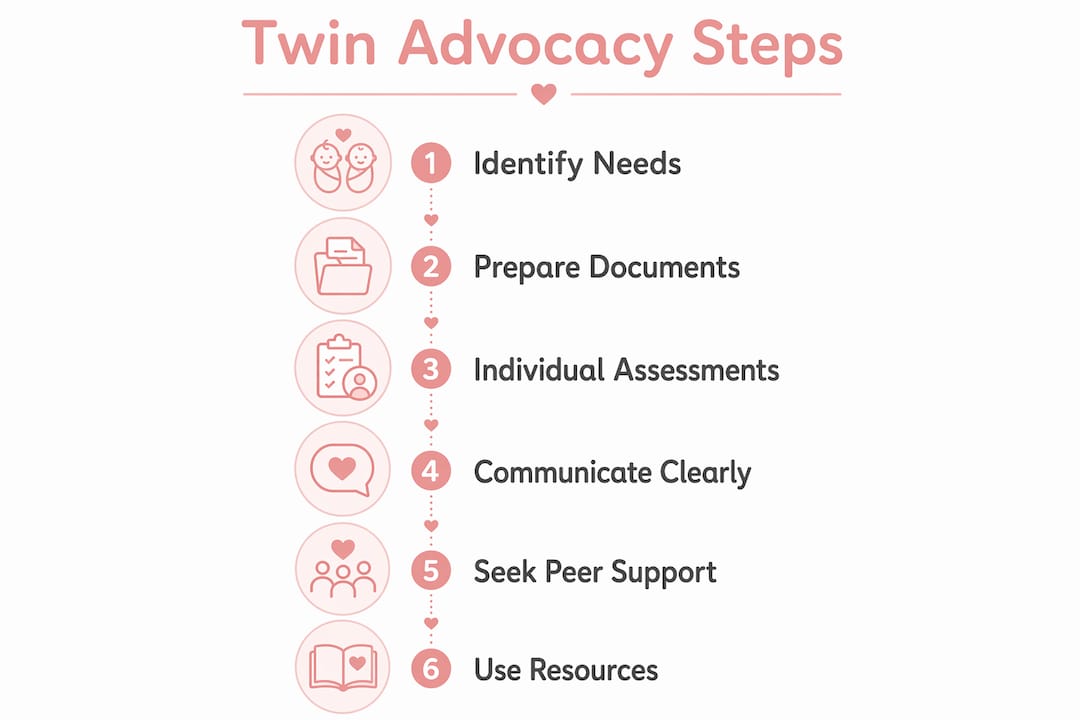
Advocacy here means requesting that each child be assessed individually. It means bringing this context to speech therapists, pediatricians, and school psychologists before they apply a checklist designed for a different kind of child.
Social isolation and the need for tailored support
Twin parenting feels isolating in ways that are hard to explain to parents of singletons. The logistics alone, two feeding schedules, two sleep regressions, two sets of developmental milestones, create a level of demand that standard parenting groups rarely address. Advocacy in the social sphere means seeking out communities and professionals who understand this reality rather than settling for generic advice that does not fit.
Key challenges that drive the need for advocacy include:
- Frequent specialist appointments requiring parents to coordinate and communicate across multiple providers
- NICU experiences that leave parents with complex medical knowledge and no clear framework for using it at home
- School systems that default to placing twins together or apart without consulting parents on what each child actually needs
- Mental health pressures that go unrecognized because twin parenting is often framed as a blessing rather than a genuine clinical stressor
How do parents effectively advocate in medical and educational settings?
Effective advocacy is a skill, and it looks nothing like confrontation. Research confirms that clinicians welcome data brought by parents when it is presented respectfully, and that this approach improves care alignment and trust. The goal is to position yourself as a prepared team member, not an adversary.
Here is a practical framework for medical and school settings:
- Prepare before every appointment. Write down your two or three most specific concerns. Vague concerns get vague answers. “He seems behind” gets less traction than “His speech therapist noted 15 words at 18 months; I want to understand what that means for a twin with a close sibling relationship.”
- Bring documentation. Growth charts, feeding logs, and developmental notes give clinicians something concrete to respond to. Shared decision-making research shows that parents who arrive with curated information accelerate complex decisions rather than slowing them down.
- Request individual assessments explicitly. Ask that each twin be evaluated separately, especially for language, behavior, and learning. Professionals often overlook that twins need individual attention to address issues caused by the twin social dynamic.
- Use specific language when asking for help. Scripts like “Right now, the most useful thing would be X” produce better results than open-ended requests. Specificity removes guesswork for the person trying to help you.
- Follow up in writing. A brief email after an appointment confirming what was agreed creates accountability and a record you can reference at the next visit.
Pro Tip: Before any IEP or school placement meeting, write a one-page summary of each twin’s individual strengths, challenges, and social needs. Hand it to the team at the start. It signals preparation and frames the conversation around your children as individuals.
Advocacy in educational settings follows the same logic. Request separate parent-teacher conferences for each child. Ask how the school handles classroom placement decisions for twins. Push for individualized education plans when one twin has different needs from the other.
What roles do peer support and community networks play?
Peer support is not a soft add-on to twin parent advocacy. It is one of its most effective mechanisms. 83% of parents find peer stories and lived experiences more helpful than generic parenting advice. That preference has driven the growth of specialized twin parenting communities that offer seminars, peer Q&As, and age-specific support groups.
The Nuffield Family Justice Observatory has documented how peer parental advocates reshape professional perceptions, shifting the dynamic from intervention-focused to collaborative support. Social workers report working better with families when a parent advocate is involved. That shift matters because it changes the entire tone of a care relationship.
“This is an opportunity for me to be someone I wish I could have had back then.” That sentiment, shared by a trained peer advocate, captures exactly why peer advocacy works. It is not abstract support. It is lived experience offered at the moment another parent needs it most.
Peer advocacy programs work best when advocates receive proper training. Effective peer advocates understand professional language, respect confidentiality, and show up reliably. That discipline is what makes them credible to the professionals they work alongside.
Online and in-person formats each serve different needs. Online communities provide access at 2:00 AM when both babies are awake and you need to know you are not alone. In-person groups build the kind of trust that comes from sitting in the same room with someone who gets it. The strongest support systems combine both. Twinsandcounting’s postpartum support resources offer a starting point for parents looking to connect with both formats.
How can parents find and use twin family resources effectively?
Twin family resources exist at national, regional, and local levels, and the best approach combines several formats rather than relying on one. Multiples of America, for example, offers a national network with local chapters that run age-specific groups, workshops, and annual conferences. These groups give parents access to vetted information and peer connections at the same time.
When choosing a group or resource, match it to where your children are developmentally. A group focused on infant feeding does not serve you well when your twins are starting kindergarten. Age-specific alignment makes the advice relevant and the peer connections more meaningful.
| Resource format | Best for | What to look for |
|---|---|---|
| National organizations | Vetted information and structured programs | Age-specific groups, trained facilitators |
| Local twin clubs | In-person peer connection | Active membership, regular meetings |
| Online communities | 24/7 access and broad experience pool | Moderated discussions, real parent voices |
| Hospital-based groups | Medical advocacy and NICU follow-up | Clinical staff involvement, specialist access |
| Dedicated parenting sites | Practical daily guidance | Twin-specific content, not adapted singleton advice |
Twinsandcounting sits in that last category. Its content addresses twin-specific challenges directly, from individual attention strategies to mental health support for parents managing the weight of raising two children at once.
Pro Tip: When you join a new parent group, introduce yourself with your twins’ ages and one specific challenge you are facing. You will get more useful responses than a general introduction, and you will find the people in the group who have already solved that exact problem.
The most effective parents combine digital resources for information with in-person communities for emotional grounding. Neither replaces the other.
Key Takeaways
Twin parent advocacy is most effective when parents combine prepared, specific communication with professionals and consistent connection to peer communities that understand the twin experience.
| Point | Details |
|---|---|
| Advocacy is informed participation | Bringing curated information to appointments improves clinical decisions and builds trust with providers. |
| Twins need individual assessment | Request separate evaluations for each child to account for the twin dynamic in language and development. |
| Peer support changes outcomes | Trained peer advocates improve communication between families and professionals in measurable ways. |
| Specific requests get real help | Scripts like “the most useful thing right now would be X” produce better support than open-ended asks. |
| Combine resource formats | Use national organizations, local clubs, and dedicated sites like Twinsandcounting together for full coverage. |
Why advocacy changed how I parent, not just how I talk to doctors
I used to think advocacy meant arguing. It took me a while to understand that the most powerful thing I ever did for my twins was walk into an appointment with a one-page summary of each child’s developmental history and a list of three focused questions. The clinician’s entire posture changed. We went from a 15-minute check-in to a real conversation.
The other misconception I see constantly is that asking for help signals weakness. Parents of twins carry a load that most people genuinely cannot picture. Asking a neighbor to take one baby for two hours so you can sleep is not a failure. It is logistics. The same logic applies to advocacy. Asking a teacher to evaluate your twins separately is not being difficult. It is being accurate.
What I have found in peer communities is something I did not expect: the relief of being understood without explanation. You do not have to justify why you are tired or why a standard parenting tip does not apply to your situation. That shared understanding is itself a form of advocacy. It keeps you grounded enough to show up prepared at the next appointment.
The parents who thrive in this are not the loudest ones. They are the most specific. They know what they need, they ask for it clearly, and they build relationships with professionals over time. That is the version of advocacy worth practicing.
— Jay
Twinsandcounting: resources built for the twin parenting experience
Twinsandcounting is built specifically for parents who know that generic parenting advice often misses the mark. The site covers the full arc of twin parenting, from NICU follow-up and feeding challenges to developmental milestones and mental health support.
If you are looking for real stories from parents who have navigated the same decisions you are facing, the twin parenting stories section offers exactly that. For parents managing their own wellbeing alongside their children’s needs, the mental health guide provides practical, twin-specific strategies. Every resource on Twinsandcounting is written with the understanding that your family has two children with two sets of needs, and that you deserve support that reflects that reality.
FAQ
What is twin parent advocacy in simple terms?
Twin parent advocacy is the active effort parents of twins make to secure individualized care, resources, and support for their children. It includes speaking up in medical settings, requesting separate assessments in schools, and connecting with peer communities that understand the twin experience.
How do I start advocating for my twins at medical appointments?
Bring a written list of two or three specific concerns and any relevant documentation, such as growth charts or feeding logs. Research shows that parents who arrive with curated information improve clinical decision-making and build stronger relationships with their care team.
Do twins really need individual assessments?
Yes. Twins develop within a shared social environment that can affect language acquisition and behavior in ways that standard singleton timelines do not account for. Requesting separate evaluations for each child gives professionals the context they need to assess accurately.
How does peer support help with advocacy for twin parents?
Peer advocates provide emotional support and help parents navigate complex systems by sharing lived experience. Social workers report working more effectively with families when a trained parent advocate is involved, improving communication and reducing misunderstanding on both sides.
Where can I find twin-specific family resources?
National organizations like Multiples of America offer local chapters with age-specific groups and workshops. Online communities provide around-the-clock peer connection. Dedicated sites like Twinsandcounting offer practical, twin-specific guidance on development, feeding, sleep, and parental wellbeing.