

Premature twin care is the specialized medical and emotional support provided to twins born before 37 weeks gestation to address their unique health and developmental needs. About 60% of twin pregnancies in the U.S. result in preterm birth, with 20% arriving before 34 weeks. That statistic means most twin parents will encounter some level of neonatal intensive care. Knowing what to expect, from NICU protocols to feeding strategies and developmental milestones, gives you the confidence to show up as an active, informed partner in your babies’ care.
What is premature twin care and why does it differ from singleton care?
Premature twin care is a coordinated set of medical, nutritional, and developmental interventions designed specifically for twins born before full term. Twins face a higher baseline risk than singleton preemies because shared uterine space, placental competition, and the mechanics of multiple pregnancy all accelerate early delivery. The result is two babies who often arrive smaller, less developed, and more medically fragile than a single preterm infant.
Gestational age at birth shapes everything. Clinicians group preterm births into three categories: late preterm (34–36 weeks), very preterm (28–33 weeks), and extremely preterm (under 28 weeks). Each category carries a different set of challenges, a different NICU timeline, and a different set of milestones for parents to track. Understanding which category your twins fall into helps you ask the right questions from day one.
Twin neonatal care also differs logistically. You are managing two individual patients with potentially different birth weights, different gestational ages if they are discordant twins, and different rates of progress. One baby may be ready to breastfeed while the other still depends on a nasogastric tube. That asymmetry is normal, and the NICU team will guide each twin on their own timeline.

What health challenges do premature twins face?
Late preterm infants born at 34–36 weeks have feeding difficulties roughly four times more common than full-term babies, plus higher rates of jaundice, hypothermia, hypoglycemia, respiratory distress, and apnea. Those numbers climb sharply for very preterm and extremely preterm twins. This is why extra monitoring for twins begins immediately after birth.
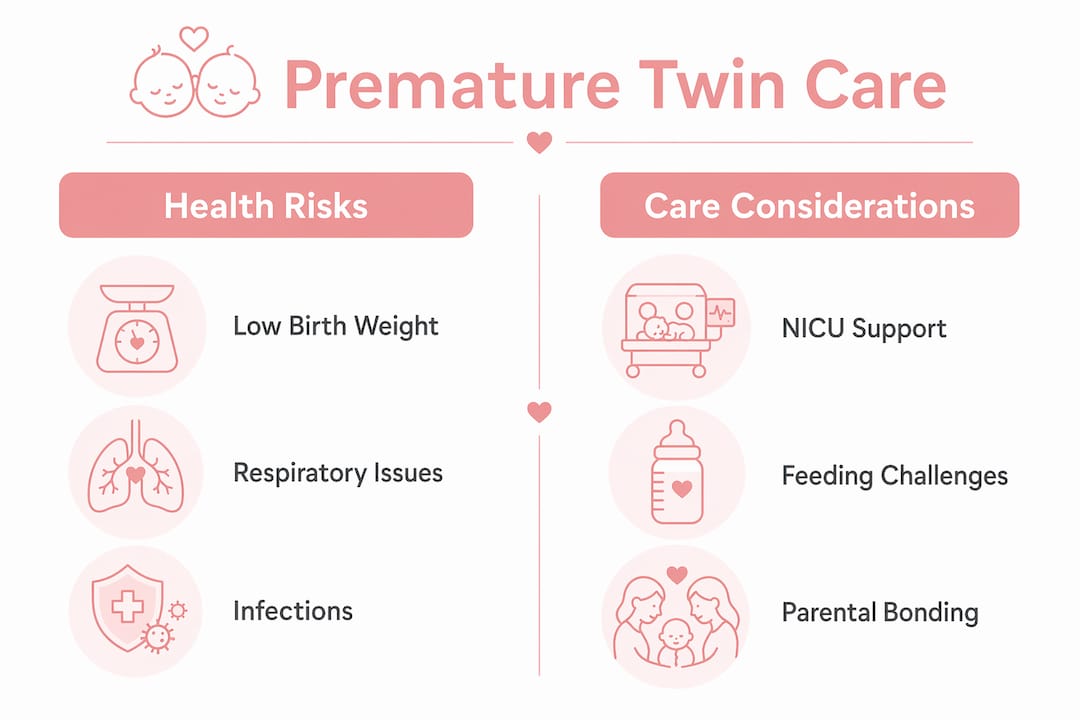
The most common conditions premature twins face include:
- Respiratory distress syndrome (RDS): Underdeveloped lungs cannot produce enough surfactant, the substance that keeps air sacs open. Ventilatory support or surfactant therapy addresses this directly.
- Apnea of prematurity: Breathing pauses are common before 35 weeks. Continuous monitoring for apnea, bradycardia, and hypoxemia is standard until 35 weeks gestation.
- Jaundice: Immature livers cannot process bilirubin efficiently. Phototherapy under blue spectrum lights is the standard treatment.
- Temperature instability: Premature babies lack the fat stores needed to regulate body heat. Incubators and servo-controlled warmers maintain a stable thermal environment.
- Feeding difficulties: The suck-swallow-breathe reflex does not fully coordinate until around 34 weeks, making oral feeding impossible for very preterm twins.
- Infection risk: Immature immune systems make premature twins vulnerable to hospital-acquired infections, requiring strict hygiene protocols from everyone who touches them.
Multiple births amplify these risks because twins are statistically more likely to be growth-restricted, share placental blood flow unevenly, or arrive via emergency cesarean after fetal distress. Knowing this is not meant to frighten you. It is meant to help you understand why the NICU team moves quickly and monitors so closely.
How does NICU care support premature twins?
The NICU provides a controlled environment that replicates, as closely as possible, the conditions your babies would have experienced inside the womb. The first hours after birth involve rapid assessments: Apgar scores, weight, gestational age confirmation, blood glucose checks, and respiratory evaluation. From there, care becomes highly individualized.
Here is a typical progression of NICU milestones for premature twins:
- Admission and stabilization (day 1–3): Each twin is placed in an incubator or under a servo-controlled warmer. Respiratory support, IV fluids, and initial labs begin immediately.
- Feeding via nasogastric tube: Oral feeding is not possible until the suck-swallow-breathe reflex matures, typically around 34 weeks corrected gestation. Until then, your pumped breast milk or a specialized preterm formula is delivered directly to the stomach through a thin tube.
- Respiratory weaning: As lung function improves, the team gradually reduces ventilatory support, moving from mechanical ventilation to CPAP to high-flow nasal cannula and eventually to room air.
- Introduction of skin-to-skin care: Once each twin is stable, Kangaroo Mother Care begins. Kangaroo Mother Care reduces mortality in preterm infants by 32% when started early and improves temperature stability and breastfeeding success. That single intervention is one of the most powerful things you can do.
- Transition to oral feeding: Breastfeeding or bottle feeding trials begin when each twin shows readiness cues, not on a fixed calendar date.
- Discharge criteria: Babies go home when they can maintain their own temperature, feed consistently by mouth, and gain weight steadily without medical support.
Pro Tip: Ask your NICU nurse to show you how to read each twin’s monitor. Understanding what the numbers mean reduces anxiety and helps you recognize when a baby is truly stable versus when an alarm is a false trigger.
The NICU runs on the babies’ physiological clock, not yours. NICU milestones occur according to neurodevelopmental readiness, not chronological age or weight. Parents who understand this manage the experience with far less distress.
What are the feeding challenges for premature twins?
Feeding is the most time-consuming and emotionally charged part of premature twin care. The suck-swallow-breathe sequence requires neurological coordination that simply does not exist before 34 weeks. Before that point, every calorie your babies receive comes through a nasogastric tube, and your pumped milk is the single most valuable thing you can provide.
Very low-birthweight infants under 1,500 grams require human milk fortified with extra protein, calcium, and phosphorus, or a specialized preterm formula. Human milk alone does not deliver enough of these nutrients for rapid catch-up growth. The NICU dietitian will guide fortification decisions for each twin individually.
Common feeding challenges parents encounter include:
- One twin progressing to oral feeds while the other remains tube-dependent, creating two completely different feeding routines simultaneously.
- Fatigue during feeds. Premature babies tire quickly and may fall asleep before taking an adequate volume.
- Slow weight gain despite adequate intake, which can feel discouraging but is often normal in the early weeks.
- Difficulty latching at the breast due to low muscle tone or a small mouth relative to the nipple.
Pro Tip: Start pumping within the first hour after delivery if possible, and pump every 2–3 hours around the clock to establish supply. Your milk production in week one directly determines your supply for the weeks ahead.
Parental involvement in NICU feeding tasks, including pumping, skin-to-skin feeding practice, and bottle feeding trials, improves both infant outcomes and your own sense of purpose during a period when so much feels out of your control. For detailed guidance on managing feeds after discharge, Twinsandcounting has a dedicated resource on feeding premature twins at home.
How do parents support bonding and development during NICU care?
Bonding with two babies in an intensive care unit is genuinely hard. Wires, alarms, and incubator walls create physical distance at the exact moment your instincts are screaming to hold your children. The good news is that the NICU team actively wants you involved, and your presence has measurable clinical value.
Skin-to-skin contact is your most powerful tool. Beyond the 32% mortality reduction, Kangaroo Mother Care also reduces the risk of positional plagiocephaly by breaking the constant pressure of supine positioning on your babies’ soft skulls. Premature twins spend long hours on their backs, which puts them at higher risk for flat head syndrome. Regular skin-to-skin sessions interrupt that pattern.
Key strategies for supporting development and bonding in the NICU:
- Use adjusted age for milestones. Premature twins need adjusted age tracking until about two years old. Adjusted age is chronological age minus the weeks born early. A baby born 10 weeks early who is 6 months old has an adjusted age of about 3.5 months. Use that number when comparing to developmental charts.
- Talk and sing to your babies. Your voice is familiar from the womb and has a documented calming effect on heart rate and oxygen saturation.
- Participate in cares. Diaper changes, temperature checks, and repositioning are tasks the NICU team will teach you. Doing them builds competence and deepens your bond.
- Protect your own mental health. NICU stress is real and cumulative. Postpartum support resources specifically for twin parents can help you process the experience without burning out.
Start preparing your home environment for your twins’ arrival well before discharge. Premature babies go home before they reach their original due date, and the transition happens faster than most parents expect.
What ongoing care do premature twins need after discharge?
Discharge from the NICU is not the finish line. Premature twins require structured follow-up care that continues for months or years depending on their gestational age at birth and any complications they experienced.
| Care area | What to expect |
|---|---|
| Pediatric checkups | Frequent weight and growth checks in the first weeks; neurodevelopmental screening at regular intervals |
| Adjusted age tracking | Use corrected age for all milestone assessments until approximately 2 years old |
| Therapies | Physical, occupational, or speech therapy may be recommended based on individual development |
| Respiratory monitoring | Watch for signs of breathing difficulty, especially during RSV season; some preemies qualify for RSV prophylaxis |
| Vaccination schedule | Preemies follow the standard vaccine schedule based on chronological age, not adjusted age, with rare exceptions |
| Feeding progress | Monitor weight gain, feeding duration, and signs of adequate intake at every visit |
The most common gap parents fall into after discharge is comparing their premature twins to full-term babies of the same chronological age. That comparison will consistently make your babies look behind. Use adjusted age, trust the developmental trajectory, and raise concerns with your pediatrician early rather than waiting.
Key Takeaways
Premature twin care requires coordinated medical support, parent-led bonding, and adjusted-age developmental tracking from birth through at least the first two years of life.
| Point | Details |
|---|---|
| Preterm birth is the norm for twins | About 60% of twin pregnancies end before 37 weeks, making NICU care a common experience. |
| Gestational age determines care intensity | Late preterm, very preterm, and extremely preterm twins each face distinct health challenges and timelines. |
| Kangaroo Mother Care saves lives | Skin-to-skin contact reduces preterm mortality by 32% and supports temperature regulation and breastfeeding. |
| Feeding requires specialized nutrition | Very low-birthweight twins need fortified human milk or preterm formula; tube feeding precedes oral feeds until ~34 weeks. |
| Adjusted age guides development | Track milestones using corrected age, not birth date, until your twins reach approximately 2 years old. |
The NICU clock runs differently than yours
The hardest thing I have seen parents struggle with in the NICU is not the medical complexity. It is the waiting. You arrive expecting to hold your babies, and instead you watch monitors and ask permission to touch your own children. That gap between expectation and reality is where most of the emotional damage happens.
What I have learned is that the NICU’s timeline is not arbitrary. Every milestone, the first time a nurse lets you do a diaper change, the first skin-to-skin session, the first oral feeding attempt, happens when the baby is ready, not when the calendar says it should. Fighting that timeline does not speed it up. Accepting it, and finding your role within it, is what actually helps.
The medical outlook for preterm infants has improved significantly over the past two decades. Family-centered care, where parents are active participants rather than visitors, is now the standard at most level III and IV NICUs. That shift matters. Your presence, your voice, your milk, and your touch are not just emotionally meaningful. They are clinically significant.
Give yourself permission to grieve the birth experience you expected while still showing up fully for the one you have. Both things are true at the same time. And if you are struggling with the isolation that comes with a long NICU stay, you are not alone in that feeling. Connecting with other twin parents who have been through it is one of the most grounding things you can do.
— Jay
Support for every stage of premature twin care
Caring for premature twins does not end when you leave the hospital. The weeks and months after discharge bring their own set of questions, from feeding schedules to sleep patterns to developmental worries, and you deserve practical support for all of it.

Twinsandcounting has built a library of resources specifically for parents of twins at every stage, including guides on self-care practices for twin parents that hold up under the real demands of NICU life and early twin parenting. You will also find honest community stories from parents who have navigated premature twin care and come out the other side. When the nights feel long and the progress feels slow, knowing that other families have walked this path and thrived makes a real difference.
FAQ
What is premature twin care?
Premature twin care is the specialized medical, nutritional, and developmental support provided to twins born before 37 weeks gestation. It includes NICU monitoring, thermal regulation, tube feeding, respiratory support, and parent-led bonding through Kangaroo Mother Care.
How long do premature twins typically stay in the NICU?
NICU length of stay depends on gestational age at birth. Late preterm twins (34–36 weeks) may stay a few weeks, while extremely preterm twins (under 28 weeks) can remain in the NICU for several months.
When can premature twins start breastfeeding?
Breastfeeding readiness develops around 34 weeks corrected gestation, when the suck-swallow-breathe reflex matures. Before that point, your pumped milk is delivered via nasogastric tube.
How do I track development for premature twins?
Use adjusted age, which is chronological age minus the number of weeks born early, for all developmental assessments. Adjusted age tracking is recommended until approximately 2 years old.
Is skin-to-skin contact safe in the NICU?
Skin-to-skin contact, also called Kangaroo Mother Care, is safe and actively encouraged once each twin is stable. It reduces preterm mortality by 32% and supports temperature regulation, breastfeeding, and bonding.