

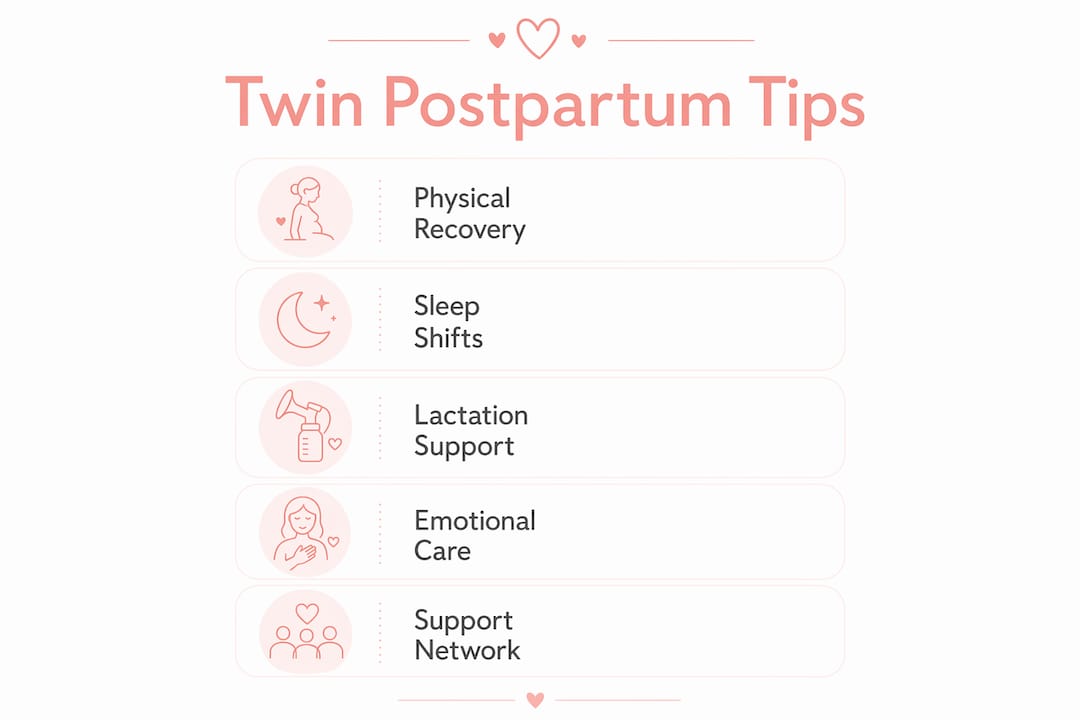
Caring for two newborns at once is double the joy and, honestly, double the overwhelm. Twin postpartum planning basics cover five core areas: physical recovery, sleep management, feeding support, emotional health, and building a practical help network. Parents of twins face a steeper climb than singleton parents from day one. Twin pregnancies carry a higher likelihood of C-section delivery, preterm birth, and intensified sleep deprivation, factors that make early planning less of a luxury and more of a lifeline. The good news is that with the right framework in place before your babies arrive, you can move through those first weeks with far more confidence and far less chaos.
Here is a quick snapshot of what solid postpartum care for twins looks like:
- Physical recovery: Plan for several weeks minimum, longer after a C-section
- Sleep: Split nighttime duties so at least one parent gets 4–5 hours uninterrupted
- Feeding: Work with an IBCLC (International Board Certified Lactation Consultant) who specializes in multiples
- Emotional health: Monitor for postpartum mood and anxiety disorders (PMADs), especially beyond the 2-week mark
- Support network: Assign specific tasks to helpers rather than accepting vague offers
- Pre-birth prep: Complete nursery setup and logistics by 30 weeks of pregnancy
Twinsandcounting has gathered clinical guidance, expert insights, and real-world strategies in this guide so you can walk into the postpartum period prepared rather than blindsided.
1. What your physical recovery timeline actually looks like
Your body needs real time to heal after a twin birth, and that timeline is longer than most people expect. Full physical recovery takes several weeks, and around a few months is when infant sleep schedules typically become more predictable. A C-section, which is more common with twins, adds abdominal surgery recovery on top of everything else: limited lifting, incision care, and pain management while simultaneously feeding two babies.

Common physical changes you will notice include postpartum bleeding, uterine cramping, leg and foot swelling, abdominal separation (diastasis recti), profound exhaustion, and hair loss. Pelvic floor weakness affects both vaginal and cesarean deliveries. These are normal, but they do require attention.
Sleep is the single most powerful recovery tool you have. Fragmented sleep directly worsens mood regulation and raises the risk of postpartum anxiety and depression. Splitting nighttime care so each parent gets a longer stretch is essential; it is the strategy that keeps both of you functional.
Recovery care tips and sleep strategies:
- Accept every offer of help with household tasks so you can rest when babies sleep
- Keep diaper-changing stations on multiple floors to cut unnecessary trips
- Avoid vigorous exercise until your six-week postpartum visit; gentle walking is fine sooner
- Eat regularly and stay hydrated, especially if breastfeeding or pumping
- Prioritize pelvic floor recovery with guidance from a pelvic floor physical therapist
Pro Tip: Implement a sleep-shift system where one parent handles one feeding while the other takes a later shift using pumped milk or formula. This gives each of you an uninterrupted block of restorative sleep, which is critical for recovery.
For more on coordinating rest around two babies, Twinsandcounting’s guide on synchronized nap strategies walks through practical scheduling approaches.
2. Feeding twins: what gets hard and where to get help
Feeding two newborns is genuinely time-consuming. Each baby may feed for 30–45 minutes at a stretch, and when you add burping, diaper changes, and soothing, you can find yourself in a near-continuous loop. Supply demands for breastfeeding twins are also higher than for a singleton, and many twins are born before 38 weeks, which means the breast-to-bottle transition often requires extra support from the start.

An IBCLC who has experience with multiples is one of the most valuable people you can have on your team. Lactation consultants specializing in multiples can guide you through tandem feeding positions, help you establish and monitor milk supply, and create a flexible plan that reduces exhaustion rather than adding to it. A twin nursing pillow makes tandem feeding far more manageable and works equally well for bottle-feeding, so your partner can take over a session.
Feeding is not an all-or-nothing decision. Breastfeeding, pumping, formula, and mixed feeding are all valid paths. What matters is that your babies are fed and you are not running on empty.
Feeding challenges and support tips:
- Wake both babies for feedings when one wakes, to keep them on the same schedule
- Switch nursing sides at each session to balance supply and support babies’ eye development
- Store expressed milk so a partner or helper can cover a feeding while you sleep
- Use a hands-free pumping bra to reclaim time during pumping sessions
- Ask your pediatrician about supplementing with formula if supply is slow to establish
- Keep lanolin on hand to manage nipple soreness in the early weeks
Pro Tip: Book an IBCLC consultation before your due date, not after. Lactation consultants with multiples experience fill up quickly, and having a relationship established means you can call for help the moment a feeding problem surfaces.
Twinsandcounting covers twin feeding strategies in depth, including tandem breastfeeding and pumping schedules tailored to multiples.
3. How to protect your emotional health after a twin birth
Parents of multiples face a higher risk of postpartum mood and anxiety disorders than parents of singletons. The combination of sleep deprivation, double the caregiving demands, and the hormonal shifts of the postpartum period creates real vulnerability. Brigham and Women’s Hospital’s Comprehensive Care Center for Multiples notes that a survey of more than two dozen studies found parents of multiples experience heightened symptoms of depression, anxiety, and parenting stress during pregnancy and through early parenthood.
Baby blues, which feel like sadness, moodiness, and tearfulness, typically resolve within two weeks on their own. Postpartum depression is different. Symptoms that persist beyond two weeks, or that include persistent hopelessness, difficulty bonding with your babies, excessive crying, or an inability to care for yourself, require medical evaluation. Both partners can experience postpartum depression, sometimes up to a year after birth.
Self-compassion is not a soft suggestion here. Gentle grounding exercises, short breathing practices, and regular check-ins with your partner about what is and is not working all help. If you notice persistent sadness or irritability, reaching out to a mental health professional is the right move. Resources on postpartum mood disorders can help you recognize warning signs early and understand what treatment looks like.
Emotional health tips and warning signs to watch for:
- Check in with your partner weekly: what is working, what needs to change
- Practice short grounding or breathing exercises during feeding sessions
- Give yourself permission to feel the full range of emotions, including the hard ones
- Watch for persistent sadness, irritability, or disconnection from your babies lasting more than two weeks
- Contact your healthcare provider immediately if symptoms worsen or interfere with daily function
- Seek a therapist who specializes in perinatal mental health for ongoing support
4. Building a support network that actually works
Asking for help is not a sign of struggle. Social workers who specialize in multiple births consistently emphasize that handling the transition alone leads to burnout, and with twins, the caregiving load makes solo management genuinely unsustainable. Your support network should include family, friends, and where possible, professionals like a postpartum doula, night nurse, or pelvic floor therapist.
The most practical tool for organizing help is a task menu. Write a visible list of specific chores and post it somewhere helpers can see it. This removes the mental load of directing people in real time and lets visitors contribute in ways that actually matter. “Bring a meal,” “fold the laundry,” and “hold a baby while I shower” are far more useful than an open-ended “let me know if you need anything.”
A strict visitor policy in the early postpartum weeks protects your rest and reduces stress. Social visits that require you to host, entertain, or stay alert are the opposite of helpful. Visitors who come to help should come to work, not to hold babies while you serve coffee.
Types of support and how to ask for them:
- Meal delivery or grocery runs: ask friends to coordinate a meal train
- Laundry, dishes, and light cleaning: assign these to family members on a rotating basis
- Baby-holding shifts: let a trusted helper take a baby so both parents can sleep simultaneously
- Night nurse or postpartum doula: hire professional overnight support if your budget allows
- Older sibling support: arrange for a family member to take older children for outings or overnights
- Emotional support: designate one or two people you can call honestly, without performing “fine”
5. What to prepare before your twins arrive
Twin pregnancies have a higher rate of preterm birth, which means your preparation window is shorter than you might assume. Complete your nursery setup, pack hospital bags, and finalize postpartum logistics well before the later stages of pregnancy. Waiting until 36 weeks, as many singleton parents do, is a risk you do not need to take.
Stocking postpartum essentials before birth removes one more decision from an already overwhelming first week. Think overnight pads, a peri-bottle, witch hazel pads, postpartum ice packs, pain relievers, stool softeners, nursing bras, a hands-free pumping bra, and loose, comfortable clothing. Pre-made freezer meals and a stocked pantry mean one less thing to coordinate when you are running on three hours of sleep.
Schedule your postpartum healthcare visits and your babies’ pediatrician appointments before you deliver. Twins often have more frequent early check-ins, particularly if they are born prematurely or have different growth trajectories. Having those appointments already on the calendar removes a task from your postpartum to-do list entirely.
Twinsandcounting’s guide on preparing your home for twins covers nursery setup and logistics in detail, including what to prioritize when space and budget are limited.
Key preparatory steps:
- Complete nursery setup and hospital bags by 30 weeks
- Stock postpartum recovery supplies before your due date
- Pre-make and freeze at least two weeks of meals
- Book an IBCLC consultation and confirm pediatrician availability for twins
- Write your task menu and share it with your support network in advance
- Arrange postpartum mental health support, such as a therapist referral, before birth
6. What the clinical evidence says about twin postpartum care
The research on twin postpartum recovery points consistently toward a few non-negotiable priorities. Physical recovery takes a minimum of 6–8 weeks, with around 3 months as the point when infant schedules become more predictable and sleep stretches longer. That 3-month milestone is worth holding onto during the hardest early weeks.
Sleep deprivation is the most documented stressor for twin parents, and the evidence supports splitting nighttime care as the most effective mitigation. Separating babies for care shifts, so one parent handles one baby while the other rests, ensures at least one adult gets a restorative sleep block. Parents who are exclusively nursing will need additional overnight support to make this work.
The PMAD risk for parents of multiples is well-documented and clinically significant. Symptoms lasting beyond two weeks require professional screening, not a wait-and-see approach. Early identification and treatment reduce both the severity and duration of postpartum depression and anxiety. Brigham and Women’s Hospital’s Comprehensive Care Center for Multiples specifically trains its social work team to educate twin parents about PMAD risks and normalize asking for help.
Key research-backed findings:
- Complete all pre-birth logistics by 30 weeks due to elevated preterm birth risk
- Physical recovery: minimum 6–8 weeks, with 3-month milestone for schedule predictability
- PMAD screening threshold: symptoms lasting more than 2 weeks require medical evaluation
- Sleep shifts and task menus are the two most evidence-supported practical tools for reducing parental anxiety
- A vetted visitor policy in the first 2–4 weeks measurably improves rest and reduces stress
- Flexibility and weekly partner communication reduce pressure and help adapt to babies’ evolving needs
7. Managing twin feeding schedules and tracking growth patterns
Getting both babies on the same feeding schedule is the single most effective way to create any downtime in the early weeks. When one baby wakes to eat, wake the other. It feels counterintuitive to wake a sleeping baby, but keeping them in sync means both sleep at the same time, which is the only window you have to rest. Newborns need to eat every 2–3 hours, and breastfed babies may cluster-feed every 1–2 hours, so the schedule will feel relentless at first.
Treat daytime and nighttime feedings differently from the start. Daytime feeds are active: talk to your babies, make eye contact, keep the lights up. Nighttime feeds should be calm, quiet, and low-lit. This distinction teaches your babies early that night is for sleeping, not socializing, and it pays off around the 3-month mark when longer overnight stretches begin.
Growth patterns in twins can diverge. One baby may feed more aggressively, gain weight faster, or have a stronger latch. Track each baby’s weight gain and wet diaper count separately, and bring those numbers to every pediatric visit. Your pediatrician can tell you whether each baby is on a healthy individual trajectory, which matters more than whether the two are identical. For premature twins, growth monitoring is especially close in the early months.
Pro Tip: Keep a simple feeding log for each baby separately, noting time, duration, and which breast or how many ounces. After two weeks, patterns emerge that make scheduling far easier and give your pediatrician concrete data to work with.
For parents navigating premature twin feeding challenges, Twinsandcounting has dedicated guidance on growth monitoring and adjusted feeding timelines.
Key Takeaways
Solid twin postpartum planning requires physical recovery awareness, strategic sleep splitting, IBCLC-supported feeding, early PMAD monitoring, and a task-specific support network built before birth.
| Point | Details |
|---|---|
| Physical recovery timeline | Full recovery takes at least 6–8 weeks; schedule predictability improves around 3 months. |
| Sleep shift strategy | Splitting nighttime care gives each parent a 4–5 hour uninterrupted block, protecting mental health. |
| IBCLC support for feeding | Lactation consultants specializing in multiples reduce exhaustion and help establish flexible feeding plans. |
| PMAD screening threshold | Symptoms lasting beyond 2 weeks require medical evaluation, not watchful waiting. |
| Pre-birth prep deadline | Complete nursery setup, hospital bags, and postpartum logistics by 30 weeks of pregnancy. |
You are more prepared than you think
The postpartum period with twins is intense, but it is also temporary. Every strategy in this guide, from sleep shifts to task menus to early IBCLC contact, exists because other twin parents figured out what works and shared it. You do not have to reinvent any of it.

Twinsandcounting has pulled together the most practical, clinically grounded twin care advice in one place. Start with the 9 essential tips for caring for twins for a fast, actionable overview that complements everything covered here. And when the harder emotions surface, the guide on twin parenting guilt is a honest, compassionate read that reminds you what “good enough” actually looks like.
You have got this. And you have support.