

Demand feeding twins is defined as responding to each baby’s individual hunger cues, and with two infants, those cues almost never align. The result is near-continuous caregiving that pushes most parents to their physical and mental limits within days. Understanding why demand feeding twins is difficult starts with one fact: newborns feed 8–12 times per day each, which means you are managing up to 24 feeding events every 24 hours. That number alone explains the exhaustion. Add in latch differences, mismatched sleep cycles, and the pressure to maintain milk supply, and you have a challenge that goes far beyond feeding skill. It is a logistics problem, and recognizing it as one is the first step toward managing it.
Why is demand feeding twins so difficult?
Demand feeding twins is uniquely hard because overlapping hunger cues create almost no rest between feeding cycles. With a single baby, you feed, burp, settle, and rest. With twins, the second baby’s hunger cues often begin before the first feeding is complete. That gap closes fast, and many parents find themselves in a loop that feels impossible to exit.
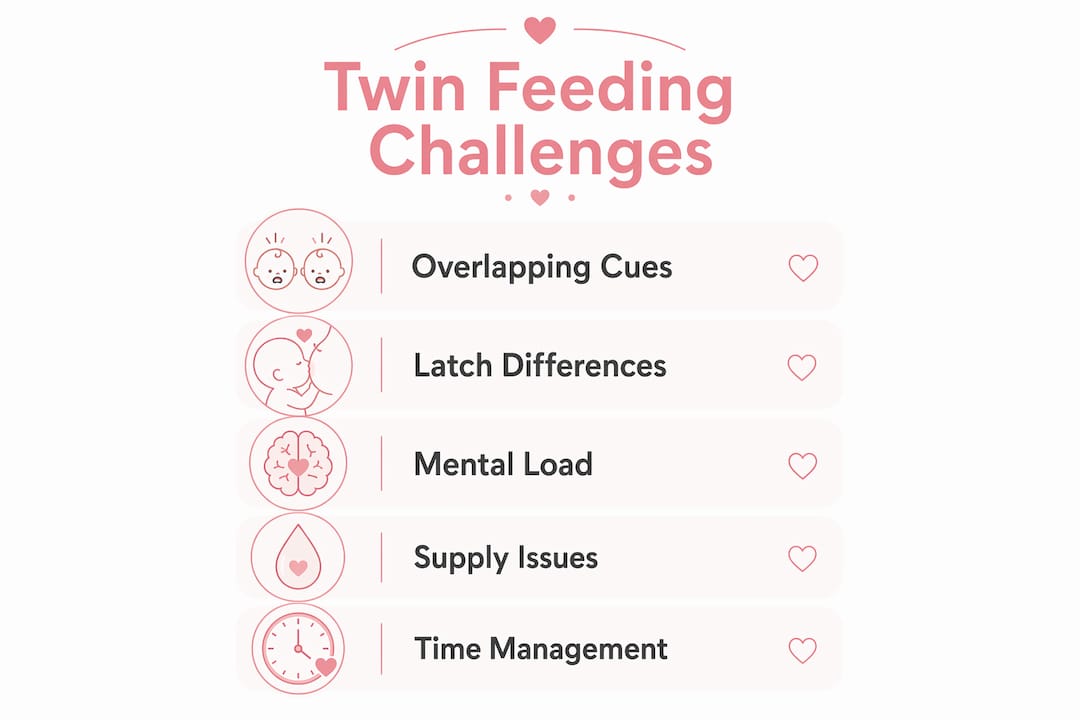
The core challenges stack quickly:
- Overlapping hunger windows mean you are coordinating feeding, burping, and diapering two babies on slightly different clocks, producing near-continuous caregiving.
- Nighttime fragmentation compounds daytime fatigue. Disrupted sleep cycles reduce your ability to read hunger cues accurately and respond with patience.
- Milk supply pressure is constant. Frequent milk removal is critical to maintaining supply, and if one twin sleeps through a feeding window, supply disruption follows.
- Physical exhaustion is not incidental. Research shows 70% of twin mothers report significant fatigue, and only 4% exclusively breastfeed for six months. That statistic reflects how unsustainable the demand feeding pace becomes for most families.
The mental load adds another layer. You are tracking two sets of hunger cues, two feeding durations, two latch qualities, and two diaper outputs simultaneously. Most caregivers do not struggle because they lack commitment. They struggle because the workload is genuinely extreme.
Pro Tip: Keep a simple feeding log for each twin using an app like Baby Tracker or Huckleberry. Tracking feeding times removes the mental burden of remembering and helps you spot patterns faster.

How do latch differences make twin feeding harder?
Latch and feeding pace differences between twins are one of the most underestimated twin breastfeeding difficulties. Twins are frequently born premature or at lower birth weights, and both factors directly affect feeding ability. A twin with a NICU history or prematurity often has a weaker suck reflex, a smaller mouth, or reduced stamina during feeds.
Here is what that looks like in practice:
- Twin A latches well and feeds in 15 minutes. Twin B struggles to latch, feeds slowly, and takes 35 minutes. By the time Twin B finishes, Twin A is showing hunger cues again.
- Mismatched feeding pace stretches total feeding time and fragments any rest window you had.
- Inconsistent milk removal caused by a poor latch does not just affect that session. Over days and weeks, latch timing mismatches reduce supply signals and can slow both twins’ weight gain.
The important distinction here is that supply problems in twin breastfeeding most commonly come from inconsistent milk removal, not from a mother’s inability to produce enough milk. The body responds to demand. When demand is irregular because one twin feeds poorly, the supply signal weakens. That is a fixable problem, but it requires identifying it early and getting support from a certified lactation consultant, known by the credential IBCLC.
Supplementation with pumped milk or formula is sometimes the right call during this period. It protects growth while you work on latch and does not automatically end breastfeeding.
Why do twin parents switch from demand to scheduled feeding?
The shift from demand feeding to scheduled feeding is not a failure. Clinical research shows that after weeks of demand feeding, many mothers move to scheduled feeding because the stress and workload become unsustainable. The decision is driven by workload, not willingness.
Here is why scheduled feeding appeals to exhausted twin parents:
- Predictability reduces mental load. When you know both babies will feed at 7 a.m., 10 a.m., and 1 p.m., you can prepare, rest, and plan around those windows.
- Nighttime preparation becomes simpler. Scheduled nighttime feeds allow you to pre-prepare bottles or set up nursing stations in advance, cutting the chaos of reactive middle-of-the-night scrambles.
- Caregiver rest improves. Knowing when the next feed is coming allows you to sleep intentionally between sessions rather than lying awake waiting for a cry.
- Burnout prevention becomes possible. Without a predictable structure, parents enter what The Newborn Care Solutions Agency describes as a cycle of “always feeding,” which leads directly to exhaustion and reduced caregiving quality.
“Demand feeding stress is often due to workload, not lack of willingness.” — BMJ Fetal & Neonatal research on feeding multiples and caregiver stress.
Scheduled feeding does involve trade-offs. Some babies may not be ready for rigid timing in the first few weeks. A hybrid approach, where you use a loose schedule but remain responsive to strong hunger cues, often works better than a strict clock-based system. The goal is a structure that protects both your babies’ nutrition and your ability to keep going.
What practical strategies can ease twin feeding struggles?
Managing the challenges of feeding twins requires systems, not just effort. The families who sustain demand or semi-demand feeding longest are the ones who treat it as a coordination problem and build routines around it.
Synchronize feedings to cut total time
The single most effective strategy is syncing twin feeding schedules so both babies feed within the same window. If Twin A wakes hungry, wake Twin B too. This feels counterintuitive at first. Waking a sleeping baby seems wrong. But feeding both together cuts your total daily feeding time significantly and creates rest windows that actually exist.
A tandem nursing pillow like the Twin Z Pillow or the My Brest Friend Twin Nursing Pillow allows you to breastfeed both babies simultaneously. This takes practice, but most parents find it manageable within one to two weeks.
Share the workload deliberately
| Strategy | Solo Caregiver | With a Partner or Support Person |
|---|---|---|
| Feeding method | Tandem feeding with a nursing pillow | One baby each, simultaneous bottle or breast |
| Night feeds | Prep bottles in advance, use a feeding station | Alternate nights or split the feed between you |
| Burping and settling | Sequential, one at a time | Simultaneous, one baby each |
| Fatigue management | Nap when both babies sleep | Take shifts to allow longer rest blocks |
Shared caregiving is not a luxury. Coordinated support is what prevents the burnout cycle. If you are parenting solo, the strategies shift but the principle stays the same. You can find specific guidance for that situation at Twinsandcounting’s solo parenting schedule tips.
Simplify your setup
- Pre-fill water bottles and prepare formula or pumping equipment before each feeding block.
- Set up a dedicated feeding station with everything within arm’s reach: burp cloths, diapers, a phone charger, and a snack for yourself.
- Use a white noise machine in the feeding area to help settle the waiting twin while you finish with the first.
Pro Tip: Prepare your nighttime feeding station before you go to sleep. Pre-measure formula, lay out burp cloths, and charge your phone. Removing those small decisions at 3 a.m. makes a real difference to how you function the next day.
Prioritize lactation support early
An IBCLC who has experience with multiples is worth contacting in the first week, not after problems develop. Early support catches latch issues before they affect supply and gives you a realistic picture of what is achievable for your specific situation.
Key takeaways
Demand feeding twins is a logistics challenge that requires coordination, support systems, and realistic expectations to sustain.
| Point | Details |
|---|---|
| Overlapping hunger cues | Two babies feeding on slightly different clocks creates near-continuous caregiving with almost no rest. |
| Fatigue is the primary barrier | Research shows 70% of twin mothers report significant fatigue, making sustained demand feeding very hard. |
| Latch differences drive supply problems | Inconsistent milk removal from one twin’s latch issues weakens supply signals over time. |
| Scheduled feeding is a valid choice | Clinical research confirms that switching to scheduled feeding is a workload response, not a failure. |
| Synchronizing feeds is the top strategy | Waking the second twin to feed simultaneously cuts total daily feeding time and creates real rest windows. |
What i’ve learned about demand feeding twins
Here is the honest truth most parenting resources skip: demand feeding twins is not primarily a breastfeeding challenge. It is a logistics and capacity challenge. I have seen parents with excellent latch technique, great supply, and genuine commitment still hit a wall at week three because the sheer volume of feeding events overwhelmed their ability to function.
The advice to “just follow their cues” works beautifully for a single baby. With twins, following every cue sequentially means you are almost never not feeding. That is not sustainable, and pretending it is does parents a disservice.
What actually helps is accepting early that you need a system. That system does not have to be rigid. It does not have to look like a military schedule. But it does need to include some predictability, some shared responsibility, and some intentional rest. The parents who do best with twin feeding are not the ones who try hardest. They are the ones who build the best support structure around themselves.
The other thing worth saying plainly: supplementing with formula while you work on supply or latch does not end your breastfeeding relationship. It protects your babies’ growth and your mental health while you figure out what works. That is a reasonable, evidence-informed choice, not a compromise.
— Jay
More twin feeding help from Twinsandcounting
If you are in the thick of twin feeding struggles right now, you are not alone and you are not doing it wrong. Twinsandcounting has built a library of practical, twin-specific resources to help you find your footing.

Start with the complete twin care guide for a full picture of what to expect in the early weeks. When you are ready to look at feeding patterns and signs your babies are getting enough, the feeding adequacy guide gives you clear markers to watch for. And if caregiver burnout is already knocking at your door, the twin parent self-care guide offers real strategies for protecting your wellbeing while you care for two. You deserve support too.
FAQ
What is demand feeding, and does it apply to twins?
Demand feeding means feeding each baby in response to their individual hunger cues rather than a fixed schedule. With twins, this approach is technically possible but creates near-continuous feeding cycles because two babies rarely hunger at the same time.
How many times a day do you feed newborn twins?
Newborn twins typically need 8–12 feeds each per day, which means managing up to 24 feeding events in 24 hours. That frequency is the primary reason demand feeding twins is so physically demanding.
Why do so few twin mothers exclusively breastfeed long-term?
Research shows only 4% of twin mothers exclusively breastfeed for six months, with fatigue and supply concerns cited as the main barriers. The volume of feeding required makes sustained exclusive breastfeeding very difficult without strong support systems.
Is it okay to wake a sleeping twin to feed?
Yes. Waking the second twin when the first shows hunger cues is a widely recommended strategy for syncing feeding windows. It reduces total daily feeding time and creates longer rest periods between sessions.
When should i contact a lactation consultant for twin feeding?
Contact a certified lactation consultant, specifically one with an IBCLC credential, in the first week after birth. Early support prevents latch and supply problems from compounding, which is especially important when feeding two babies with potentially different feeding abilities.